“Music is liquid architecture and architecture is frozen music”*…
“Classical music” is a label applied to radically different compositions across more than 1,000 years of history. Composer, conductor, writer, pianist, and 2018 MacArthur Fellow Matthew Aucoin that we need a better definition…
… What is classical music, whom is it for, and what about it is worth defending?
Our answers to these questions will depend on what exactly we love about this music, and what we care about preserving, enriching, and expanding. Claiming that classical music deserves a prominent place in American culture merely because we want to safeguard a particular sound, style, or cultural or ethnic lineage—“music that sounds like Brahms,” or “music from one of three Central European countries”—would be a losing cause.
But a better answer is out there. Rather than defend the “classical” in classical music, I want to champion a particular creative process. What links Hildegard von Bingen and Kaija Saariaho, Johann Sebastian Bach and George Benjamin, is not a specific sound or aesthetic but a shared technology of transmission. At its core, classical music isn’t “classical.” It is written music.
By “written music,” I mean music that comes into being through the act of composition. Music from practically any tradition can, of course, be written down. If you’re a Beatles fan, you can buy a collection of Beatles sheet music, and if you want to plunk out your favorite jazz standard, you can order a copy of The Real Book, which contains the essential harmonic and melodic information for hundreds of well-traversed tunes. (Both a Real Book and a 1,136-page tome called The Beatles: Complete Scores are sitting on my piano as I write this.)
Though all music can be documented and experienced in multiple ways—scores, recordings, live performances—one approach to distinguishing musical traditions is to ask which form a given tradition treats as authoritative. It would be odd, for instance, to claim that a collection of printed scores constitutes a definitive document of the Beatles canon, because the unquestioned reference point is the band’s studio albums. My Beatles compendium proudly declares its own contingency: Printed on the front cover is an all-caps proclamation that its pages contain FULL TRANSCRIPTIONS FROM THE ORIGINAL RECORDINGS.
In other words: albums first, scores later. Taylor Swift’s 2019 decision to rerecord her earlier albums was a potent gesture, even a radical one, precisely because in pop music, the studio album typically possesses an authority upon which all subsequent iterations—whether live performances or written transcriptions—are based. Only by returning to the studio could Swift achieve control over her master recordings and literally set the record(s) straight.
Jazz musicians and aficionados tend to have a different perspective. Even though certain albums (Kind of Blue, A Love Supreme ) have attained the status of holy relics in the minds of many listeners, I think most jazz lovers would agree that the genre is not defined by the worship of specific studio recordings. Fans are more likely to value the evanescent moment of live performance, with its potential for spontaneous expression, for the very reason that a familiar tune can sound different every time it’s performed. A major artist such as Miles Davis might have performed and recorded a certain song—“My Funny Valentine,” for example—many times throughout his career, and there’s no reason to automatically treat a particular performance as the authoritative version. In spite of The Real Book’s name, jazz musicians rarely consider the printed score to be “the real thing” either. No self-respecting jazz musician would play a Real Book score exactly as written.
Western classical music is an unusual case. The reference point for a given piece of music is the score, rather than a studio recording or a live performance. Beethoven’s symphonies have been recorded hundreds—if not thousands—of times, and they’ve been performed many more times than that, but every one of those performances and recordings refers to the same score. For a composer, the score is the foundational site of creativity, and the act of score-making links together artists who could hardly sound more different from one another—say, an Italian composer of the late Renaissance and early Baroque period like Claudio Monteverdi and a 20th-century American avant-gardist like John Cage. Even an extreme case, such as Cage’s famous 4’33”—a work in which performers refrain from playing their instrument for four minutes and 33 seconds—depends on its score, a simple and playful set of written instructions. (In fact, to a greater degree than most notated music, 4’33” is inconceivable as a work of art without those directions.)
If we let ourselves be guided by this basic question—which musical artists regard the score as a creative starting point?—we arrive at the broadest and most welcoming definition of “classical” music. All kinds of unexpected affiliations and affinities emerge beyond music that’s typically thought of as belonging to the tradition. Many of the big-band masterpieces of Duke Ellington and Billy Strayhorn, for instance, strike me as indistinguishable, in their creative genesis, from orchestral works by Igor Stravinsky and Aaron Copland that were being written around the same time: They are notated in exquisite detail, usually for large ensembles, and Strayhorn’s gorgeously balanced wind and brass voicings remind me in particular of Stravinsky’s. To my ear, Strayhorn is a symphonist at heart. His work—in its fundamental writtenness—has more to do with that of many so-called classical composers than it does with, for example, that of an artist like Ornette Coleman, a free-jazz master who ostensibly hails from a tradition that is continuous with Strayhorn’s, but whose method could hardly be more different.
Written music matters for the same reason written langauge does: To write is to free oneself from the constraints of memory. It’s possible, in a novel or an essay or a nonfiction narrative or a book of poems, to devise an aesthetic structure full of details, depths, and digressions that would be far harder to construct in a purely oral storytelling tradition, one in which verbal transmission works through either memorization or improvisation. When you write, you don’t simply set down your thoughts; in the process of writing, your thoughts are transformed, and allowed to assume a newly complex shape—the miraculous scaffolding that emerges from the accumulation of thoughts on the page.
Our world is awash in written language, but not written music. The musical genres that dominate mainstream American culture are all more or less oral traditions….
… Musical literacy is a highly specialized skill; to become a fluent reader of music, a student needs to be given the kind of focused instruction that not all public schools have the funding to provide. Exposure to music education, beyond the rudiments, all too often becomes a question of whose family can afford expensive private lessons. We can react to this fact by feeling guilty about it, and letting notated music be tainted by its association with elitism, or we can push for an expansion of musical education. We all understand that to teach a child to read and write is to endow them with potent means of expression and self-discovery. Why should musical literacy be any different? Even a basic grounding in musical notation can transform a child’s sense of what can be communicated to another human being, especially—and this is crucial—if notation is treated as a tool of creativity rather than simply an unpleasant test of the ability to play all the right notes or else.
If we understand that writing, in music as in language, has the potential to be a force for liberation, and that it can transcend localized questions of style and aesthetic, we might come to a fuller sense of what music can be in our lives—the many forms it can take, the many truths it can tell. And if I could prescribe one thing for our world at this moment, it would be to deepen and expand our understanding of what it is to listen…
Eminently worth reading in full: “Do You Actually Know What Classical Music Is? Does Anyone?” (gift article) from @theatlantic.com.
* Johann Wolfgang von Goethe (though we might recall that Martin Mull observed that “writing about music is like dancing about architecture”)
###
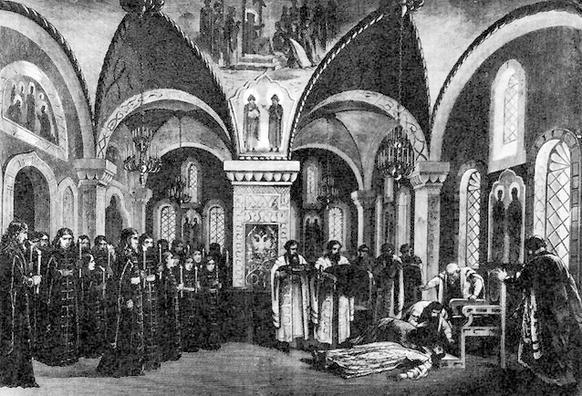
As we read and write, we might recall that this date– National Opera Day— is the anniversary of the premiere in 1874 of Modest Mussorgsky‘s (and here) Boris Godunov at the Mavrinsky Theater in St. Petersburg. (Some sources give the date as January 27 of that year.) Mussorgsky’s only completed opera, it is considered his masterpiece.
Mussorgsky composed the work, based on Pushkin‘s 1825 play Boris Godunov (and here), between 1868 and 1873. By the 1980s In the 1980s, Boris Godunov had moved closer to the status of a repertory piece than any other Russian opera, even Tchaikovsky‘s Eugene Onegin, and is the most recorded Russian opera.
The death of Boris in the
Faceted Palace, from the premiere production (
source)
#BorisGodunov #classicalMusic #culture #FolkMusic #history #jazz #MatthewAucoin #ModestMussorgsky #music #musicalLiteracy #musicology #Mussorgsky #NationalOperaDay #opera #popMusic #Pushkin #rock Kathy Bryson
 Nikolas Kozloff
 MediaFaro News Digest
 R. Magnusholm Author 🇺🇦 🇮🇱
 Awe & Wonder & Dream media
 Italian News by RSS
 (Roughly) Daily
 SebasFC