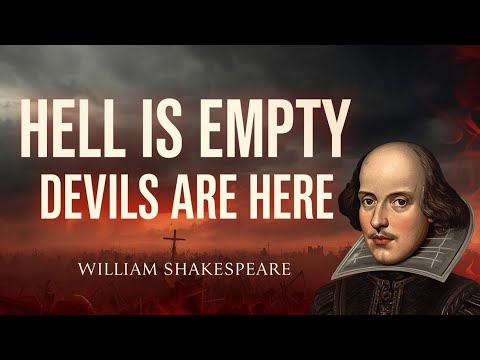
#Oberturas y #Prólogos: El arte de comenzar 📚🎵 https://letrasprestadas-clubpickwick.blogspot.com/2025/04/oberturas-y-prologos-el-arte-de-comenzar.html Te propongo unas reflexiones y ejemplos sobre los prólogos de libros y las oberturas de óperas. Nos acompañan #Borges, #Monteverdi, #Shakespeare, #Mozart, #Wagner, #JavierEscudero
Can't wait to read this 🤓😎. I shall start immediately.
#dudeism #lebowski #shakespeare

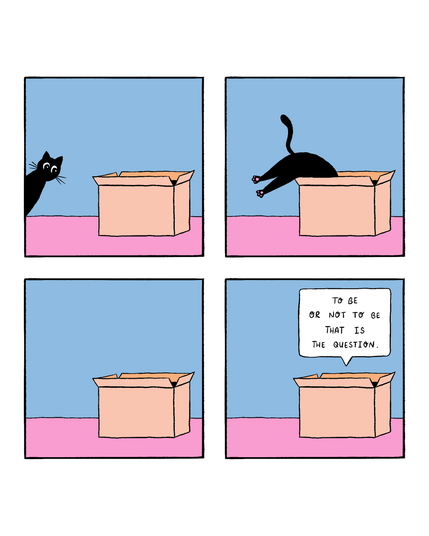
AI Interpreter Over-Learns Shakespeare, Actor Certified as King

A 'hello' to the PM sparked a royal succession crisis.

#AltAndPaperEN #AI #Shakespeare #royalty #ShortComic

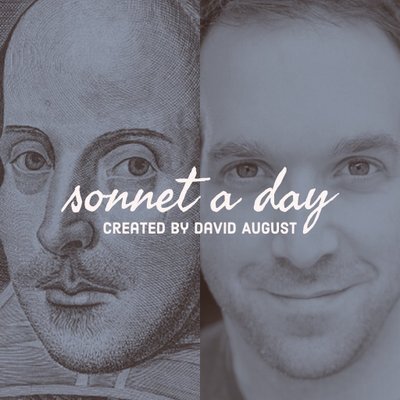
Sonnet 043 - XLIII
When most I wink, then do mine eyes best see,
For all the day they view things unrespected;
But when I sleep, in dreams they look on thee,
And darkly bright, are bright in dark directed.
Then thou, whose shadow shadows doth make bright,
How would thy shadow's form form happy show
To the clear day with thy much clearer light,
When to unseeing eyes thy shade shines so!
How would, I say, mine eyes be blessed made
By looking on thee in the living day,
When in dead night thy fair imperfect shade
Through heavy sleep on sightless eyes doth stay!
All days are nights to see till I see thee,
And nights bright days when dreams do show thee me.

bot by @davidaugust

#sonnet #poem #Shakespeare

The Adaptable Educator’s Book Review – Henry VI, Part 3 by Shakespeare

William Shakespeare’s Henry VI, Part 3 is one of the bleakest and most relentless of his early histories, a play in which political legitimacy collapses into brute force and the very idea of kingship becomes inseparable from violence. If Part 1and Part 2 trace the weakening of English rule, Part 3 stages the full catastrophe: civil war is no longer a threat hovering at the margins of power, but the atmosphere itself. The result is a work that feels less like a pageant of dynastic succession than a study in the moral corrosion of ambition.

What gives the play its force is Shakespeare’s refusal to romanticize any side. Henry VI himself remains devout, passive, and tragically unsuited to the world he inhabits. His desire for peace is sincere, but in the context of the play it becomes almost a liability. When he laments, “O, tigers’ hearts wrapp’d in a woman’s hide!” he gives us not only a memorable insult but also a glimpse into the play’s emotional register: rage is everywhere, and tenderness is rare enough to sound miraculous. Henry’s weakness is not just personal; Shakespeare makes it emblematic of a political order in which rightful authority cannot survive without force.

Yet the play is not merely about a weak king. It is about the monstrous energy unleashed when power is pursued without moral restraint. The figure of Richard, Duke of Gloucester—later Richard III—emerges here as one of Shakespeare’s most chilling creations. He is brilliant, articulate, and openly contemptuous of ordinary human feeling. His famous declaration, “I can smile, and murder whiles I smile,” captures the play’s central terror: evil is most dangerous when it is theatrical, witty, and self-aware. Richard is not a hidden villain but a man who turns performance itself into a weapon. Shakespeare seems fascinated by the way language can disguise appetite, and Richard’s speeches are among the play’s clearest evidence of that fascination.

The play’s treatment of revenge is equally severe. Margaret, often one of Shakespeare’s most formidable women, becomes the embodiment of political grief turned incandescent. She is no longer merely a queen or a widow; she is vengeance personified. Her cry over her son’s death—“O Ned, sweet Ned! speak to thy mother, boy!”—is among the play’s most devastating moments because it punctures the public violence with intimate, unbearable sorrow. Shakespeare uses Margaret to show how civil war devours the private life of families. Bloodshed is not abstract here; it enters the nursery, the household, the body.

Indeed, Henry VI, Part 3 is full of scenes that force the audience to confront the bodily cost of power. The play is obsessed with severed heads, bleeding wounds, and mutilated kinship. The famous scene in which York is mocked with a paper crown after his capture is cruel in a specifically theatrical way: power is reduced to costume, then destroyed in front of us. Shakespeare understands that political legitimacy is partly symbolic, and so he repeatedly stages the humiliation of symbols. Crowns, titles, vows, and bloodlines all prove fragile in a world where victory belongs to the most ruthless.

Still, the play is not without moral complexity. One of its most striking features is the way it makes us feel the tragedy of enemies. Warwick, Edward, Clarence, and Richard are not simply villains; they are also embodiments of a system that rewards betrayal. Shakespeare shows how quickly allies become rivals and how unstable loyalty becomes when it is founded on power rather than principle. The death of the Duke of York, the shifting allegiance of Warwick, and the final collapse of the Lancastrian cause all suggest that the real antagonist is not any one person, but the logic of civil conflict itself.

Stylistically, the play can feel uneven, even sprawling, but that unevenness serves its subject. The rapid reversals, sudden deaths, and emotional extremes create a world in which no stability is possible. Shakespeare’s language alternates between rhetorical grandeur and brutal simplicity, mirroring a nation that cannot decide whether it is still governed by ideals or already ruled by appetite. This tension is precisely what makes the play so powerful. It is not polished in the way the later histories are, but its roughness carries its own authority.

As a literary work, Henry VI, Part 3 is less interested in heroic triumph than in the anatomy of collapse. It shows that when sovereignty is severed from justice, politics becomes an engine of annihilation. And yet Shakespeare does not leave us in mere despair. By making us witness the ruin so closely, he asks us to see what history too often hides: that dynastic struggle is always paid for in human flesh. The play’s greatness lies in that unsparing vision. It is a drama of crowns, but also of corpses; of speeches, but also of silenced bodies; of rule, but above all of ruin.

#BookReviews #classics #LiteraryCriticism #Plays #poetry #Shakespeare #Theatre

I was clearing junk from my bedroom table (I do not have a nightstand, I have a 6-foot Lifetime table) and found a paperback copy of A Midsummer Night's Dream.

I assume it was already there because I want to read it, and just got lost in the mess, but now it's back on my book pile. I assume it would only take a few hours to read, being that it's a play and all.

(I'm clearing space for a new wooden case for #miniatures.)

#Shakespeare #AMidsummerNightsDream #book #play #SpringCleaning

What #JamesShapiro’s look at one year in #Shakespeare’s life has to do with your life. And your work. We review #TheYearofLear: http://the-agency-review.com/year-of-lear #advertising #writing

The English department was "told they could no longer teach texts written by gay authors."

"We have even been told to censor novels with gay characters."

For Texas, it's goodbye Shakespeare & some half of the history of literature.

https://www.npr.org/2026/04/08/nx-s1-5561690/public-university-professors-in-texas-say-a-new-law-restricts-their-academic-freedom

#Teaching #Reading #Censorship #Education #Shakespeare #Texas

What #JamesShapiro’s look at one year in #Shakespeare’s life has to do with your life. And your work. We review #TheYearofLear: http://the-agency-review.com/year-of-lear #advertising #writing
#NowWatching "Rosaline" (2022) on Prime Video Get it amzn.to/4mn6FmD Directed by Karen Maine Starring Kaitlyn Dever, Kyle Allen, Sean Teale A comedic retelling of Shakespeare's "Romeo and Juliet," told from the point of view of Romeo's jilted ex, Rosaline #comedy #parody #satire #Shakespeare