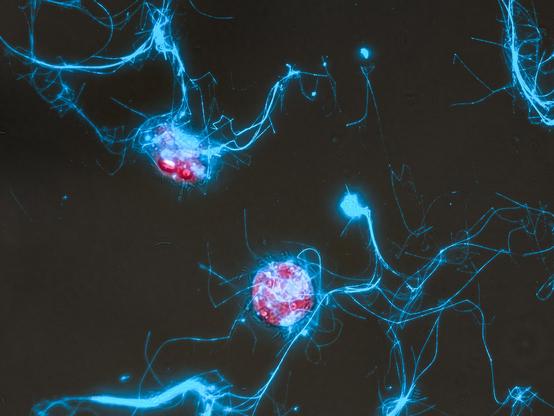
.. We discuss our interpretation: that we may be seeing (unexpected) regions of high-MW HA that play a role in HA recognition and binding by HA-interacting proteins. At the same time, these (#NMR) methods should be important tools for studying the molecular and atomic features of the wide variety of #hyaluronicacid #polysaccharide based #biomaterials and hydrogels that are in use in the pharmaceutical industry and #biomedicalengineering.
Anyway, check out the paper: https://doi.org/10.1021/acsami.4c08428

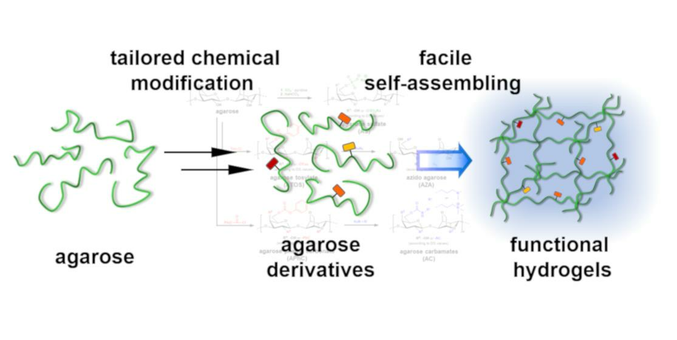
I am excited to share our newest publication on #agarose. First authored by my colleague at @unijena, I am happy to have contributed to this work: we present novel functional agarose gels unsing "advanced #polysaccharide #chemistry" and their characterization.

https://doi.org/10.3390/polysaccharides5030014

#biopolymer #biomaterials #mdpi #polysaccharides

Functional Agarose Hydrogels Obtained by Employing Homogeneous Synthesis Strategies

The goal of this study was to explore a route for introducing functionalities into agarose-based hydrogels to tune the physical, chemical, and biological properties. Several agarose derivatives were prepared by homogeneous synthesis, including anionic agarose sulfates (ASs), reactive azido agaroses (AZAs), and cationic agarose carbamates (ACs), as well as agarose tosylates (ATOSs) and agarose phenyl carbonates (APhCs). The products were characterized in terms of their molecular structure and solubility behavior. The results suggest that the native gel-forming ability of agarose is retained if the introduced functionalities are hydrophilic, and the overall degree of substitution is low (DS < 0.5). Thus, functional hydrogels from several agarose derivatives could be obtained. The mechanical stability of the functional hydrogels was decreased compared to native agarose gels but was still in a range that enables safe handling. An increase in mechanical strength could be achieved by blending functional agarose derivatives and agarose into composite hydrogels. Finally, it was demonstrated that the novel functional agarose hydrogels are biocompatible and can potentially stimulate interactions with cells and tissue.

MDPI

Hi everyone! 👋 #introduction

I'm Markus, currently a postdoc lecturer 👨‍🏫 at Bonn-Rhein-Sieg University, Germany!

My field is #AnalyticalChemistry 🔬and #QualityAssurance, although I did my PhD on #polysaccharide chemistry ⚗️, #DrugRelease 🧪 and #biomaterials for bone tissue engineering.

I am interested in #scicomm, #chemistry, #climateresearch, #space, and current #science topics!

I'm here to find nice people and connect!

Currently reviewing some #biochemistry as a part of a course I’m taking. They seem to be able to form pretty wonky structures etc. Are #polysaccharide #catalysts a thing at all?
A new preprint from the lab (together with Marthe Walvoort's group) is now on #bioRxiv : https://www.biorxiv.org/content/10.1101/2023.03.16.532902v1 This manuscript presents nice work by Pushpa Rampratap, who did a great job figuring out how to make 13C-enriched hyaluronic acid #polysaccharide for use in #ssNMR . More forthcoming on the applications, but this paper introduces the protocols for producing the high-molecular weight HA. Enjoy! #glycotime #nmrchat #TeamMassSpec (Feedback welcome!)
Kohlenhydratsynthese: Lange Zuckerschlangen aus dem Automat

Neuer Syntheseautomat für die speziellen Zuckerpolymere

Exploring the polysaccharide composition of plant cell walls in succulent aloes

Aloe vera is a well-known plant species from the genus Aloe used throughout the globe in wide range of products from creams and soaps to drinks and over-the-counter products. The genus Aloe has been used in traditional medicine for centuries, and approximately 20% of the species are used locally in the regions they grow.

Phys.org

Cell aggregation is associated with enzyme secretion strategies in marine #polysaccharide-degrading bacteria

https://www.nature.com/articles/s41396-023-01385-1

Cell aggregation is associated with enzyme secretion strategies in marine polysaccharide-degrading bacteria - The ISME Journal

Polysaccharide breakdown by bacteria requires the activity of enzymes that degrade polymers either intra- or extra-cellularly. The latter mechanism generates a localized pool of breakdown products that are accessible to the enzyme producers themselves as well as to other organisms. Marine bacterial taxa often show marked differences in the production and secretion of degradative enzymes that break down polysaccharides. These differences can have profound effects on the pool of diffusible breakdown products and hence on the ecological dynamics. However, the consequences of differences in enzymatic secretions on cellular growth dynamics and interactions are unclear. Here we study growth dynamics of single cells within populations of marine Vibrionaceae strains that grow on the abundant marine polymer alginate, using microfluidics coupled to quantitative single-cell analysis and mathematical modelling. We find that strains that have low extracellular secretions of alginate lyases aggregate more strongly than strains that secrete high levels of enzymes. One plausible reason for this observation is that low secretors require a higher cellular density to achieve maximal growth rates in comparison with high secretors. Our findings indicate that increased aggregation increases intercellular synergy amongst cells of low-secreting strains. By mathematically modelling the impact of the level of degradative enzyme secretion on the rate of diffusive oligomer loss, we find that enzymatic secretion capability modulates the propensity of cells within clonal populations to cooperate or compete with each other. Our experiments and models demonstrate that enzymatic secretion capabilities can be linked with the propensity of cell aggregation in marine bacteria that extracellularly catabolize polysaccharides.

Nature
Knapp sieben Jahre hat es gedauert, aber nun habe ich ich meine Doktorarbeit an der @unijena erfolgreich verteidigt. 🎓🎓😄 #polysaccharide #chemie
Long, dense spikes on red algae-derived metal-polysaccharide show promise for anti-microbial applications

Antibiotic resistant bacteria are becoming more and more of a concern as traditional sources of anti-microbial treatments become less effective. Therefore, researchers at Ben-Gurion University of the Negev are looking farther afield for promising compounds to treat wounds and infections.

Phys.org