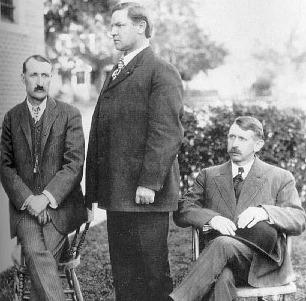
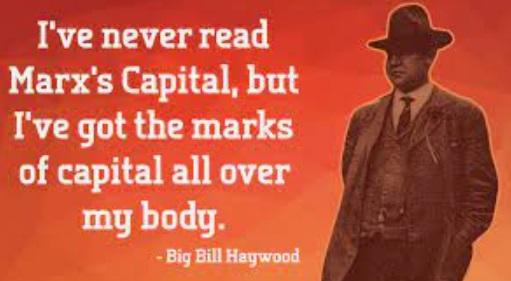
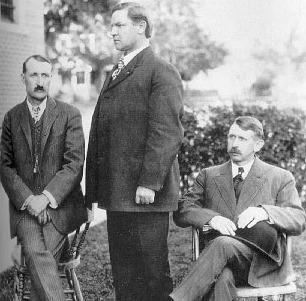
Today in Labor History February 17, 1906: The authorities arrested "Big Bill" Haywood and two others on trumped up charges for the murder of former Idaho Governor Frank Stuenenberg. Clarence Darrow successfully defended them, telling jurors, "If at the behest of this mob you should kill Bill Haywood, he is mortal, he will die, but I want to say that a million men will grab up the banner of labor where at the open grave Haywood lays it down . . ." The actual perpetrator was a one-time WFM union member named Harry Orchard, who was also a paid informant for the Cripple Creek Mine Owners' Association.

Haywood and his WFM comrades had been framed by James McParland, an agent for the Pinkertons Detective Agency. This was the same James McParland who framed dozens of Irish coal miners in Pennsylvania in the 1870s, whom he, and the media, had falsely branded as terrorists (Molly Maguires). Ten of them were executed in one day—the 2nd largest mass execution in U.S. history after the 1862 mass execution of 38 Dakota warriors. My novel, Anywhere But Schuylkill, is about one of these Irish miners, a teenager named Mike Doyle.

Read more on the Pinkertons here: https://michaeldunnauthor.com/2024/04/04/union-busting-by-the-pinkertons/

Read more on the Molly Maguires here: https://michaeldunnauthor.com/2024/04/13/the-myth-of-the-molly-maguires/

You can get a copy of Anywhere But Schuylkill here:
keplers.com/
https://www.greenapplebooks.com/
https://boundtogether.org//
https://www.historiumpress.com/michael-dunn

Or send me $27 via Venmo (@Michael-Dunn-565) and your mailing address, I will send you a signed copy! (Shipping included)

#workingclass #LaborHistory #BigBillHaywood #IWW #WFM #union #strike #mining #socialism #clarencedarrow #pinkertons #mollymaguires #terrorism #racism #irish #books #novel #historicalfiction #writer #author @bookstadon

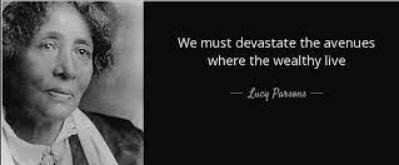
“What I want is for every dirty, lousy tramp to arm himself with a revolver or knife on the steps of the palaces of the rich and stab or shoot their owners as they come out.”
-Lucy Parsons

This was what Lucy Parsons, then in her 80’s, told a crowd at a May Day rally in Chicago, at the height of the Great Depression. The way folk singer Utah Phillips tells the story, she was the image of everybody’s grandmother, prim and proper, face creased with age, tiny voice, hair tied back in a bun.

Little is known about Lucy Parson’s early life, but various records indicate that she was born to an enslaved African American woman, in Virginia, sometime around 1848-1851. She may also have had indigenous and Mexican ancestry. Some documents record her name as Lucia Gonzalez. In 1863, her family moved to Waco, Texas. There, as a teenager, she married a freedman named Oliver Benton. But she later married Albert Parsons, a former Confederate officer from Waco, who had become a radical Republican after the war. He worked for the Waco Spectator, which criticized the Klan and demanded sociopolitical equality for African Americans. Vigilantes shot Albert in the leg and threatened to lynch him for helping African Americans register to vote. It is unclear whether her initial marriage was ever dissolved, and likely that her second marriage was more of a common-law arrangement, considering the anti-miscegenation laws that existed then.

In 1873, Lucy and Albert moved to Chicago to get away from the racist violence and threats of the KKK. There, they joined the socialist International Workingmen’s Association, and the Knights of Labor, a radical labor union that organized all workers, regardless of race or gender. They had two children in the 1870s, one of whom died from illness at the age of eight. Lucy worked as a seamstress. Albert worked as a printer for the Chicago Times. These were incredibly difficult times for workers. The Long Depression had just begun, one of the worst, and longest, depressions in U.S. history. Jobs were scarce and wages were low. Additionally, bosses were exploiting the Contract Labor Law of 1864 to bring in immigrant workers who they could pay even less than native-born workers.

Lucy and Albert Parsons helped organize protests and strikes in Chicago during the Great Upheaval. The police violence against the workers there was intense. One journalist wrote, “The sound of clubs falling on skulls was sickening for the first minute, until one grew accustomed to it. A rioter dropped at every whack, it seemed, for the ground was covered with them.” During the Battle of the Viaduct (July 25, 1877), the police slaughtered thirty workers and injured over one hundred. Albert was fired from his job and blacklisted, because of his revolutionary street corner speeches.

After the Great Upheaval, they both moved away from electoral politics and began to support more radical anarchist activism. Lucy condoned political violence, self-defense against racial violence, and class struggle against religion. Along with Lizzie Swank, and others, she helped found the Chicago Working Women’s Union (WWU), which encouraged women workers to unionize and promoted the eight-hour workday.

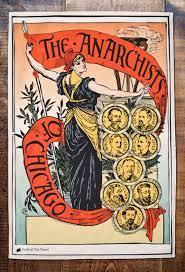
On May 1, 1886, 350,000 workers went on strike across the U.S. to demand the eight-hour workday. In Chicago, Albert and Lucy led a peaceful demonstration of 80,000 people down Michigan Avenue. It was the world’s first May Day/International Workers’ Day demonstration—an event that has been celebrated ever since, by nearly every country in the world, except for the U.S. Two days later, another anarchist, August Spies, addressed striking workers at the McCormick Reaper factory. Chicago Police and Pinkertons attacked the crowd, killing at least one person. On May 4, anarchists organized a demonstration at Haymarket Square to protest that police violence. The police ordered the protesters to disperse. Somebody threw a bomb, which killed at least one cop. The police opened fire, killing another seven workers. Six police also died, likely from “friendly fire” by other cops.

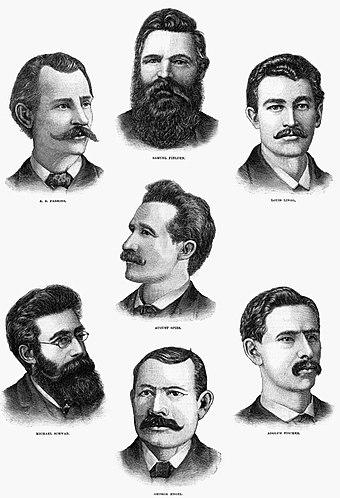
The authorities, in their outrage, went on a witch hunt, rounding up most of the city’s leading anarchists and radical labor leaders, including Albert Parsons and August Spies. Despite her efforts, and those of other activists fighting to free the Haymarket anarchists, the courts ultimately convicted the seven men of killing the cops, even though none of them were present at Haymarket Square when the bomb was thrown. They executed four of them in 1887, including Albert Parsons. On the morning of his execution, Lucy brought their children to see him for the last time. But the police arrested her and strip-searched her for explosives. Albert’s casket was later brought to Lucy’s sewing shop, where over 10,000 people came to pay their respects. 15,000 people attended his funeral. Several years later, the governor of Illinois pardoned all seven men, determining that neither the police, nor the Pinkertons, who testified against them, were reliable witnesses.

You can read my complete biography of Lucy here: https://michaeldunnauthor.com/2024/03/24/lucy-parsons/

#workingclass #LaborHistory #anarchism #lucyparsons #IWW #KnightsOfLabor #union #strike #racism #civilwar #generalstrike #sabotage #texas #chicago #haymarket #police #policebrutality #pinkertons #prison #blackhistorymonth #BlackMastodon
Today in Labor History December 30, 1905: Governor Frank Steunenberg of Idaho was assassinated by a bomb. Steunenberg had been elected on a Populist Party "defend the working man" ticket. But then he called on federal troops to crush the 1899 miners’ strike. Authorities promptly blamed members of the radical WFM, including Big Bill Haywood, who would later go on to cofound the IWW. The actual assassin was Harry Orchard, a WFM union member who was also a paid informant and agent provocateur for the Cripple Creek Mine Owners’ Association. The investigation was conducted by Pinkerton agent James McParland, the same man who infiltrated the Ancient Order of Hibernians in eastern Pennsylvania and acted as an agent provocateur, leading to the wrongful executions of 20 Irish miners. After interrogation by McParland, Orchard signed a 64-page typed confession claiming that he had been hired to kill Steunenberg by the WFM leadership ("Big Bill" Haywood; General Secretary, Charles Moyer; and President George Pettibone). Superstar labor lawyer Clarence Darrow got all three WFM defendants acquitted. Orchard pled guilty and received a death sentence in a separate trial, but the sentence was commuted to life in prison. McParland also plays prominently in my novel, “Anywhere But Schuylkill,” about the period leading up to the wrongful executions of the Irish miners.

Read more about the Western Federation of Miners here: https://michaeldunnauthor.com/2021/05/13/the-western-federation-of-miners/

Read more about the Pinkertons here: https://michaeldunnauthor.com/2024/04/04/union-busting-by-the-pinkertons/

Read more about the wrongfully convicted Irish miners here: https://michaeldunnauthor.com/2024/04/13/the-myth-of-the-molly-maguires/

Pick up a copy of my novel, Anywhere But Schuylkill, here:
https://www.keplers.com/
https://www.greenapplebooks.com/

Or send me $25 via Venmo (@Michael-Dunn-565) and your mailing address, and I will send you a signed copy!

#workingclass #LaborHistory #union #strike #wfm #westernfederationofminers #bigbillhaywood #pinkertons #police #prison #books #novel #historicalfiction #writer #author @bookstadon

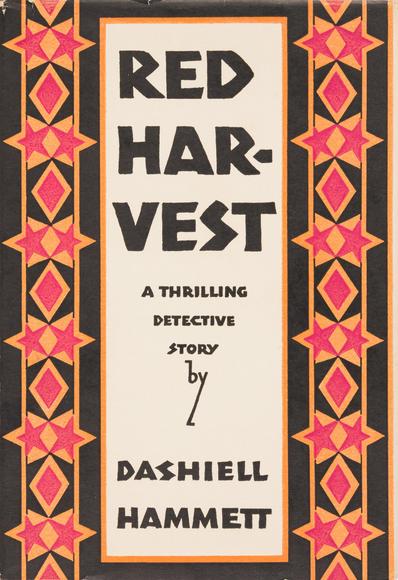
Today in Labor History December 1, 1912: The rustling card system was put into place by the Anaconda Mining and Smelter Company. Rustling cards verified employees’ identities and employment status. The company used spies to identify union agitators and refused them rustling cards and jobs. In 1917, the IWW called a strike at the Anaconda mines around Butte, Montana. They demanded the end of the rustling cards system, and the implementation of the 8-hour day and higher wages. Author Dashiell Hammett served as a Pinkerton strikebreaker in the Anaconda miners’ strike. However, when the Pinkertons enlisted him to assassinate Native American IWW organizer Frank Little, he refused, and quit the agency. On 4/21/1917, guards opened fire on unarmed picketers, killing one and injuring sixteen, while vigilantes lynched Frank Little. Dashiell Hammett depicted the strike in his first novel, “Red Harvest.” André Gide called Red Harvest “the last word in atrocity, cynicism, and horror.”

You can read my biography of Frank Little here: https://michaeldunnauthor.com/2024/04/05/frank-little/

You can read my essay on the Pinkertons here: https://michaeldunnauthor.com/2024/04/04/union-busting-by-the-pinkertons/

You can read my biography of Hammett here: https://michaeldunnauthor.com/2024/04/05/dashiell-hammett/

#workingclass #LaborHistory #IWW #union #strike #mining #wages #unionbusting #books #fiction #franklittle #assassination #indigenous #nativeamerican #author #writer #dashiellhammett #pinkertons @bookstadon

Today in Labor History October 14, 1883: The two-day founding congress of the International Working People's Association (IWPA) occurred in Pittsburgh, Pennsylvania, at the Allegheny Turner Hall, marking the beginning of the anarchist-trade union movement in the US. Participants wore red badges and carried red flags. The congress endorsed militant labor organizing, overthrowing the state, and "propaganda by the deed," which included assassinations. Parsons, Spies, Johann Most, and others drafted the Pittsburgh Manifesto at this event. The manifesto called for the overthrow of the ruling class and replacing it with free cooperatives. The manifesto ends with the following line: “Tremble, oppressors of the world! Not far beyond your purblind sight there dawns the scarlet and sable lights of the JUDGEMENT DAY!”

Here are the basic principles called for in the manifesto:
1. Destruction of the existing class rule, by all means, i.e., by energetic, relentless, revolutionary, and international action.
2. Establishment of a free society based upon co-operative organization of production.
3. Free exchange of equivalent products by and between the productive organizations without commerce and profit-mongering.
4. Organization of education on a secular, scientific, and equal basis for both sexes.
5. Equal rights for all without distinction to sex or race.
6. Regulation of all public affairs by free contracts between the autonomous (independent) communes and associations, resting on a federalistic basis.

Preceding the IWPA was the Workingmen’s Party (WPUS), formed in Philadelphia in 1876, which played a major role in the Great Upheaval of 1877, particularly in St. Louis and Chicago. During that strike wave, over 100 workers were slaughtered by cops, Pinkertons and federal troops. Albert and Lucy Parsons were important organizers during that strike. However, the WPUS became dominated by Lasallian socialists, who opposed strikes and direct action, and believed they could vote capitalism away. The Parsons, and many others, were radicalized by the brutality against the Great Upheaval strikers, and subsequently became anarchists. The WPUS ultimately split as a result of the conflict between the anarchists, Marxists, and Lasallians, later becoming the Socialist Labor Party. And the anarchists left to form the IWPA, which helped unite Albert Parsons and August Spies and other anarchists who were later wrongly implicated in the 1886 Haymarket bombing. The subsequent witch hunt for anarchists, and the convictions and executions that followed the Haymarket bombing, effectively destroyed the IWPA.

Read my article on Lucy Parsons and the Haymarket Affair here: https://michaeldunnauthor.com/2024/03/24/lucy-parsons/

Read my article “The Wide Awakes and the Antebellum Roots of Wokeness” to learn more about the Turner Society and the radical German immigrant abolitionists in the mid- to late 1800s: https://michaeldunnauthor.com/2024/04/27/the-wide-awakes-and-the-antebellum-roots-of-wokeness/

#workingclass #LaborHistory #anarchism #lucyparsons #AlbertParsons #pittsburgh #Pinkertons #strike #union #syndicalism #marxism #socialism #directaction #abolition #haymarket #prison

Today in Labor History October 13, 1902: Teddy Roosevelt threatened to send in federal troops as strikebreakers to crush a coal strike. The strike by anthracite coal miners in eastern Pennsylvania was led by the United Mineworkers of America (UMWA). The region had had dozens of previous strikes led by earlier and now defunct unions like the WBA. The UMWA was created 12 years prior, when the Knights of Labor Assembly #35 merged with the National Progressive Miners Union. Over 100,000 miners participated in the strike, threatening to cut off heating fuel for most of the country. It was also the first strike settled by federal arbitration. The miners won a 9-hour work day (down from 10) and a 10% wage increase.

This was the same region where, in 1877, 20 Irish union activists were hanged on false charges of Molly Maguire terrorism to crush the WBA, brought on by the shenanigans of agent provocateur James McParland, working for the Pinkertons. That struggle is depicted in my novel, Anywhere But Schuylkill.

Read my article on the Molly Maguires here: https://michaeldunnauthor.com/2024/04/13/the-myth-of-the-molly-maguires/

Read my article on the Pinkertons here: https://michaeldunnauthor.com/2024/04/04/union-busting-by-the-pinkertons/’

Purchase my novel:
https://www.keplers.com/
https://www.greenapplebooks.com/
https://www.historiumpress.com/michael-dunn
Or send me $25 via Venmo (@Michael-Dunn-565) and your mailing address, and I will send you a signed copy!

#workingclass #LaborHistory #coal #mining #union #strike #pennsylvania #Pinkertons #MollyMaguires #AnywhereButSchuylkill #fiction #historicalfiction #books #novel #writer #author @bookstadon

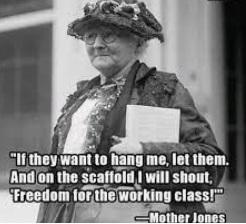
Today in Labor History September 23, 1913: The United Mine Workers of America began the first of a series of strikes which would escalate into the Colorado Coalfield War. Miners were fighting the Rockefeller-owned Colorado Fuel and Iron (CF&I) for safer working conditions and better pay. From 1884 and 1912, Colorado miners averaged 6.81 deaths per every 1,000 miners, a fatality rate over double the national average of 3.12. However, two mine explosions in 1910 brought the state mining mortality rate to above 10, triple the national average. Due to jury tampering by the company, Rockefeller was never held accountable and never had to pay out any settlements. CF&I virtually owned the political apparatus of Colorado. The company registered every one of its employees to vote, even non-citizen immigrants and company mules, in a tactic that would make today’s Republicans blush. The Colorado Coalfied War lasted over the next two years and resulted in up to 200 deaths, including over 37 soldiers and private cops working for Rockefeller. The war included the Ludlow Massacre, when National Guards massacred at least 19 people living in a tent colony, including 12 children and three women. In retaliation for this unprovoked massacre, armed miners attacked mines, killing scabs, destroying property, and fighting National Guard troops. It was possibly the bloodiest labor dispute in U.S. history. Rockefeller used both Pinkertons and Baldwin-Felts private detectives to protect scabs and intimidate striking miners. They would attack mining camps with machine guns mounted on a car dubbed the “Death Special.” The authorities repeatedly jailed Mother Jones, who had come to support the strike. During one arrest, miners tried to free her but were repelled by National Guards. On the first day of the strike, she said during a speech: "Rise up and strike! If you are too cowardly, there are enough women in this country to come in here and beat the hell out of you."

Read my article on the Ludlow massacre here: https://michaeldunnauthor.com/2024/04/20/the-ludlow-massacre/

Read my article on the Pinkertons here: https://michaeldunnauthor.com/2024/04/04/union-busting-by-the-pinkertons/

#workingclass #LaborHistory #strike #union #miners #coal #massacre #police #policebrutality #pinkertons #immigrants #colorado #ludlow #rockefeller #nationalguards #motherjones

Today in Labor History August 25, 1819: Allan Pinkerton was born. He founded the Pinkerton private police force, whose strike breaking detectives (Pinkertons, or 'Pinks') slaughtered dozens of workers in various labor struggles and scores more imprisoned. Ironically, Pinkerton, himself, was a violent, radical leftist as a youth. He fought cops in the streets as a member of the Chartist Movement. He had to flee the UK in order to not be imprisoned. Yet in America, he became the nation’s first super cop. He created the secret service. He foiled an assassination attempt against Lincoln. He fine-tuned the art of spying on activists and planting agents provocateur in their ranks. His agents played a major role in destroying the miners’ union in the 1870s, as portrayed in my novel, “Anywhere But Schuylkill.” Later, the Pinkertons assassinated numerous organizers with the IWW and came within inches of successfully getting Big Bill Hayward convicted on trumped up murder charges. They tried to hire author Dashiell Hammett to murder Native American IWW organizer Frank Little. He declined, but wrote about his experience as a Pinkerton agent in his first novel, Red Harvest.

You can get Anywhere But Schuylkill from any of these indie bookstores:
https://www.keplers.com/
https://www.greenapplebooks.com/

Or send me $25 via Venmo (@Michael-Dunn-565) and your mailing address, and I will send you a signed copy!

You can read my biography of Pinkerton here: https://michaeldunnauthor.com/2024/04/04/union-busting-by-the-pinkertons/

My biography of Frank Little here: https://michaeldunnauthor.com/2024/04/05/frank-little/

#workingclass #LaborHistory #pinkertons #IWW #union #police #books #fiction #historicalfiction #AnywhereButSchuylkill #mining #coal #writer #author #FrankLittle #indigenous #novel @bookstadon

Today in Labor History July 26, 1894: President Grover Cleveland created a Strike Committee to investigate the causes of the Pullman strike and the subsequent walkout by the American Railway Union, led by Eugene Debs. After four months, the commission absolved the strikers and placed the blame entirely on Pullman and the railroads for the conflict. Roughly 250,000 workers participated in the strike. And an estimated 70 workers died, mostly at the hands of cops and soldiers. To appease workers, the government came up with a new holiday, Labor Day, to commemorate the end of the Pullman Strike. However, President Cleveland had other interests in creating the new holiday. Rather than rewarding workers, his goal was to bury the history of the Haymarket Affair and the radical anarchist and socialist history of the labor movement by choosing any day other than May 1 as the new national labor holiday.

On May 1, 1886, 350,000 workers went on strike across the U.S. to demand the eight-hour workday. It was the world’s first May Day/International Workers’ Day demonstration—an event that has been celebrated ever since, by nearly every country in the world, except for the U.S. Two days later, Chicago Police and Pinkertons attacked protesters, killing at least one person. On May 4, anarchists organized a demonstration at Haymarket Square to protest that police violence. Somebody threw a bomb, which killed at least one cop. The police opened fire, killing another seven workers. Six police also died, likely from “friendly fire” by other cops.

The authorities went on a witch hunt, rounding up most of the city’s leading anarchists and radical labor leaders. They ultimately convicted seven anarchists, even though none of them were present at Haymarket Square when the bomb was thrown, and executed four of them in 1887, including Albert Parsons. After her husband’s execution, Lucy Parsons continued her radical organizing, writing, and speeches. In 1905, Lucy cofounded the Industrial Workers of the World (IWW), along with Mother Jones, Big Bill Haywood, Eugene Debs, James Connolly, and others.

You can read my complete article about the Great Upheaval here: https://michaeldunnauthor.com/2024/03/31/the-great-upheaval/

You can read my biography of Lucy Parsons here: https://michaeldunnauthor.com/2024/03/24/lucy-parsons/

#workingclass #LaborHistory #pullman #strike #railroad #eugenedebs #socialism #laborday #haymarket #anarchism #union #policebrutality #police #IWW #lucyparsons #pinkertons #mayday

Today in Labor History July 23, 1892: Anarchist Alexander Berkman tried to assassinate industrialist Henry Clay Frick in retaliation for the 9 miners killed by Pinkerton thugs on July 6, during the Homestead Steel Strike. Frick was the manager of Homestead Steel and had hired the Pinkertons to protect the factory and the scab workers he hired to replace those who were on strike. Berkman, and his lover, Emma Goldman, planned the assassination hoping it would arouse the working class to rise up and overthrow capitalism. Berkman failed in the assassination attempt and went to prison for 14 years. He wrote a book about his experience called, “Prison Memoirs of an Anarchist” (1912). He also wrote “The Bolshevik Myth” (1925) and “The ABC of Communist Anarchism” (1929).

You can read my complete article on the Pinkertons here: https://michaeldunnauthor.com/2024/04/04/union-busting-by-the-pinkertons/

#workingclass #LaborHistory #anarchism #communism #alexanderberkman #prison #assassination #strike #steel #carnegie #massacre #emmagoldman #pinkertons #books #writing #author @bookstadon