@b_age Nice photo. Now wondering which parasitoid wasp ventures into that brush of deadly spikes, for surely there is at least one that does. I further wonder whether there's a database of parasitoid wasps with their known hosts?
#entomology #parasitoids #wasps

On my way to AAB Advances in Integrated Pest and Pathogen Management meeting - looking forward to a couple of days hearing about what's happening in applied IPPM research. https://www.aab.org.uk/event/advances-in-integrated-pest-and-pathogen-management/

I'll be talking about aphids on soft fruit, and how to optimise different aspects of biocontrol to improve the approach overall.

#IPM #IntegratedPestManagement #Biocontrol #Parasitoids #Aphids #AppliedEntomology

#Mainers! Here's your chance to help fight #EmeraldAshBorer!

#MaineForestryService - Emerald Ash Borer (Agrilus planipennis) Update

September 22, 2025

"Since 2019, MFS has been releasing parasitoid wasps for the long-term management of emerald ash borer (#EAB) in the forests of Maine. These are tiny, non-stinging members of the order Hymenoptera, and they specialize in EAB. In most cases, they will not keep the mature trees already in the forest alive, but there is evidence from other states that have had EAB longer than we have that these #wasps provide protection to the seedlings and saplings as they grow. We are attempting to release them in as many areas with EAB as possible so that they can eventually spread throughout the state, allowing ash to remain in #Maine’s forests.

"As of 2025, we have released these #parasitoids in 20 sites throughout the range of EAB. Of the ten sites that are at the stage where we can start monitoring for their establishment, we have recovered one or both of Spathius or Tetrastichus at five of them: four in #YorkCounty and one in northern #Aroostook. We are still years away from actual control of EAB, but it is encouraging to start recovering parasitoids.

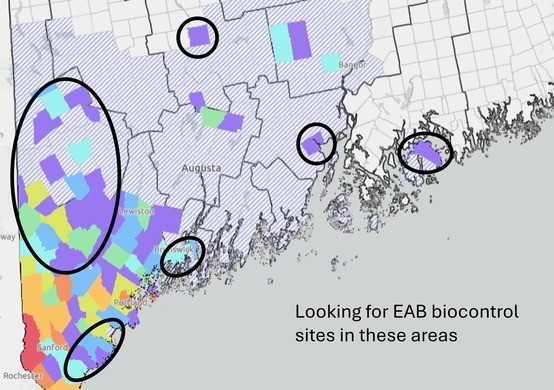
"With the many new detections of EAB in Maine in recent years, we would like to establish new biological control release sites. The ash-dominated forests that serve as release sites can be public or privately owned. Many of our cooperators are private woodlot owners. Ideally, we would like to ship biological control directly to a local landowner or manager and have them conduct releases after training by MFS. The releases take 5-15 minutes, 4-6 times a summer for two summers. We are looking for new release sites in areas where EAB has recently become established. Specifically, we would like to find sites in or near #BarHarborME, #SolonME, #BelfastME, the #BathME / #BrunswickME area, #CoastalMaine south of #PortlandME, and #WesternMaine west of #LewistonME. If you have forested land in one of these areas and are potentially interested in having it become a biological release site, please review the guidelines and information about EAB biocontrol available on-line, and email foresthealth @ maine . gov (no spaces) with the town in which your ash stand is, the approximate acreage of ash, and the coordinates (approximate is fine) of the stand. If it looks like your land would be suitable for a biological control site, we will reach out to you."

Source:
Emailed newsletter

Link to guidelines (PDF):
https://www.maine.gov/dacf/mfs/forest_health/invasive_threats/eab/documents/meeting-082020/Emerald%20Ash%20Borer%20Biocontrol%20Info%20For%20Potential%20Cooperators.pdf

#InvasiveSpecies #AshTrees #SaveTheForests #ProtectTheSacred #Wabanaki #Basketry #SolarPunkSunday #Biocontrol

💡 Did you know: Some wasps build mud nests with live prey paralyzed by a precise sting, then lay an egg beside it so the larva has fresh food when it hatches, while others deposit eggs in living hosts, allowing larvae to develop hidden within. Both are finely tuned adaptations of evolution.

📝 Read on: https://TPC8.short.gy/iYor9Y2v

🐝 Two strategies. One goal. Survival.

#Wildlife #Biodiversity #Nature #Entomology #InsectLifeCycle #InsectBehavior #Wasps #Larva #Insects #Parasitoids #Pollinators #TPC8

🐝 Two Wasp Approaches to Securing the Next Generation: Builders vs. Infiltrators in Nature

Comparison of two wasp strategies — mud‑nest builders and internal parasitoids — showing prey handling, larval feeding, pupation, and emergence.

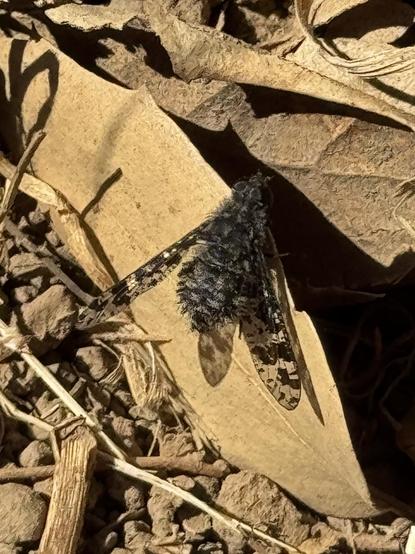
Spotted Bee Fly (Anthrax irroratus) larvae are parasitoids of solitary bees and wasps, living in close association with their hosts and ultimately causing the host’s death.

#parasitoids #beeflies #nature #wildlife #california

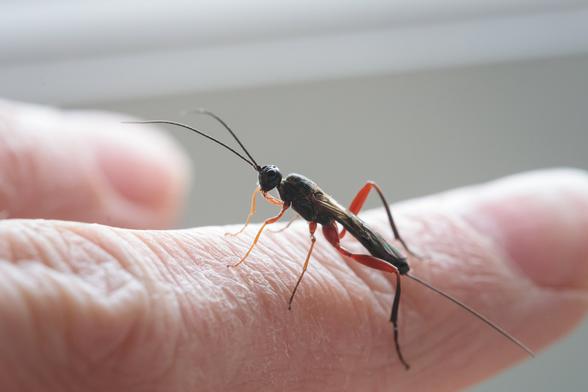
In further Wasp Friend news, I just rescued *another* ichneumon wasp from the window. (This one obligingly hopped directly on to my hand before flying out the newly opened section...)

#wasps #insects #parasitoids #macrophotography
Another wasp friend!

Found inside a window - and, during a drawn-out rescue attempt with a bit of paper, it finally hopped on to my finger and let me take some more photos, before flying out the now-open window...

(Possibly the same ichneumon species as the last one, only female this time judging by the long ovipostor...)

#wasps #insects #macrophotography #Derbyshire #parasitoids
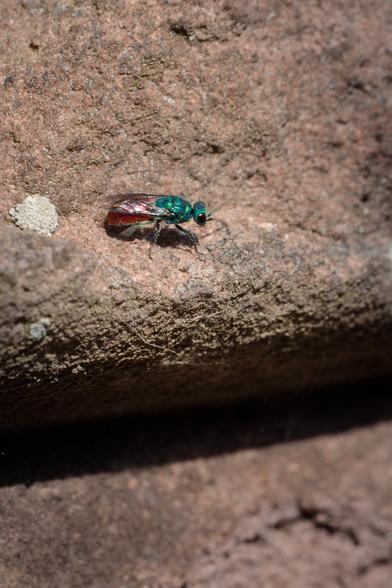
My recent spree of #macrophotography continues - and I appear to have become a friend of the #wasps. One morning - a small, slender, black and orange wasp (possibly an Ichneumon of some kind?) was sat in the window of the front door - after taking photos, I duly released it into the outdoors. And later that day - a tiny, glittering Cuckoo wasp purposefully scampering over old stonework!

#Derbyshire, May 2025.

#insects #macro #naturePhotography #parasitoids
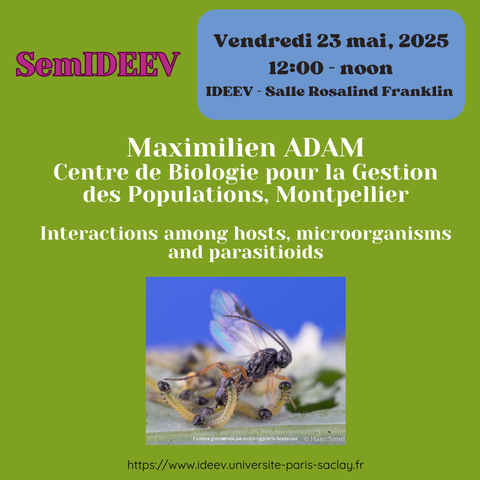
Interactions among hosts, microorganisms and parasitoids

Parasitoids rely on other insects for the development of their offspring. They oviposit in or on a host, which is progressively consumed during larval development. Both parasitoids and their hosts harbour diverse microbial symbionts that may influence the outcome of their interaction and contribute to the evolutionary arms race between them. Many parasitoids are associated with symbiotic viruses that are injected into the host during oviposition and suppress the host’s immune responses. In contrast, several herbivorous hosts carry bacterial symbionts that play various important functions, including resistance to parasitism. In this work, I aim to better understand how microorganisms influence and are influenced by host-parasitoid interactions.

IDEEV
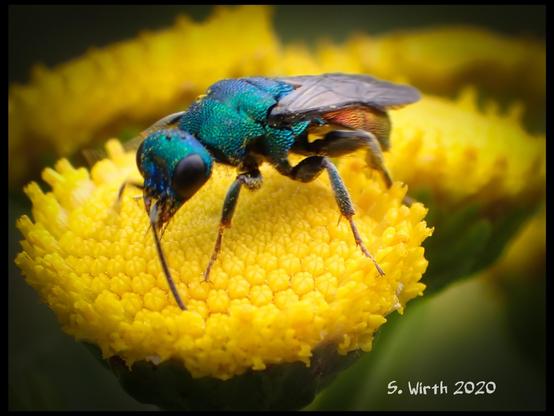
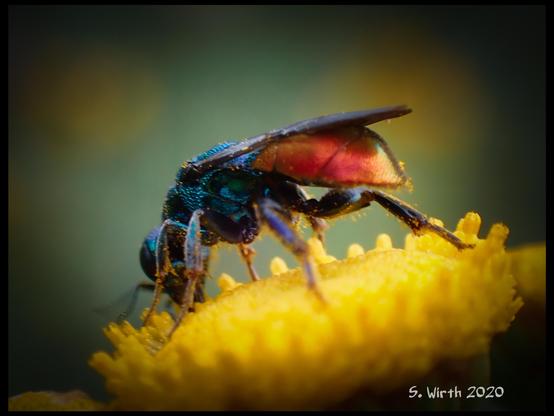
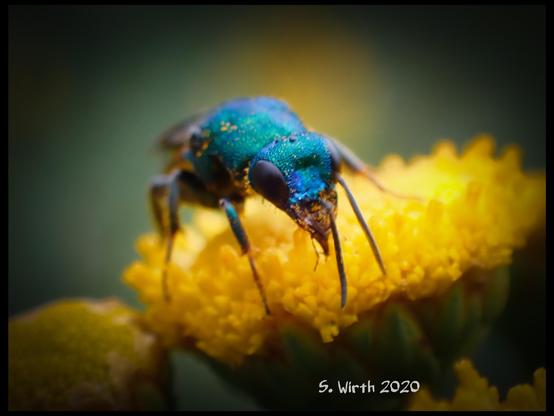
#Cuckoowasps (#Chrysididae) always have a close relationship with other insects, mostly other #Hymenoptera, they can be brood parisites, which kill the host larva but mostly feeding their #foodsupply. They can also be #parasitoids that feed on older larvae or pupae. I previously identified the species shown as #Hedychrum #rutilans, but it may be H. #gerstaeckeri, the #hosts would then be: #Cerceris rybyensis and C. ruficornis. #biodiversity
© #StefanFWirth #Berlin 2020, new edit & text 2025