We're also #hiring a coupled climate and ice sheet modeller for a 3 year position @dmidk.bsky.social
Come and work with me + colleagues on the @icelink-project.bsky.social developing #ECEarth + #Pism in both Greenland + Antarctica

Job based @dmidk in Copenhagen
🇩🇰🇬🇱🇦🇶🇪🇺🌍
#AcademicJobs #FediHire #Fedijobs

https://candidate.hr-manager.net/ApplicationInit.aspx?cid=5001&ProjectId=192267&DepartmentId=10155&MediaId=5

Global climate and ice sheet modelling scientist

The Danish Meteorological Institute (DMI) opens a 3-year, full-time position for a scientist to work on global climate modeling with a particular focus on how t

Talentech
We're also #hiring a coupled climate and ice sheet modeller for a 3 year position @[email protected] Come and work with me + colleagues on the @[email protected] developing #ECEarth + #Pism in both Greenland + Antarctica 🇩🇰🇬🇱🇦🇶🇪🇺🌍 candidate.hr-manager.net/ApplicationI...

Global climate and ice sheet m...
Global climate and ice sheet modelling scientist

The Danish Meteorological Institute (DMI) opens a 3-year, full-time position for a scientist to work on global climate modeling with a particular focus on how t

Talentech

I think this is the right moment to remind this #PISM report from March 2025 “Defining Ukraine’s Victory”. It’s authored by #Poland analyst Daniel Szeligowski and it does not represent Ukraine’s official position, but I believe it quite accurately approximates it:

Political objective: To preserve strong, secure, and independent Ukrainian statehood on as much territory of the country as possible while also preparing a framework for future reunification of the country. To uphold the fundamental principles of the European security architecture and pave the way for lasting peace in Europe.

Military objective: To enforce a ceasefire without Ukraine having to make political concessions that would infringe on its sovereignty.

*Conditions enabling Ukrainian victory: − Political self-determination – Ukraine preserves its sovereign, legitimate government; secures popular acceptance for war outcomes; − Military deterrence – Ukraine deters Russia from restarting the war or engaging in disruptive behaviour to destabilise the country; − Economic reconstruction – Ukraine rebuilds its economy to the point where it can function without international assistance; − Social justice – Ukraine reintegrates its post-war society; − Informational control – Ukraine protects its information sphere from Russian interference through a post-war settlement; and, − Diplomatic respect – the international community maintains a non-recognition policy on Russia-occupied territories; upholds sanctions on Russia until its full withdrawal from Ukraine.

Full report much recommended:

https://pism.pl/webroot/upload/files/Raport/PISM%20Report%20-%20Defining%20Ukraine%E2%80%99s%20Victory.pdf

#Ukraine #Russia

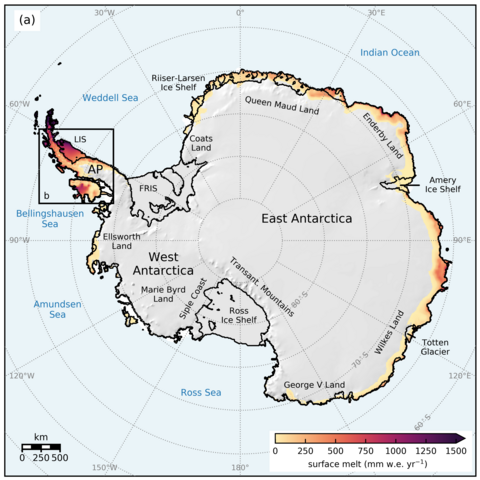
Extremely happy that my new paper on the future of #AntarcticIceSheet surface melting is finally published! 🎉
We use a new melt module in our ice-flow model #PISM which in addition to temperature also takes into account the effect of solar radiation & thus the melt–albedo feedback. Check it out! #OpenAccess #OpenScience
https://doi.org/10.5194/tc-17-4571-2023
The evolution of future Antarctic surface melt using PISM-dEBM-simple

Abstract. It is virtually certain that Antarctica's contribution to sea-level rise will increase with future warming, although competing mass balance processes hamper accurate quantification of the exact magnitudes. Today, ocean-induced melting underneath the floating ice shelves dominates mass losses, but melting at the surface will gain importance as global warming continues. Meltwater at the ice surface has crucial implications for the ice sheet's stability, as it increases the risk of hydrofracturing and ice-shelf collapse that could cause enhanced glacier outflow into the ocean. Simultaneously, positive feedbacks between ice and atmosphere can accelerate mass losses and increase the ice sheet's sensitivity to warming. However, due to long response times, it may take hundreds to thousands of years until the ice sheet fully adjusts to the environmental changes. Therefore, ice-sheet model simulations must be computationally fast and capture the relevant feedbacks, including the ones at the ice–atmosphere interface. Here we use the novel surface melt module dEBM-simple (a slightly modified version of the “simple” diurnal Energy Balance Model) coupled to the Parallel Ice Sheet Model (PISM, together referred to as PISM-dEBM-simple) to estimate the impact of 21st-century atmospheric warming on Antarctic surface melt and ice dynamics. As an enhancement compared to the widely adopted positive degree-day (PDD) scheme, dEBM-simple includes an implicit diurnal cycle and computes melt not only from the temperature, but also from the influence of solar radiation and changes in ice albedo, thus accounting for the melt–albedo feedback. We calibrate PISM-dEBM-simple to reproduce historical and present-day Antarctic surface melt rates given by the regional atmospheric climate model RACMO2.3p2 and use the calibrated model to assess the range of possible future surface melt trajectories under Shared Socioeconomic Pathway SSP5-8.5 warming projections until the year 2100. To investigate the committed impacts of the enhanced surface melting on the ice-sheet dynamics, we extend the simulations under fixed climatological conditions until the ice sheet has reached a state close to equilibrium with its environment. Our findings reveal a substantial surface-melt-induced speed-up in ice flow associated with large-scale elevation reductions in sensitive ice-sheet regions, underscoring the critical role of self-reinforcing ice-sheet–atmosphere feedbacks in future mass losses and sea-level contribution from the Antarctic Ice Sheet on centennial to millennial timescales.

Qing Yan, Ting Wei, and Zhongshi Zhang. Modeling the timing and extent of glaciations over southeastern Tibet during the last glacial stage. Palaeogeography, Palaeoclimatology, Palaeoecology, pages 111336, dec 2022. https://doi.org/10.1016/j.palaeo.2022.111336

#PISM #IceSheetModel #NumericalModeling #Glaciations #Tibet

New #PISM #IceSheetModel paper

Mark L. Pittard, Pippa L. Whitehouse, Michael J. Bentley, and David Small. An ensemble of Antarctic deglacial simulations constrained by geological observations. Quaternary Science Reviews, 298:107800, dec 2022. https://doi.org/10.1016/j.quascirev.2022.107800.

Hi! Here's my #introduction. I'm a Research Software Engineer (#RSE) at https://www.gi.alaska.edu/. I work on the #IceSheet model #PISM (https://www.pism.io/).

Interested in #HPC, #SoftwareDevelopment, #SoftwareMaintenance, #AppliedMath, elegant #algorithms and #code.

When not at work I enjoy #cycling (#FatBiking in the winter), #running, #photography, and baking #bread.

I'm likely to write about software development and (probably less often) whatever else I find interesting.

Home | Geophysical Institute

Since it was established by an Act of Congress in 1946, scientists at the Geophysical Institute have studied geophysical processes from the center of the Earth to the surface of the sun and beyond, turning data and observations into information useful for state, Arctic and national priorities.