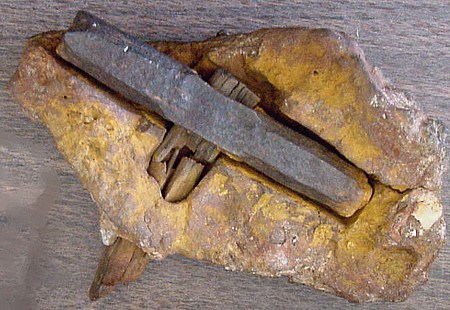
The hammer entombed in rock

Originally published June 7, 2017

A tenet of geology is that rocks are old. Therefore, objects of human origin embedded in rock suggest that the rock formed after the object was created. However, there are several examples of these anomalies, which, upon first appearance, seem to set the geological timescale and assumptions topsy-turvy. One of these items is the London Hammer.

The story of its discovery goes as follows: Mr. and Mrs. Max Hahn found a nodule with the wood handle sticking out near Red Creek in London, Texas in either 1934 or 1936. Later retelling of the story by others say it was lying loose on a rock ledge when found. The nodule was broken open several years later to reveal the entire embedded iron head.

These type of anomalies are known colloquially as OOPARTs (out-of-place artifacts). Such items also include similar embedded objects like iron nails and gold chains but also alleged human footprints in prehistoric rock. Other OOPARTs assumed by some to be ancient objects created by some mysterious culture are actually natural phenomena that resemble cultural products. I hope to include some more interesting OOPARTs descriptions in future posts.

But let’s take this London hammer artifact and try to determine just how strange it is.

The matrix around the hammer head included modern shells.

The hammer is of 19th-century origin. We know this because we can find matching hammers used by miners of that time and not before. The wooden handle of the hammer would not preserve much longer intact. Wood would either decompose or mineralize, depending on the conditions. How did it get encased in rock? The clue to this seems to lie in the description of the rock type – “limey”. Calcite precipitates from saturated solutions quickly under the right conditions, weeks to years. Shell beds also accumulate and cement together in a short time. In this case, we can surmise that a miner might have dropped the hammer or it fell into a spot where he was unable to retrieve it, perhaps into some limey clay that eventually hardened around the hammerhead. However, there are some suspicious details about the hammer.

First, it was not found in situ. We have no documentation of exactly where it was found or under what conditions. We just have a story from the Hahns. The strata in this location are Cretaceous in age but do not match the concreted substance. The nodule matrix cannot reliably be associated with a host rock.

But the primary problem is where the artifact is now kept and for what purpose. The item resides in a Creationist museum in Texas and is exhibited as “proof” that a worldwide flood occurred and wiped out most of the earth’s inhabitants, as related in the Biblical tale of Noah. Carl Baugh, the current owner of the artifact, will not allow testing of the wooden handle or the concretion matrix to definitively characterize its origin, though there is an undetailed, uncorroborated report from a supporter of Baugh who claims the handle was dated “from present to 700 years ago”.

Researcher Glen Kuban has an excellent chronology and details of the history of the artifact and its problematic provenance here. He supports the explanation that the hammer is a typical 19th-century miner’s tool that was encased in the limey concretion by natural means. This plausible explanation does not overturn any geological ideas about the age of the earth or of humans’ place in it. The London Hammer is simply the result of unique circumstances that produced a fascinating object.

Unfortunately, those who possess the item now (Creation Evidence Museum in Glen Rose, TX) have no reason to have it analyzed further to help determine how this anomaly formed because of their use of it to support their anti-science narrative of Biblical creation.

Update 25-June-2024

Here is another example of rapid cementation of a recent item – an engine block left in an intertidal zone became incorporated into the rock along with shells and rock.

Young-earth creationists will shift position on these artifacts depending upon what might gain them traction in an argument. As noted above, they will claim that the rock indicates that humans were around long ago at the same time as extinct animals, so evolution must somehow be false or that fossils can form very quickly so the earth does not have to be old. Both arguments have mistaken assumptions and are flawed. Some rock does form quickly. But some types of rock are demonstrably ancient – perhaps even a billion years old for some continental bedrock – as are the creatures whose remains were preserved in them. There are multiple lines of evidence that establishes that the earth is over 4 billion years old and that there are billions of animal species that evolved and lineages that went extinct over time. It wasn’t just a few thousand years and a flood that constitutes the history of earth.

UPDATE 5-Jan-2026 (Revised) So a version of this artifact was sold for $330 at auction in January 2026. It was part of a lot of mineral specimens, fossils, casts, and related items owned by Melvin Weaver. While it seemed really strange to some of us who knew what it was that 1. it was being sold and, 2. that it went for such a low price. Jason Colavito contacted the Creationist museum where it was supposedly housed and found that it’s still there. So this version was a replica. I did not imagine there were replicas made, and there was no accessible info on the auction site that showed that. Sorry for the misinformation.

#Anomalies #artifact #concretion #creationism #creationist #LondonHammer #NoahSFlood #OOPARTs https://sharonahill.com/?p=435
"Didn't It Rain", sometimes given as "Oh, Didn't It Rain", is a #spiritual about #NoahsFlood. In 1919 it appeared as #sheetMusic in an arrangement for voice and piano by #HenryThackerBurleigh (1866–1949).
https://www.youtube.com/watch?v=n0KxVXsdSvg
Mahalia Jackson - Didn't It Rain 1964 52 Years OLD

YouTube
"Didn't It Rain", sometimes given as "Oh, Didn't It Rain", is a #spiritual about #NoahsFlood. In 1919 it appeared as #sheetMusic in an arrangement for voice and piano by #HenryThackerBurleigh (1866–1949).
https://www.youtube.com/watch?v=n0KxVXsdSvg
Mahalia Jackson - Didn't It Rain 1964 52 Years OLD

YouTube

"I'll Give You $1M to Debate #NoahsFlood!" RIDICULOUS Caller Shut Down | Matt & Seth

https://www.youtube.com/watch?v=I_OVHEpGtXQ

A caller using the pseudonym "Believer" attempts to challenge the hosts to a $1M debate about Noah's #globalflood, but refuses to provide any preview of their arguments.

"I'll Give You $1M to Debate Noah's Flood!" RIDICULOUS Caller Shut Down | Matt & Seth

YouTube
The Pre-Biblical Origins of Noah's Flood

YouTube

🌊 Ever wondered if Noah's Flood really happened? Discover the scientific and archaeological evidence that sheds light on this ancient story. Dive into the debate! #NoahsFlood #AncientHistory #Geology

https://bdking71.wordpress.com/2024/08/24/uncovering-evidence-of-noahs-flood-what-does-science-say/

Uncovering Evidence of Noah’s Flood: What Does Science Say?

Explore the fascinating debate surrounding Noah’s Flood as we examine geological, archaeological, and historical evidence. Is there truth behind the biblical story, or is it a mythological re…

Bryan King

The story of Noah’s Flood is one of the most compelling narratives in religious and cultural history, sparking imaginations and debates for centuries. The tale of a global deluge, as depicted in the Bible, is a cornerstone of various religious traditions, but what does modern science have to say about its validity? In this blog, we’ll delve into the evidence surrounding Noah’s Flood, examining geological, archaeological, and historical perspectives to shed light on this ancient story.

Geological Evidence: A Glimpse into Ancient Cataclysms

One of the primary sources of evidence for the biblical flood comes from geological studies. Proponents of the flood theory often point to various geological formations and sedimentary layers that they believe could be remnants of a massive flood event. For instance, the discovery of sedimentary rock layers and massive fossil beds in regions like the Black Sea has sparked significant interest. Some researchers suggest that these findings might be indicative of a large-scale flooding event that could align with the biblical narrative.

In the late 1990s, a groundbreaking study led by a team of scientists uncovered evidence suggesting that the Black Sea experienced a significant rise in water levels around 7,500 years ago. This event, often referred to as the “Black Sea deluge,” has been linked to a massive influx of water from the Mediterranean, which could have been remembered and mythologized as a global flood. However, while this evidence is compelling, it remains one of many pieces in a complex puzzle.

Archaeological Insights: Bridging Myth and Reality

Archaeology plays a crucial role in understanding ancient civilizations and their myths. While no direct evidence of Noah’s Ark has been discovered, some archaeological finds suggest that ancient peoples experienced significant flooding events. For example, archaeological sites in Mesopotamia, such as Ur and Eridu, reveal layers of silt and debris that might have resulted from historical floods.

The Epic of Gilgamesh, a Mesopotamian text predating the Bible, also contains a flood narrative with striking similarities to the story of Noah. This epic describes a great flood sent by the gods to cleanse the earth, with a hero named Utnapishtim building a boat to save his family and various animals. The similarities between these ancient stories hint at a shared cultural memory of catastrophic flooding, possibly rooted in real historical events.

Historical Context: Unraveling the Story’s Origins

To fully grasp the context of Noah’s Flood, it’s essential to explore the historical and cultural backdrop of ancient civilizations. The story of Noah and the flood likely reflects a broader tradition of flood myths common in ancient cultures. These myths often served as allegories or explanations for natural disasters and their impacts on early societies.

Historical research suggests that flood myths were prevalent in ancient Near Eastern cultures, with variations of the story appearing in the Sumerian, Babylonian, and Assyrian traditions. The widespread nature of these myths indicates that the idea of a great flood was deeply embedded in the collective consciousness of early civilizations. This cultural phenomenon may have been influenced by actual catastrophic events, such as regional floods or tsunamis, which were interpreted and recorded in mythological terms.

Scientific Skepticism: A Critical Perspective

While there is intriguing evidence supporting the possibility of ancient floods, many scientists remain skeptical about the literal interpretation of Noah’s Flood. Critics argue that the geological and archaeological evidence does not conclusively point to a global deluge but rather suggests localized or regional events. The concept of a worldwide flood, as described in the Bible, poses significant challenges from a scientific standpoint, particularly when considering the logistics of such an event.

Furthermore, the absence of concrete evidence for the Ark’s existence and the challenges of fitting the biblical narrative into the geological and historical record contribute to the ongoing debate. Many scientists advocate for a more nuanced interpretation, suggesting that the flood story may be a mythologized account of real events rather than a literal historical occurrence.

Conclusion: A Blend of Myth and Reality

The evidence surrounding Noah’s Flood is a complex interplay of geology, archaeology, and historical context. While scientific investigations offer intriguing insights, they also highlight the challenges of interpreting ancient narratives within a modern framework. The story of Noah’s Flood continues to captivate our imagination, blending historical kernels of truth with mythological embellishments.

Ultimately, the quest for evidence of Noah’s Flood serves as a reminder of the enduring human fascination with our origins and the natural world. Whether seen as a literal historical event or a rich cultural allegory, the flood narrative invites us to explore the intersections of science, history, and mythology.

D. Bryan King

Join the Discussion

What do you think about the findings related to Noah’s Flood? Share your opinions and insights with our community! We’re eager to hear your thoughts and engage in a meaningful conversation about this intriguing topic. Your perspective could add a valuable dimension to the discussion. Leave a comment below and let’s explore the evidence together!

Rate this:

https://bdking71.wordpress.com/2024/08/24/uncovering-evidence-of-noahs-flood-what-does-science-say/

#ancientCivilizationsFlood #ancientFloodAccounts #ancientFloodMyths #ancientTextsFlood #archaeologicalEvidenceFlood #AssyrianFloodMyths #BabylonianFloodStories #biblicalFlood #biblicalStoriesAndScience #BlackSeaDeluge #BlackSeaFloodEvidence #culturalSignificanceFloodMyths #EpicOfGilgameshFlood #evidenceOfNoahSFlood #floodAllegory #floodArchaeology #floodDisasterAncient #floodLegendsAndHistory #floodMythOrigins_ #floodMythsAndReality #floodMythsComparison #floodMythsNearEast #floodNarrativeHistory #floodResearch #floodSedimentEvidence #floodStorytelling #geologicalEvidenceFlood #geologicalFormationsFlood #globalFloodEvidence #historicalContextOfNoahSFlood #historicalFloods #MesopotamianFloodStories #NoahSArk #NoahSFlood #NoahSFloodAndGeology #NoahSFloodDebate #regionalFloodEvents #scientificSkepticismNoahSFlood #scientificViewNoahSFlood #SumerianFloodMyths #UtnapishtimFlood

Uncovering Evidence of Noah’s Flood: What Does Science Say?

Explore the fascinating debate surrounding Noah’s Flood as we examine geological, archaeological, and historical evidence. Is there truth behind the biblical story, or is it a mythological re…

Bryan King
#Oklahoma mandated “teaching the Bible” in all public schools. I’m not in OK, but if I were, I’d sign up to teach.
#Fratricide #Rape #JaelsPeg #DeadBloatedBodies (#NoahsFlood ) #Inconsistencies #Decapitation #Eroticism #Incest
#WelcomingForeigners #FreeFood #FreeHealthCare #SevenYearJubilee #GiveMoneyToThePoor
An apology & a response to an argument for Noah's flood

YouTube