Hemodynamic initial-dip reflects local spiking activity.
🧠 Initial-dip: transient HbR increase.
🔍 More spatially specific than hemodynamic response.
📉 HbT decrease leads to capping HbR.
🔄 Biphasic HbR with early decrease, late rebound.

#fNIRS #Neuroimaging #Hemodynamics #Neuroscience #Pub2Post https://tnyp.me/l3nndrWk/m

Frontiers | The hemodynamic initial-dip consists of both volumetric and oxymetric changes reflecting localized spiking activity

The initial-dip is a transient decrease frequently observed in functional neuroimaging signals, immediately after stimulus onset, believed to originate from ...

Frontiers

Another reason why you really can't beat yourself up over mistakes in the past -

Human #brains have 5 distinct 'epochs' in a lifetime, study finds https://www.nbcnews.com/science/science-news/human-brains-5-epochs-development-rcna245663

#braindevelopment #research #neuroimaging #neuralnetwork #mentalhealth #brainarchitecture

Human brains have 5 distinct 'epochs' in a lifetime, study finds

As we age, the human brain rewires itself.

NBC News
New post out! 🚀 Dive into R's `apply()` function with me. I'm breaking down `MARGIN` from basic matrices to complex 5D fMRI neuroimaging data, showing how to avoid messy loops. Essential for anyone working with arrays! #RStats #Neuroimaging #DataAnalysis
https://drmo.site/k40xD5

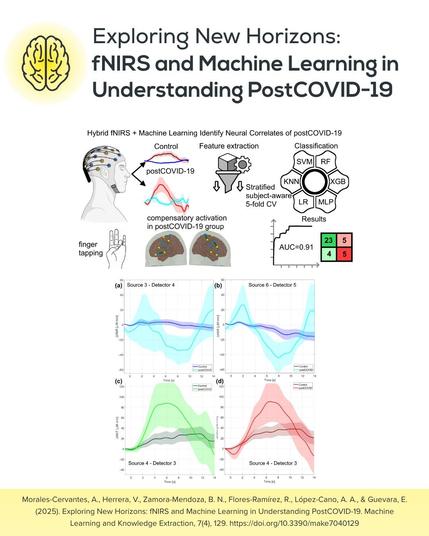
Machine learning analysis of fNIRS-derived hemodynamics revealed distinct cortical patterns distinguishing post-COVID-19 from controls (AUC=0.91) 🧠🦠

Read the publication at: https://www.mdpi.com/2504-4990/7/4/129

#fNIRS #Neuroimaging #BrainResearch #PostCOVID

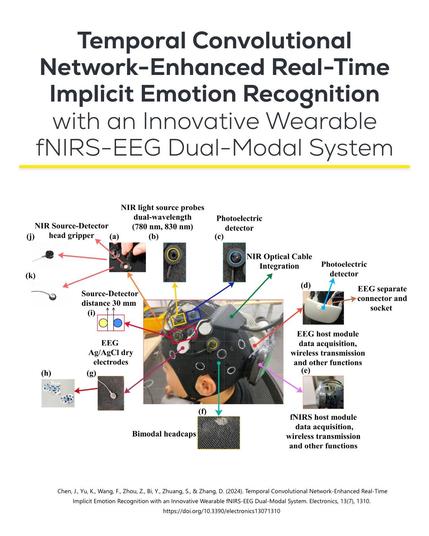
Chen et al. explored the temporal dynamics of cortical activation during cognitive tasks using a multimodal fNIRS–EEG approach. By integrating hemodynamic and electrophysiological signals, the team achieved a comprehensive view of both the where and when of brain activation.
The findings highlight how simultaneous fNIRS and EEG measurements complement each other to paint a richer picture of brain function.

🔗 Read the full article here: https://publications.artinis.com/publication/chen-temporal-2024/

#fNIRS #EEG #Neuroimaging

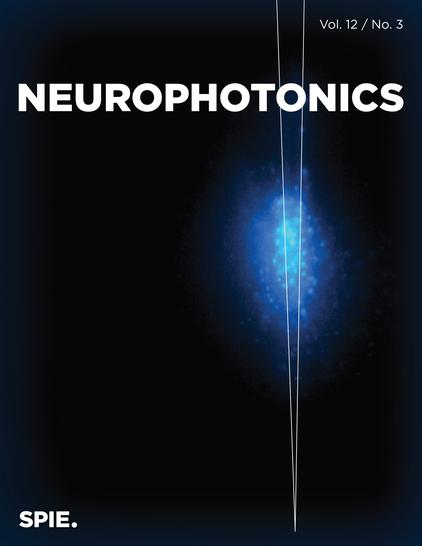
Neurophotonics gets a cool new cover! Inside, depth-resolved fiber photometry @ferruccio-phc.bsky.social and much more!
#Neurophotonics #Neuroscience #Neuroimaging #BrainImaging #OpticalImaging #Microscopy
#studyBRAIN

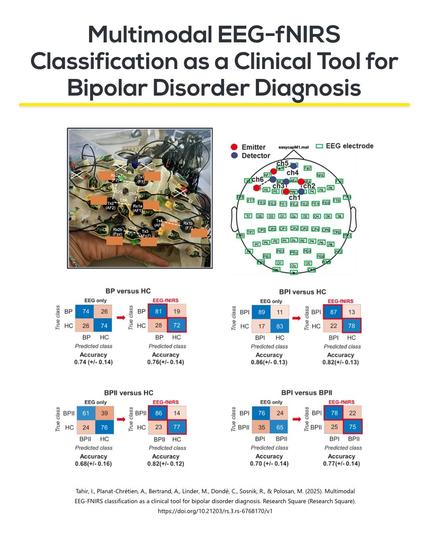
In a recent study, Tahir et al. explored the potential of combining fNIRS with EEG as a diagnostic tool for bipolar disorder.

The team used the OxyMon to record brain hemodynamics alongside neural electrical activity, offering a more comprehensive picture of brain function than either modality alone.
Their findings highlight how multimodal fNIRS-EEG could pave the way for improved diagnostic detection in psychiatric disorders.

🔗 https://publications.artinis.com/publication/tahir-multimodal-2025/

#fNIRS #EEG #Neuroimaging #bipolar

We are pleased to announce that BIDS Extension Proposal 42 - Electromyogrpahy is open for community review!

https://github.com/bids-standard/bids-specification/discussions/2219

The review period is open from September 29 - October 10.
#bids #neuroimaging #electromyography #emg

Community Review: BEP042 - Electromyography (EMG) · bids-standard bids-specification · Discussion #2219

We are pleased to announce the community review period for BIDS Extension Proposal (BEP) 042! BEP042 extends the BIDS standard to include electromyography recordings. The draft specification may be...

GitHub

We are pleased to announce that BIDS Extension Proposal 20 - Eye Tracking is open for community review!

https://github.com/bids-standard/bids-specification/discussions/2218

The review period is open from September 29 - October 10.
#bids #neuroimaging #eyetracking

Community Review: BEP020 - Eye Tracking · bids-standard bids-specification · Discussion #2218

We are pleased to announce the community review period for BIDS Extension Proposal (BEP) 020! BEP020 extends the BIDS standard to formally specify eye-tracking recordings, which has previously been...

GitHub
×
New post out! 🚀 Dive into R's `apply()` function with me. I'm breaking down `MARGIN` from basic matrices to complex 5D fMRI neuroimaging data, showing how to avoid messy loops. Essential for anyone working with arrays! #RStats #Neuroimaging #DataAnalysis
https://drmo.site/k40xD5