@fugueish I'd say every website that doesn't work on Lynx Browser over Iridium or Tor Browser with disabled JavaScript over 2G should be banned from existing it's developers forced to fix it!

  • Anything else is too much lenience for Enshittification…
    • Seriously, stuff like FrogFind should be unnecessary to begin with!!!

#Sarcasm #Commentary #LynxBrowser #TorBrowser #2G #Tor #Iridium #Narrowband #FrogFind #JS #JavaScript #AntiJS #AntiJavascriptAction #Malware #Bloatware #Enshittification

I Built a Search Engine... for Vintage Computers!

YouTube

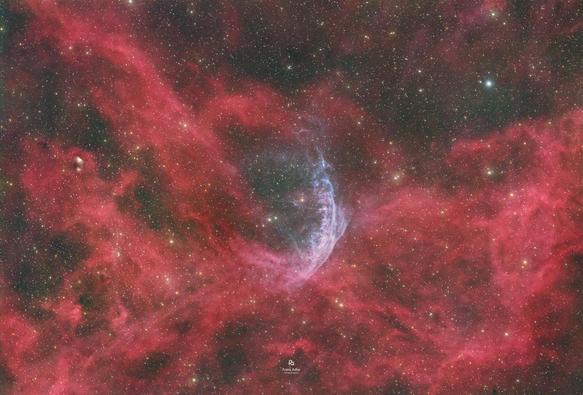
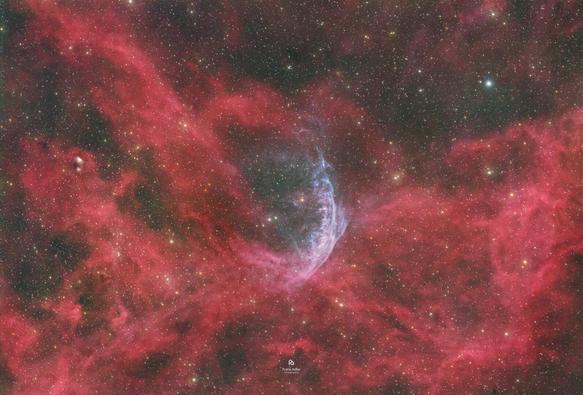
The Bubble Maker - WR134 in Cygnus. A Wolf-Rayet star sculpting a spherical emission bubble with its relentless stellar wind over millennia. Imaged in Hubble palette mapping (HOS). NGC 6883 and β² Cygni also in the field.

https://adfr.io/astro/20260522_wr134

#Astrophotography #Astrodon #WolfRayet #Cygnus #Nebula #NarrowBand #OIII #Halpha

The Bubble Maker
=============

WR134 is a Wolf-Rayet star - one of the rarest and most extreme stellar types in our galaxy. A relentless stellar wind hurling matter into space at thousands of kilometres per second has, over millennia, compressed and shaped the surrounding gas into the spherical emission bubble you see here. It glows in OIII, the light of doubly ionized oxygen, set against the vast red curtain of the Cygnus H-alpha complex. Also in the field: the open cluster NGC 6883 and the double star β² Cygni.

What draws me to Wolf-Rayet objects is the violence made visible. This bubble is not decoration - it is the direct record of a star slowly destroying itself, pushing its own outer layers outward until they pile up and glow. WR134 will likely end as a supernova. For now, it makes bubbles.

Scope: Askar 103APO
Lens: Askar 1.0x Flattener
Camera: ZWO ASI 294MC Pro
Filter: Antlia Tri-Band RGB Ultra
Mount: SkyWatcher AZ-EQ5-GT
Guiding: SkyWatcher Evoguide 50ED with ZWO ASI 224MC
Controller: ZWO ASIAir Pro
Focusser: ZWO EAF

Integration time: 13hrs 15min

Full version and print available at:
https://adfr.io/astro/20260522_wr134

#astrophotography #nebula #wr134 #wolfrayet #cygnus #narrowband #hubblepalette #hos #deepsky #nightsky #space #astronomy #astrophoto #stars #oiii #halpha #ngc6883
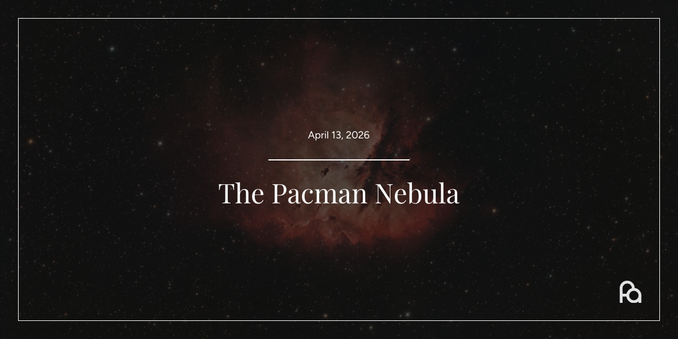
The Pacman Nebula
===============

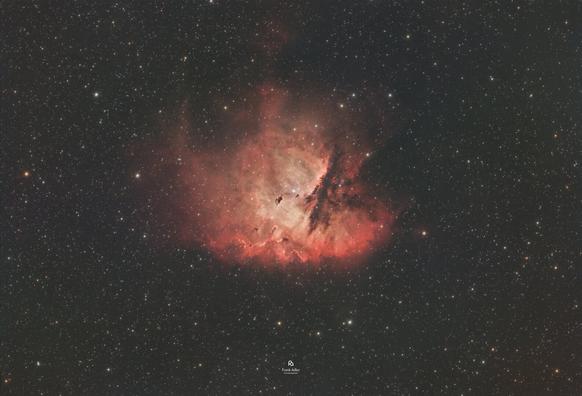
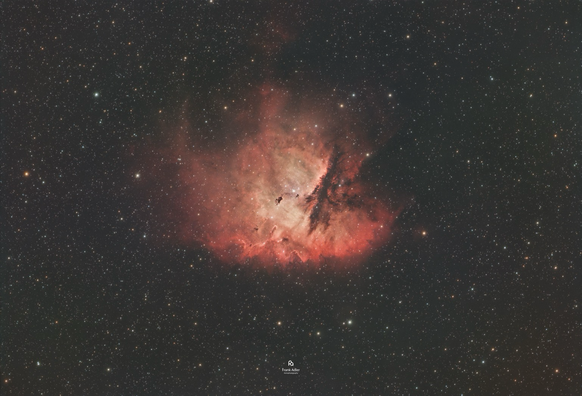
NGC 281, the Pacman Nebula - a return to a familiar target in Cassiopeia. This time with a new setup and considerably more integration time, captured in the Hubble palette (HSO). The result is a view dominated by the warm red glow of ionized hydrogen and sulfur, punctuated by the brighter, subtly blue-grey core where the young star cluster IC 1590 drives the entire nebula's energy.

What fascinates me most about this object are the dark Bok globules - dense dust structures silhouetted against the glowing gas, slowly being eroded by the intense radiation from IC 1590. They look like they are being consumed, and in a sense they are. But deep inside their cold, shielded cores, gravity may be quietly winning - collapsing gas into new stars, born from the same clouds being stripped away around them.

Scope: Askar 103APO
Lens: Askar 1.0x Flattener
Camera: ZWO ASI 294MC Pro
Filter: Antlia Tri-Band RGB Ultra
Mount: SkyWatcher AZ-EQ5-GT
Guiding: SkyWatcher Evoguide 50ED with ZWO ASI 224MC
Controller: ZWO ASIAir Pro
Focusser: ZWO EAF

Integration time: 6hrs 40min

Full version and print available at:
https://adfr.io/astro/20260407_ngc281

#astrophotography #nebula #ngc281 #pacmannebula #cassiopeia #narrowband #hubblepalette #hso #deepsky #nightsky #space #astronomy #astrography #astrophoto #stars #stargazing
NGC 281 - the Pacman Nebula in Cassiopeia. A return to a familiar object, this time with a new setup and considerably more integration time. In the Hubble palette (HSO), the dark Bok globules stand out with particular clarity - dense dust structures being eroded by the radiation pressure of the young cluster IC 1590, while possibly hiding new star formation deep within.

https://adfr.io/astro/20260407_ngc281

#Astrophotography #Narrowband #NGC281 #PacmanNebula #Cassiopeia #HSO #HubblePalette #astrodon

The Pacman Nebula

Hey there, I'm Frank. I create web experiences and capture the beauty of the universe.

Frank Adler :: Astrophotography & Web Engineering

Sh2-171 – The Question Mark Nebula in Cepheus. A two-panel mosaic covering over 100 light-years of active star formation, powered by Berkeley 59 — a cluster just 2 million years old. Its O5V star BD+66 1673 burns at 45,000 Kelvin, sculpting the dark pillars visible throughout the frame. Processed in Hubble Palette (HSO).

https://adfr.io/astro/20260310_sh2-171

#Astrophotography #Narrowband #Sh2171 #NGC7822 #Cepheus #HubblePalette #DeepSky #Nebula #astrodon #astrophoto #deepsky

The Question Mark Nebula

Hey there, I'm Frank. I create web experiences and capture the beauty of the universe.

Frank Adler :: Astrophotography & Web Engineering
The Question Mark Nebula
====================

2,600 light-years away in Cepheus, a cosmic question mark is being written in gas and dust. Sharpless 171 (NGC 7822) is an active stellar nursery spanning over 100 light-years, powered by Berkeley 59 — a star cluster just two million years old. Its brightest member, BD+66 1673, burns at nearly 45,000 Kelvin, sculpting the surrounding cloud into the elephant trunks and dark pillars you see here. A two-million-year-old star carving a hundred-light-year nebula. The universe doesn't do things small.

The foreground scatter of stars in the upper part of the frame belongs to NGC 7762 — an unrelated open cluster that is 2.5 billion years old and just happens to share the same patch of sky. Ancient stars looking on as new ones are born.

Two-panel mosaic captured over two nights from Chemnitz, processed in Hubble Palette (HSO). 🔭

Scope: Askar 103APO
Lens: Askar 0.6x Reducer
Camera: ZWO ASI 294MC Pro
Filter: Antlia Tri-Band RGB Ultra
Mount: SkyWatcher AZ-EQ5-GT
Guiding: SkyWatcher Evoguide 50ED with ZWO ASI 224MC
Controller: ZWO ASIAir Pro
Focusser: ZWO EAF

Integration time: 16hrs 50min

Full version and print available at:
https://adfr.io/astro/20260310_sh2-171

#astrophotography #deepskyobject #narrowband #hubblepalette #emissionnebula #sh2171 #ngc7822 #questionmarknebula #cepheus #starforming #stellarnursery #berkeleycluster #hso #pixinsight #astronomyphotography #spacephotography #nightsky #cosmiclandscape #astrophoto #nebula #Sternenfotografie #Astrofotografie #deepsky #mosaic #longexposure #fromchemnitz

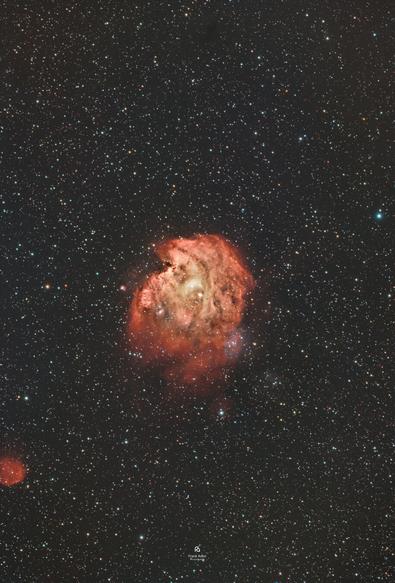
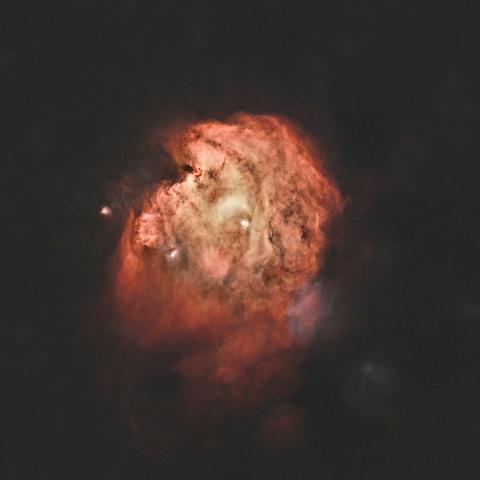
NGC 2175 - the Monkey Head Nebula - in Orion, about 6.400 light-years away. A star-forming H II region (Sh2-252/NGC 2174) sculpted by the O-type star HD 42088 and dark dust lanes.

https://adfr.io/astro/20260118_ngc2175

#astrodon #astrophotography #astrophoto #deepsky #nebula #NGC2175 #MonkeyHeadNebula #Narrowband #astronomy

The Monkey Head Nebula
======================

NGC 2175 is a glowing star-forming region in Orion, about 6.400 light-years away. It belongs to the wider Sh2-252 complex (often discussed alongside NGC 2174) and spans a surprisingly large patch of sky.

Powered by the hot O-type star HD 42088, ultraviolet light makes hydrogen shine while dark dust lanes carve the familiar “monkey” silhouette. A stellar nursery in motion, shaped by radiation and winds as new stars emerge.

Scope: Askar 103APO
Lens: Askar 0.6x Reducer
Camera: ZWO ASI 294MC Pro
Filter: Antlia Tri-Band RGB Ultra
Mount: SkyWatcher AZ-EQ5-GT
Guiding: SkyWatcher Evoguide 50ED with ZWO ASI 224MC
Controller: ZWO ASIAir Pro
Focusser: ZWO EAF

Integration time: 5hrs 35min

Full version and print available at:
https://adfr.io/astro/20260118_ngc2175

#astrophotography #astrophoto #astrophotographer #deepsky #deepskyphotography #deepskyobject #deepskyastrophotography #nebula #deepspace #space #nightsky #astronomy #cosmos #stargazing #spaceisart #Narrowband #SpacePhotography #BackyardAstronomy #AstronomyLovers #starchild #cosmicwonder #spaceart #universetoday #instaastro #NGC2175 #MonkeyHeadNebula #Sh2-252 #OrionConstellation #Halpha #OIII
The California Nebula
================

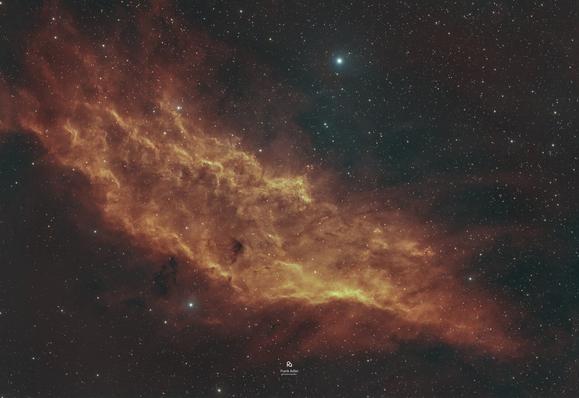
Stretching across nearly 100 light-years, this glowing river of hydrogen is known as the California Nebula. Located about 1,000–1,500 light-years away in the constellation Perseus, it’s far too faint to see with the naked eye — but long-exposure astrophotography reveals its true form.

The nebula shines almost entirely in H-alpha light, energized by intense radiation from the nearby hot star Xi Persei. What looks like a soft, golden cloud is actually a turbulent region of ionized gas, dust, and ongoing star formation.

Five times wider than the full Moon and yet nearly invisible visually, NGC 1499 is a perfect reminder of how much of the universe hides just beyond human perception.

Scope: Askar 103APO
Lens: Askar 0.6x Reducer
Camera: ZWO ASI 294MC Pro
Filter: Antlia Tri-Band RGB Ultra
Mount: SkyWatcher AZ-EQ5-GT
Guiding: SkyWatcher Evoguide 50ED with ZWO ASI 224MC
Controller: ZWO ASIAir Pro
Focusser: ZWO EAF

Integration time: 10hrs 25min

Full version and print available at:
https://adfr.io/astro/20251218_ngc1499/

#astrophotography #astrophoto #astrophotographer #deepsky #deepskyphotography #deepskyobject #deepskyastrophotography #nebula #deepspace #space #nightsky #astronomy #cosmos #stargazing #spaceisart #Narrowband #SpacePhotography #BackyardAstronomy #AstronomyLovers #starchild #cosmicwonder #spaceart #universetoday #instaastro #ngc1499 #californianebula