 Protyus A. Gendher
**God is the narrative shortcut cultures use to avoid saying “we made this up.”**
Every rule, ritual, and taboo becomes unquestionable once you attribute it to the divine. It’s not revelation — it’s branding.
#CulturalDesign #Mythmaking #Authority #HumanSystems

 WIST Quotations
The primary aim of propaganda is, of course, to influence contemporary opinion, but those who rewrite history do probably believe with part of their minds that they are actually thrusting facts into the past. When one considers the elaborate forgeries that have been committed in order to show that Trotsky did not play a valuable part in the Russian civil war, it is difficult to feel that the people responsible are merely lying. More probably they feel that their own version was what happened in the sight of God, and that one is justified in rearranging the records accordingly.
George Orwell (1903-1950) English journalist, essayist, writer [pseud. of Eric Arthur Blair]
Essay (1945-05), “Notes on Nationalism,” Polemic Magazine (1945-10)
More about this quote: wist.info/orwell-george/46375/
#quote #quotes #quotation #qotd #orwell #georgeorwell #divinetruth #history #mythmaking #past #propaganda #reality #revisionism #truebeliever #truth

Orwell, George - Essay (1945-05), "Notes on Nationalism," Polemic Magazine (1945-10) | WIST Quotations
The primary aim of propaganda is, of course, to influence contemporary opinion, but those who rewrite history do probably believe with part of their minds that they are actually thrusting facts into the past. When one considers the elaborate forgeries that have been committed in order to show that Trotsky…
 Boldly.Blue
If you're a #writer or #author #novelist #screenwriter, how does #neilGaiman #mythmaking #worldbuilding work? Let's dig in:
https://boldly.blue/neil-gaiman-writing-style-mythmaking/
#speculativefiction #sciencefiction #fantasy #readers #librarians #booklovers #booktok #bookstagram
https://boldly.blue/neil-gaiman-writing-style-mythmaking/
https://boldly.blue/neil-gaiman-writing-style-mythmaking/
#speculativefiction #sciencefiction #fantasy #readers #librarians #booklovers #booktok #bookstagram
https://boldly.blue/neil-gaiman-writing-style-mythmaking/

Neil Gaiman's Mythmaking - David Somerfleck | Science Fiction Author
Neil Gaiman's writing style transforms myth into sacred text — weaving Norse, Greek, Celtic, and personal mythology into stories that feel as old as fire and as urgent as this morning. Explore four case studies — The Sandman, American Gods, Coraline, and Norse Mythology / The Ocean at the End of the Lane — and discover how the mythmaker works.
 delong
Reässessing the “West” from John Winthrop to Marco Rubio:
**From Plato to NATO to MAGA: Marco Rubio’s Myths & the Real "Western Alliance”**
<https://braddelong.substack.com/p/from-plato-to-nato-to-maga-marco>
2026-02-16 Mo
##from-plato-to-nato-to-maga-marco-rubios-myths-the-real-western-alliance
##neofascism
#from-plato-to-nato-to-maga
#marco-rubios-myths-the-real-western-alliance
#marco-rubio
#western-alliance
#mythmaking
#city-upon-a-hill
#american-exceptionalism
#us-foreign-policy
#liberal-democracy

 C. L. Nichols
https://medium.com/storyangles/the-art-of-personal-myth-making-1327fde6f166
This isn’t hiding, it’s editing. Every writer edits. Every artist edits. Do the same thing with your identity.
#personalmythmaking #mythmaking #medium #identity #branding #personalbranding #selfimprovement #PersonalDevelopment

 Amin Girasol
The RESISTORS were the opposite of what the article claims them to be. These kids had no conception of worker solidarity and the vital importance of trade unions in pushing back against relentless capitalist exploitation. They were privileged kids who didn't question the myth of meritocracy, ("'it didn’t occur to us that girls [would] be any different in terms of what they could do.'"[2]) and unquestioningly and obliviously used their privilege as a springboard to further wealth. Their membership of the RESISTORS was part and parcel of that privilege, not something separate from it.
The IEEE article mentions the RESISTORS even interacted with Joseph Weizenbaum's ELIZA, which - if they'd been more curious - could have led them to learn about Weizenbaum's deep misgivings about the manipulation of human psychology through computers. Weizenbaum understood computing as a deeply conservative force, which entrenched existing power structures. The RESISTORS were the beneficiaries of those structures. It is misleading to claim otherwise.
#computerhistory #capital #power #privilege #siliconvalley #historiography #mythmaking #billionaires #intergenerationalwealth
[1] https://spectrum.ieee.org/teenage-hackers
[2] https://www.resistors.org/index.php/History_of_the_R.E.S.I.S.T.O.R.S.
[3] https://cals.cornell.edu/people/jean-hunter
[4] https://dwork.seas.harvard.edu/
[5] https://www.ebsco.com/research-starters/biography/steve-kirsch
[6] https://www.johnlevine.com/about.phtml
[7] https://en.wikipedia.org/wiki/Leonard_Bosack
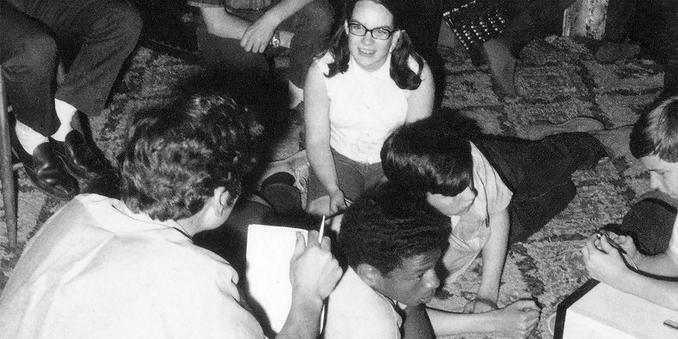
The RESISTORS were not countercultural
The Spectrum IEEE article “How the RESISTORS Put Computing into 1960s Counter-culture“[1] is disingenuous.
I'm tired of self-congratulatory mythologising in the historiography of computing. It's of a piece with the trope of plucky boys (it’s always boys) building computers in their parents’ garage, as little Davids taking down Goliath IBM. It's myth-making.
We cannot escape or elide the fact that these were all kids from highly privileged backgrounds:
Several members had parents employed at nearby technology companies, such as AT&T and RCA. Others, such as Nat Kuhn, had parents who worked at Princeton University. Kuhn’s father was Thomas Kuhn, a historian and author of The Structure of Scientific Revolutions (1962), the landmark book that introduced “paradigm shift” into the vernacular.[1]
The group had access to ”Princeton University Computer Lab where the university allowed the kids to use their very large computers as long as they could learn how.”[2] “On a couple of occasions… I drove them to the Digital Equipment Company (DEC) in Maynard, Mass. where they participated with Claude in fairly professional meetings.“[2]
That’s quite a perk, as a secondary school student. Where are these people now? Can you guess?
"Chuck Ehrlich [was] one of the original RESISTORS and later [a] venture capitalist"[2]; Jean Hunter is professor emerita of biological and environmental engineering at Cornell[3]; Cynthia Dwork is Gordon McKay Professor of Computer Science at Harvard University[4]; John Levine is described as an author, but in fact among other C-suite roles he "co-founded Segue Software" and "continued as a director of the corporation and an informal consultant until the company was sold to Borland Software in early 2006"[6]. Leonard Bosack co-founded Cisco Systems. Fifteen years ago his personal fortune was estimated at $200 million[7]. Steve Kirsch sold search engine Infoseek to Disney for $1.7B in 1999 and is an anti-vaxxer[5].
The RESISTORS themselves tell a different story about how non-sexist, non-homophobic and anti-racist they were and are: “There were a few girls who came from time to time, but I was never quite sure whether it was the computers or the boys who were the attraction.”[2]
About Kagan, the articles states “Kagan was gay, a fact that the teens (and their parents) were aware of but which, by all accounts, bothered no one.“[1] (my emphasis) but RESISTOR Bob Levine says:
[Claude Kagan] lived alone but had had a companion who died under questionable circumstances. What the parents really wanted to know was if it was safe to have their teenage boys interacting with Claude? […] As for Claude's dealing with the boys, there was not even a hint of anything improper.”[4]
Joseph Tulloch, the only named Black member of the group, later finds work as a programmer.[1] That's it. He doesn't get to bootstrap his technical expertise, nor even capitalise on the valuable network of privilege from his involvement with the group, to become a founder, or a CEO, or a professor, or a venture capitalist. I wonder why. Maybe he didn’t want it enough, right?
Their mentor Kagan, framed as a kind of fatherly farmer-tinkerer, with his barn full of donkeys and old computers, in fact had a "BA in Mechanical Engineering, a BA in Electrical Engineering, and an MSc in Civil Engineering" and among other high-stakes technical work had been "... involved in final setup and testing of Missile Range communications system". He was at the centre of the Cold War military-industrial complex.
The article starts with a garbled story about the RESISTORS breaking a strike at a computer convention which we’re supposed to consider contributes to their countercultural credentials. I don't consider strike-breaking to be countercultural - quite the opposite. There’s a less muddled telling of the story about the strike-breaking kids, published by the RESISTORS themselves:
I also recall a computer conference in Atlantic City where they had obtained some space to demonstrate their PDP-8. As the conference started, the telephone workers went on strike so that all the exhibitors who depended on the phones to demonstrate their equipment were blocked – but not the R.E.S.I.S.T.O.R.S. They quickly ran a pair of wires from the PDP-8 and clipped them to a nearby pay phone so they could communicate with another computer back at the barn. They were the only exhibitor who had anything working, and were mobbed. I think it also made the local papers. Claude was very proud of them.
1/2
#computerhistory #capital #power #privilege #siliconvalley #historiography #mythmaking #billionaires #intergenerationalwealth
[1] https://spectrum.ieee.org/teenage-hackers
[2] https://www.resistors.org/index.php/History_of_the_R.E.S.I.S.T.O.R.S.
[3] https://cals.cornell.edu/people/jean-hunter
[4] https://dwork.seas.harvard.edu/
[5] https://www.ebsco.com/research-starters/biography/steve-kirsch
[6] https://www.johnlevine.com/about.phtml
[7] https://en.wikipedia.org/wiki/Leonard_Bosack
 Lauren McMenemy
We're lucky to have such interesting people joining us for Writing the Occult: Creatures & Cryptids - including the writer A.W. Earl, who pitched this talk (see 🧵⬇️) to us and we immediately said YES PLEASE.
We're in the dying moments of ticket sales, so get in quick! writingtheoccult.carrd.co
#writers #writing #queerwriters #cryptids #folklore #mythology #mythmaking #creativity

 WIST Quotations Has Moved!
Man is certainly mad. He cannot fashion a worm, and he fashions gods by dozens.
[L’homme est bien insensé: Il ne sçauroit forger un ciron, & forge des Dieux à douzaines.]
[L’homme est bien insensé: Il ne sçauroit forger un ciron, & forge des Dieux à douzaines.]
Michel de Montaigne (1533-1592) French essayist
Essays, Book 2, ch. 12 (2.12), “Apology for Raymond Sebond [Apologie de Raimond de Sebonde]” (1573) [tr. Zeitlin (1934)]
More info about (and translations of) this quote: wist.info/montaigne-michel-de/…
#quote #quotes #quotation #qotd #montaigne #micheldemontaigne #creation #divinepower #ego #gods #hubris #humannature #life #mythmaking #power #religion

Essays, Book 2, ch. 12 (2.12), "Apology for Raymond Sebond [Apologie de Raimond de Sebonde]" (1573) [tr. Zeitlin (1934)] - Montaigne, Michel de | WIST Quotations
Man is certainly mad. He cannot fashion a worm, and he fashions gods by dozens. [L’homme est bien insensé: Il ne sçauroit forger un ciron, & forge des Dieux à douzaines.] This essay appeared in the 1st (1580) edition, and was expanded for each edition after that. This passage first…
A quotation from Ambrose Bierce
SAINT, n. A dead sinner, revised and edited.Ambrose Bierce (1842-1914?) American writer and journalist
"Saint," The Devil’s Dictionary (1911)
More info about this quote: wist.info/bierce-ambrose/21902…
#quote #quotes #quotation #qotd #ambrosebierce #devilsdictionary #canonization #mythmaking #revisionism #saint #sainthood #sinner
"Saint," The Devil's Dictionary (1911) - Bierce, Ambrose | WIST Quotations
SAINT, n. A dead sinner, revised and edited. Originally published in The Devil's Dictionary [A-Z] as Vol. 7 of his Collected Works. This seems to have been a revision of: CANONIZE, v.t.. To make a saint out of a dead sinner. That entry first appeared in the "Devil's Dictionary" column…