 Scholpp_Lab
 James Briscoe
"Is there a recent review of the #morphogen control of tissue patterning that I can read on my summer hols?" I hear you ask
Why, yes, there is. Here's @AKicheva & my summary of the current state of the field & open questions
"Is there a recent review of the #morphogen control of tissue patterning that I can read on my summer hols?" I hear you ask
Why, yes, there is. Here's @AKicheva & my summary of the current state of the field & open questions
Our paper builds on previous work from our group that
- introduced the 1D morphogen gradient model:
https://twitter.com/DagmarIber/status/1499631526056796162
- revealed the impact of cell size on patterning precision:
https://twitter.com/DagmarIber/status/1489479705292156933
- explored the effect of non-linear decay:
---
RT @DagmarIber
Does self-enhanced #morphogen #degradation improve #patterning #precision in #tissue #development? …
https://twitter.com/DagmarIber/status/1589511772285054976
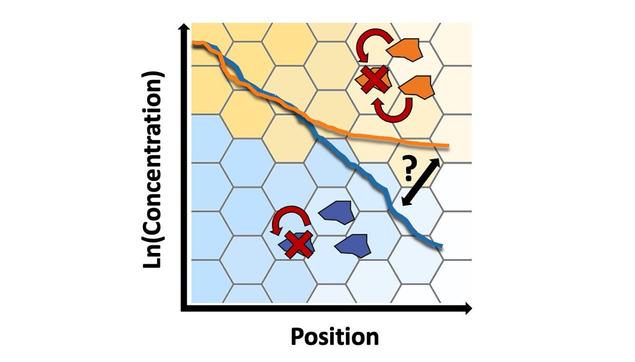
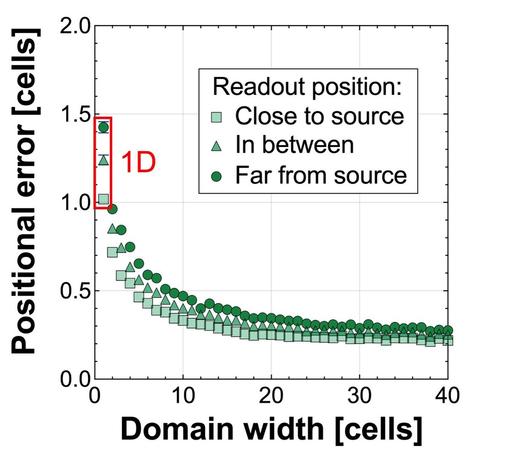
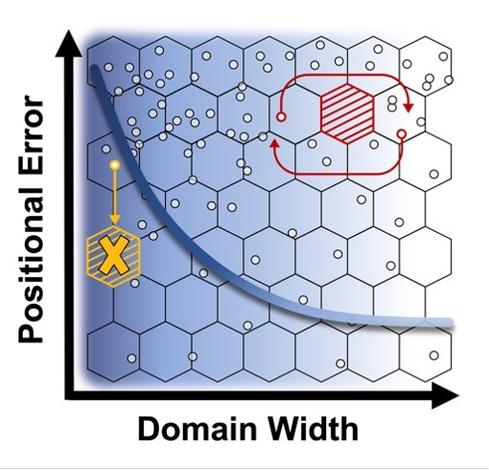
How to achieve high #patterning #precision in #development?
#Morphogen gradients are more precise in #2D than in 1D, in particular when #cells are #narrow.
Check out our latest #preprint on @biorxivpreprint: https://doi.org/10.1101/2023.03.13.532369
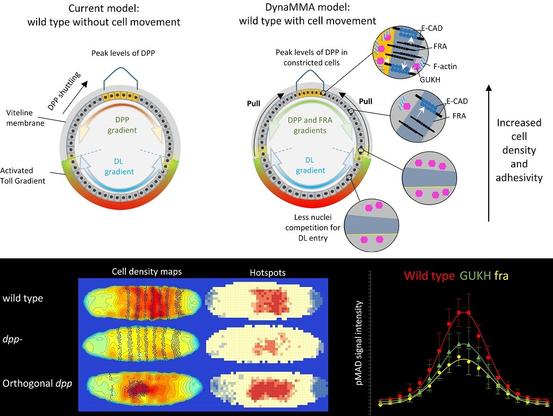

Morphogenetic gradients specify distinct cell populations within tissues. Originally, morphogens were conceived as substances that act on a static field of cells, yet cells usually move during development. Thus, the way cell fates are defined in moving cells remains a significant and largely unsolved problem. Here, we investigated this issue using spatial referencing of cells and 3D spatial statistics in the Drosophila blastoderm to reveal how cell density responds to morphogenetic activity. We show that the morphogen decapentaplegic (DPP) attracts cells towards its peak levels in the dorsal midline, whereas dorsal (DL) stalls them ventrally. We identified frazzled and GUK-holder as the downstream effectors regulated by these morphogens that constrict cells and provide the mechanical force necessary to draw cells dorsally. Surprisingly, GUKH and FRA modulate the DL and DPP gradient levels and this regulation creates a very precise mechanism of coordinating cell movement and fate specification.
Morphogenetic gradients specify distinct cell populations within tissues. Originally, morphogens were conceived as substances that act on a static field of cells, yet cells usually move during development. Thus, the way cell fates are defined in moving cells remains a significant and largely unsolved problem. Here, we investigated this issue using spatial referencing of cells and 3D spatial statistics in the Drosophila blastoderm to reveal how cell density responds to morphogenetic activity. We show that the morphogen decapentaplegic (DPP) attracts cells towards its peak levels in the dorsal midline, whereas dorsal (DL) stalls them ventrally. We identified frazzled and GUK-holder as the downstream effectors regulated by these morphogens that constrict cells and provide the mechanical force necessary to draw cells dorsally. Surprisingly, GUKH and FRA modulate the DL and DPP gradient levels and this regulation creates a very precise mechanism of coordinating cell movement and fate specification.

Morphogenetic gradients specify distinct cell populations within tissues. Originally, morphogens were conceived as substances that act on a static field of cells, yet cells usually move during development. Thus, the way cell fates are defined in moving cells remains a significant and largely unsolved problem. Here, we investigated this issue using spatial referencing of cells and 3D spatial statistics in the Drosophila blastoderm to reveal how cell density responds to morphogenetic activity. We show that the morphogen decapentaplegic (DPP) attracts cells towards its peak levels in the dorsal midline, whereas dorsal (DL) stalls them ventrally. We identified frazzled and GUK-holder as the downstream effectors regulated by these morphogens that constrict cells and provide the mechanical force necessary to draw cells dorsally. Surprisingly, GUKH and FRA modulate the DL and DPP gradient levels and this regulation creates a very precise mechanism of coordinating cell movement and fate specification.
Hi everyone!
The Vincent lab twitter account completes its migration to Mastodon.
Follow us for cool #DevBio science, mostly working with #Drosophila. We are generally interested in the signalling activities that control patterning, growth and apoptosis in epithelia. Our #morphogen of choice is #Wnt.
Here you may also find the occasional rant from JP once he gets used to the new format. Until then, this account is mostly managed by postdoc Ines.
 Alexey Veraksa
 Dagmar Iber
 PLOS Biology
 J.P. Vincent Lab