Mathematics is either inconsistent or incomplete.

What is your philosophical interpretation of Gödel’s incompleteness theorems?

https://youtu.be/jtPgdy80YZ8

#math #mathematics #maths #logic #MathematicalLogic #gödel #kurtgödel #godel #KurtGodel #Philosophy #PhilosophyOfMathematics #PhilosophicalLogic #philosophyoflogic #logic

Intro to Gödel’s Incompleteness Theorem

YouTube

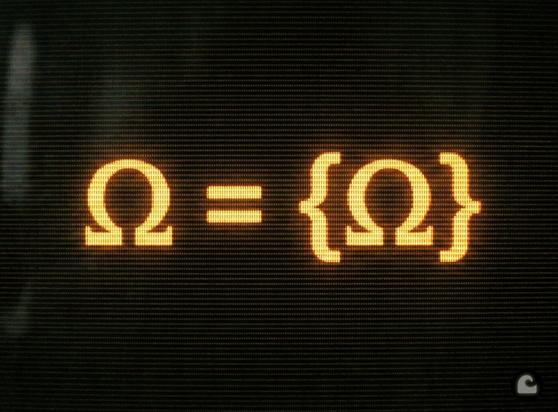
Thinking about non-well-founded set theory (Aczel 1988) and the Quine atom Ω = {Ω}.

Russell's paradox arises from self-reference in sets. But Aczel showed self-containing sets are consistent if you drop the Foundation Axiom.

Here's what I'm chewing on: Russell's paradox feels like a linguistic trap as much as a logical one. Sets are framed as containers (nouns). A container containing itself → paradox.

But Ω = {Ω} works because we're describing relationship, not containment. The set doesn't "hold" itself like a box — it refers to itself like a pattern.

Has anyone explored whether the noun/verb distinction (container vs. relationship) is doing hidden work in self-reference paradoxes?

Pointers to literature welcome.

#SetTheory #MathematicalLogic #SelfReference #FoundationsOfMathematics

@LeoTsai14 While they do not actually call it so, set theoreticians do a lot of work in a category in which the objects are the models of set theory and the arrows are the elementary embeddings (https://en.wikipedia.org/wiki/Elementary_equivalence#Elementary_embeddings) between them.
Models of (ZFC-like) set theories have the interesting property that the maps between them are to some amount determined by the mappings between their classes of ordinals: If this map is an isomorphism, the whole map is one (https://en.wikipedia.org/wiki/Critical_point_(set_theory)).
You may also have a look at inner model theory (https://en.wikipedia.org/wiki/Inner_model_theory), I think.

#SetTheory #ModelTheory #MathematicalLogic #Categories

Elementary equivalence - Wikipedia

Do we have any Gödel experts in the house?

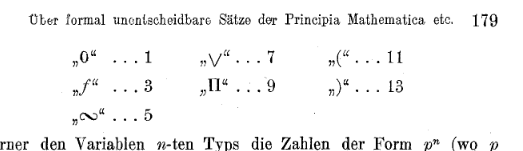
I'm trying to understand why Gödel used this encoding in the original Gödel numbering. To be clear, these are supposed to be the exponents in the unique factorisation 2ᵃ3ᵇ5ᶜ⋯, not the bases which are also coincidentally prime.

Why did Gödel pick prime exponents too?

And why did is the 0 assigned to the exponent 1 and not 2? Why is that first one not prime?

At first I thought this might be a typo in the inset figure in Wikipedia, but upon consulting the cited reference I saw that the same encoding is used in the original paper. https://en.wikipedia.org/wiki/G%C3%B6del_numbering#G%C3%B6del's_encoding

#GödelNumbers #MathematicalLogic

Logic of Relatives
https://inquiryintoinquiry.com/2024/08/05/logic-of-relatives-a/

Relations Via Relative Terms —

The logic of relatives is the study of relations as represented in symbolic forms known as rhemes, rhemata, or relative terms.

Introduction —

The logic of relatives, more precisely, the logic of relative terms, is the study of relations as represented in symbolic forms called rhemes, rhemata, or relative terms. The treatment of relations by way of their corresponding relative terms affords a distinctive perspective on the subject, even though all angles of approach must ultimately converge on the same formal subject matter.

The consideration of relative terms has its roots in antiquity but it entered a radically new phase of development with the work of Charles Sanders Peirce, beginning with his paper “Description of a Notation for the Logic of Relatives, Resulting from an Amplification of the Conceptions of Boole's Calculus of Logic” (1870).

References —

• Peirce, C.S., “Description of a Notation for the Logic of Relatives, Resulting from an Amplification of the Conceptions of Boole's Calculus of Logic”, Memoirs of the American Academy of Arts and Sciences 9, 317–378, 1870. Reprinted, Collected Papers CP 3.45–149. Reprinted, Chronological Edition CE 2, 359–429.
https://www.jstor.org/stable/25058006
https://archive.org/details/jstor-25058006
https://books.google.com/books?id=fFnWmf5oLaoC

Resources —

Charles Sanders Peirce
https://mywikibiz.com/Charles_Sanders_Peirce

Relation Theory
https://oeis.org/wiki/Relation_theory

Survey of Relation Theory
https://inquiryintoinquiry.com/2024/03/23/survey-of-relation-theory-8/

Peirce's 1870 Logic of Relatives
https://inquiryintoinquiry.com/2019/09/24/peirces-1870-logic-of-relatives-overview/
https://oeis.org/wiki/Peirce%27s_1870_Logic_Of_Relatives_%E2%80%A2_Overview

#Peirce #Logic #LogicOfRelatives #MathematicalLogic
#Mathematics #RelationTheory #Semiotics #SignRelations

Logic of Relatives

The logic of relatives, more precisely, the logic of relative terms, is the study of relations as represented in symbolic forms known as “rhemes”, “rhemata”, or “relat…

Inquiry Into Inquiry

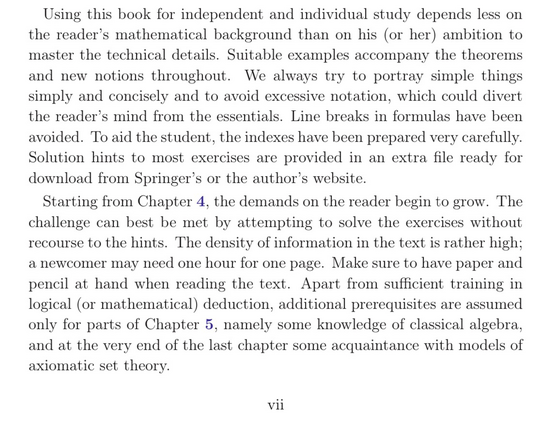
Novo semestre começando, revisando alguns conteúdos e formulações para o ensino de lógica matemática, computabilidade e prolog! #logic #mathematicallogic

Fonte: A Concise Introduction to Mathematical Logic, Wolfgang Rautenberg, Third Edition, Springer: 2010.

Peirce's 1870 “Logic of Relatives” • Selection 3.2
https://inquiryintoinquiry.com/2014/01/30/peirces-1870-logic-of-relatives-selection-3/

❝§3. Application of the Algebraic Signs to Logic❞

❝The Signs of Inclusion, Equality, Etc.❞

❝But not only do the significations of \(=\) and \(<\) here adopted fulfill all absolute requirements, but they have the supererogatory virtue of being very nearly the same as the common significations. Equality is, in fact, nothing but the identity of two numbers; numbers that are equal are those which are predicable of the same collections, just as terms that are identical are those which are predicable of the same classes.

❝So, to write \(5 < 7\) is to say that \(5\) is part of \(7,\) just as to write \(\mathrm{f} < \mathrm{m}\) is to say that Frenchmen are part of men. Indeed, if \(\mathrm{f} < \mathrm{m},\) then the number of Frenchmen is less than the number of men, and if \(\mathrm{v} = \mathrm{p},\) then the number of Vice-Presidents is equal to the number of Presidents of the Senate; so that the numbers may always be substituted for the terms themselves, in case no signs of operation occur in the equations or inequalities.❞

(Peirce, CP 3.66)

#Peirce #Logic #LogicOfRelatives #RelationTheory #LOR1870
#Boole #LogicalCalculus #MathematicalLogic #LogicalGraphs
#PropositionalCalculus #PredicateCalculus #CategoryTheory

Peirce&#8217;s 1870 “Logic of Relatives” • Selection&nbsp;3

Inquiry Into Inquiry
Related question: Is Tarski's fixed point theorem constructive, predicative?

Since Tarski's fixed point theorem can be proved by a sort of transfinite induction, how the answer of this question telated to the previous question?
#mathematicallogic #settheory

A question: is transfinite induction constructive?

Sure it would depend on the definition of ordinal, but how?
#mathematicallogic #settheory

Peirce's 1870 “Logic of Relatives” • Selection 2.1
https://inquiryintoinquiry.com/2014/01/29/peirces-1870-logic-of-relatives-selection-2/

❝§3. Application of the Algebraic Signs to Logic❞

❝Numbers Corresponding to Letters❞

❝I propose to use the term “universe” to denote that class of individuals about which alone the whole discourse is understood to run. The universe, therefore, in this sense, as in Mr. De Morgan's, is different on different occasions. In this sense, moreover, discourse may run upon something which is not a subjective part of the universe; for instance, upon the qualities or collections of the individuals it contains.

❝I propose to assign to all logical terms, numbers; to an absolute term, the number of individuals it denotes; to a relative term, the average number of things so related to one individual. Thus in a universe of perfect men \((\mathrm{men}),\) the number of “tooth of” would be 32. The number of a relative with two correlates would be the average number of things so related to a pair of individuals; and so on for relatives of higher numbers of correlates. I propose to denote the number of a logical term by enclosing the term in square brackets, thus, \([t].\)❞

#Peirce #Logic #LogicOfRelatives #RelationTheory #LOR1870
#Boole #LogicalCalculus #MathematicalLogic #LogicalGraphs
#PropositionalCalculus #PredicateCalculus #CategoryTheory

Peirce&#8217;s 1870 “Logic of Relatives” • Selection&nbsp;2

Inquiry Into Inquiry