@Sebastian
PS
unbedingte Leseempfehlung: Sydney Padua, The Thrilling Adventures of Lovelace and Babbage: The (Mostly) True Story of the First Computer

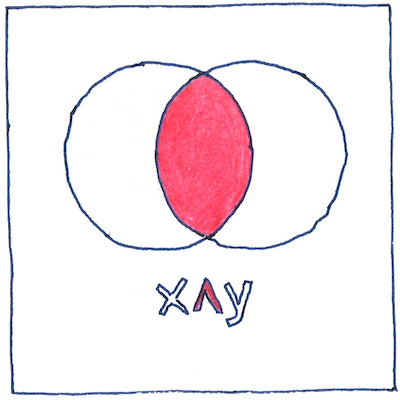
Aus dem Buch ist der Cartoon oben.
#boolean #boole #tea

Alicia #Boole au pays des #polytopes :

Au départ, il y a les cinq « solides platoniciens » vénérés en géométrie depuis l'Antiquité : le cube, le tétraèdre, l’octaèdre, le dodécaèdre et l’icosaèdre. Mais pourquoi s’arrêter aux 3 dimensions de l’espace ordinaire ? Alicia Boole Stott a consacré sa vie à chercher des solides réguliers en dimension 4… et elle a trouvé !

Une inspiration pour la future itération des #polyharmonies ;-)

https://www.arte.tv/fr/videos/107398-006-A/voyages-au-pays-des-maths/

Voyages au pays des maths - Alicia Boole au pays des polytopes - Regarder le documentaire complet | ARTE

Au départ, il y a les cinq « solides platoniciens » bien-aimés des géomètres : le cube, le tétraèdre, l’octaèdre, le dodécaèdre et l’icosaèdre.  Mais pourquoi s’arrêter aux 3 dimensions de l’espace ordinaire ? Alicia Boole Stott a consacré sa vie à chercher des solides réguliers en dimension 4… et elle a trouvé ! Voyage dans des régions mathématiques insoupçonnées par notre esprit.

ARTE
> Probability is expectation founded upon partial knowledge. A perfect acquaintance with all the circumstances affecting the occurrence of an event would change expectation into certainty, and leave neither room nor demand for a theory of probabilities.
https://gutenberg.org/ebooks/15114
#Boole #GeorgeBoole #StatisticsClass #GutenbergEbook
An Investigation of the Laws of Thought by George Boole

Free kindle book and epub digitized and proofread by volunteers.

Project Gutenberg
In 1847, George Boole developed Boolean algebra, on which all digital computers are based. #Poetry #Science #History #Logic #Boole (https://sharpgiving.com/thebookofscience/items/p1847b.html)
1847: Boolean algebra - The book of science

In 1847, George Boole developed Boolean algebra, on which all digital computers are based.

Overall thoughts: this is such a shockingly original work that no wonder it caught on slowly, and we can certainly forgive all errors and infelicities of presentation. #WSJevons (mentioned above) led one response by acknowledging #Boole 's insights but trying to fold them into the old paradigm. But with developments such as emphasing inference over equality, abandoning partially defined connectives, and new quantifiers to allow binary+ relations, the formal approach to #logic was unstoppable.
#Boole 's closing chapter, with untranslated quotes in French, Italian, and ancient Greek, was not an easy read, but he compares and contrasts the abstraction from physical observation to mathematics with his abstraction from thought to mathematical #logic , noting that correctness is a criteria that can be meaningfully applied to thought processes but not to physical ones; and observes that just as physical science cannot be entirely reduced to maths, so it is with the science of the intellect.
#FinishedReading #Boole 's Laws of Thought, whose final chapters partly shift attention from #logic to #probabilityTheory and #philosophyOfScience . I don't have a strong sense of his historical standing in either discipline, although for probability there is https://en.m.wikipedia.org/wiki/Boole%27s_inequality . The attraction of probability is clear, with its range of values from 0 to 1, use of '1 -' for negation, multiplication for conjunction (of independent events) etc. There are rhymes here with his logic at least
Boole's inequality - Wikipedia

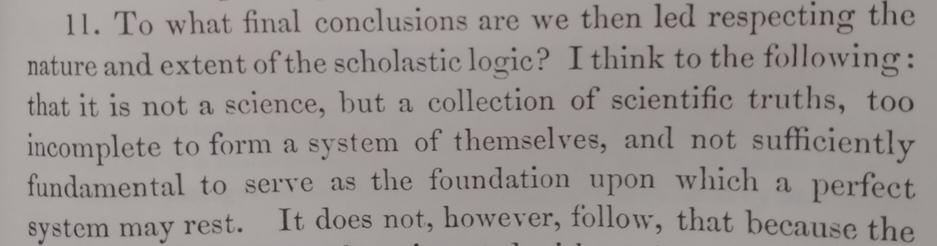
The section where #Boole compares his #logic with Aristotelian syllogisms, the dominant approach in the West for more than two millennia, would have been key for readers of the time. I imagine the attached quote would have been unbelievably spicy, but virtually nobody would disagree with it now. With the help of some tidying up and extensions from Peirce, Lewis, Schroeder, Frege etc, Boole's vision won comprehensively, and helped to build our modern world.
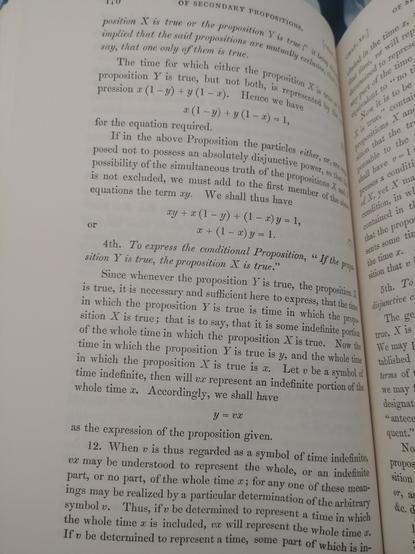
On page 170 we finally see the conditional, if-then. This is in a section on 'secondary propositions' which relate the truth of propositions. If y then x is not, perhaps surprisingly given #Boole 's mission to arithmetise #logic , encoded as the exponent xʸ, but instead via introduction of a new unknown v, as y=vx (v and x). Given that conjunction as multiplication led us to elimination via semantically dubious propositional division, I suppose I should feel lucky we avoided logical logarithms!