I'll be slinging my literary horror novels at Art a Whirl here in Minneapolis. Come check it out. I've heard all the good many things about it. Art be whirling.

#artawhirl2026 #books #events #booksale #writing #amwriting #reading #amreading #literaryhorror

https://patrickwmarshauthor.wordpress.com/2026/05/15/visit-me-selling-my-books-at-art-a-whirl-2026/

Visit me Selling my Books at Art A Whirl 2026

Alright, pretty self explanatory. I’ll be at Art A Whirl all weekend selling my books. Art A Whirl is an awesome event, and this is my first time at it. So I guess I assume it’s awesome…

Patrick W. Marsh

Read my Poem “A Junkyard Father” Published on Altered Reality Magazine

Hello again! I recently had a trifecta of luck at Altered Reality with some poems, and this is my second one that was picked up for publication by them.

This week the poem is a little different than my previous one. No haunted forest or paradoxical monsters.

Instead, I choose to focus on an image that has haunted me ever since I watched it. The toy scene in Bladerunner (director’s cut of course) in Sebastian’s attic has stuck with me ever since I watched it back in 2004. I often wonder what would those cybernetic creations do if Sebastian never returned.

Who would take care of them?

In “A Junkyard Father” I follow this same idea and principle. A scientist has created sentient toys in some robotic future, and he is confronted with the concept of mortality. When he dies and leaves this world, they’ll be nobody to take care of them. The toys will outlive him, and still require maintenance. He’ll die when they could potentially live for centuries.

How will they cope? Who will be there?

You can read “A Junkyard Father” right here.

As always, you should check out the whole of Altered Reality. They publish great stuff from a variety of voices.

Thank you for reading my work, and have a nice Wednesday!

#author #blogging #books #fantasy #fiction #horror #horrorPoetry #literaryHorror #monsters #patrickWMarsh #poem #Poetry #scienceFiction #theGreenlandDiaries #writing

New poem published by Altered Reality Magazine. This time it is more science fiction than horror. You can learn about that poem in the link attached. Happy reading!

#poetry #poems #literaryhorror #horror #writing #amwriting #amreading #reading #sciencefiction #speculativepoetry #scifi

https://patrickwmarshauthor.wordpress.com/2026/05/13/read-my-poem-a-junkyard-father-published-on-altered-reality/

Read my Poem “A Junkyard Father” Published on Altered Reality Magazine

Hello again! I recently had a trifecta of luck at Altered Reality with some poems, and this is my second one that was picked up for publication by them. This week the poem is a little different tha…

Patrick W. Marsh

Just read the first chapter of 'Bat Eater and Other Names For Cora Zeng' by Kylie Lee Baker.

Already I feel the hype is warranted. The prose is pristine, smooth like the edge of a cared-for knife. There's a litfic approach to interiority; I've got a strong sense of who Cora Zeng is and the ways in which she moves through the world. The horror side is on point, too. No half-measures when the blood pours.

I'm hooked.

#horrorlit #LiteraryHorror #books #bookstodon

Sugar Beets

They planted sugar beets over the dead.

This was the first thing the old woman told me, and she said it without looking at me, as if the sentence itself were a window she dared not face.

We were standing at the edge of the field beyond Demmin, where the earth sank and rose in shallow, uneven swells. It was late autumn. The beet leaves lay dark and rubbery against the soil, wide as tongues, veined like the hands of the very old. Beyond them the river moved with the dull patience of something that had learned not to answer questions.

“You are writing a history?” she asked.

“A story,” I said.

“That is worse.”

Her name was Frau Ilse Kröger, though she had been a child when the town burned and the people went down to the water. Her coat was buttoned to the throat. Her hair, white and thin, had been pinned so tightly that her face seemed pulled backward by memory.

“You must not make ghosts of them,” she said.

“I thought perhaps they already were.”

At that she turned to me. Her eyes were pale, not weak, but faded by long endurance.

“No,” she said. “Ghosts are the dead who cannot leave. These were the living who were not allowed to remain.”

The wind moved through the beet leaves. They rustled low to the ground, not like plants, but like a crowd whispering with its face in the dirt.

I had come to Demmin because of a sentence in an old magazine, a line in a later book, a footnote beneath a national silence. Some said seven hundred. Some said a thousand. Some said more. The numbers rose and fell like bodies seen through river water. There had been war, terror, propaganda, vengeance, collapse. There had been flames in the town and soldiers in the streets and stories told so often in fear that fear itself became a door. Mothers carried children to the river. Men tied themselves to stones. Families vanished into reeds. The Peene, the Tollense, the Trebel—all waters became witnesses.

And afterward, when the new order came, the dead were inconvenient.

So they let grass grow high.

Then they plowed.

Then they planted sugar beets.

There is a peculiar obscenity in sweetness drawn from such soil.

I asked Frau Kröger if she remembered the field.

“I remember my mother’s hand,” she said. “I remember the smoke. I remember how the sky looked too low, as though God had leaned down to see and then could not bear to look any longer.”

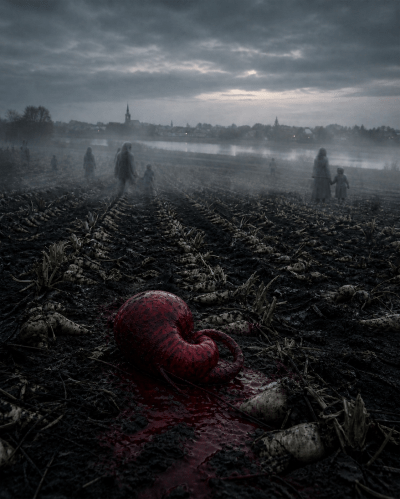
We walked along the furrows. The earth clung to our boots in black-red lumps. Here and there the beets pushed up from the ground, pale shoulders emerging from darkness. They resembled skulls that had changed their minds and decided to become vegetables.

“Did anyone speak of it later?” I asked.

“Not aloud.”

“But in homes?”

She stopped.

“In homes most of all we did not speak.”

The field seemed to hear this and approve.

That night I stayed in a small room above an inn where the wallpaper peeled in long strips like shed skin. The radiator hissed. The window looked toward the rivers, though I could not see them, only a blackness where the land dropped away.

Near midnight, I woke to the smell of wet soil.

At first I thought I had dreamed it. But the smell thickened—earth, roots, river mud, and beneath it a faint sweetness, cloying and raw, like sugar spilled in a cellar.

Then came the sound.

Scraping.

Not at the door. Not at the window.

Under the floor.

I sat up.

The boards beneath the bed gave a soft, deliberate creak, though I had not moved. Then another. Then many small sounds together: scratching, pressing, shifting. Like roots growing upward. Like fingernails beneath wood.

I lit the lamp.

Nothing.

The room was ordinary again, ordinary in the way a corpse can be ordinary once the scream has left it.

I did not sleep. Toward dawn I looked from the window and saw, in the paling gray, a line of figures walking beyond the last houses toward the fields. They were indistinct, blurred by mist, and moved slowly, not like soldiers, not like mourners, but like people following instructions they no longer understood.

At breakfast, I asked the innkeeper whether there was a memorial nearby.

He wiped the counter though it was already clean.

“There is a stone,” he said.

“A stone?”

“For those who need stones.”

“And for those who need truth?”

He looked at me then with a kind of pity.

“Truth?” he said. “Truth is heavy. People say they want it, but mostly they want a stone small enough to walk past.”

Later I returned to the field alone.

The beets had been harvested in part. Great heaps stood near the road, pale and earthen, piled like bones awaiting judgment. A truck had left deep tracks in the mud. Crows hopped among the clods.

Near the center of the field I found a place where nothing grew.

It was not large. A rough oval of bare ground. The soil there was darker than the rest and soft despite the cold. I knelt and pressed my fingers into it. Water welled up at once.

Not rainwater.

River water.

It rose around my hand, cold and brown, though the rivers lay some distance away. I pulled back, startled. The little hollow filled silently, reflecting the sky. In its surface I saw, not my own face, but the white blur of beet roots hanging downward, though there were no plants above it.

Then a voice behind me said, “Do not dig.”

Frau Kröger stood at the edge of the furrow.

“I wasn’t.”

“You were thinking of it.”

That was true.

She came closer, slowly, leaning on her cane. “There were men who dug after the war. Men who made lists. Men who counted what could be counted and buried what could not. But later the counting became dangerous.”

“Because it accused someone?”

“Because it accused everyone.”

The wind pressed her coat flat against her body.

“The dead asked too many questions,” she said. “Why did you believe the lies? Why did you fear more than you loved? Why did you stay silent? Why did you come too late? Why did you plant over us?”

A crow called from the beet heap.

“And now?” I asked.

“Now they ask nothing. That is worse.”

From the hollow in the ground came a faint sound like breathing.

Frau Kröger heard it too. Her face tightened.

“When I was a girl,” she said, “we stole beets from this field. Children are always hungry after wars. My brother carried one home under his coat. My mother slapped him when she saw where it came from. Not because he stole. Because he brought it into the house.”

“What happened?”

“She cooked it.”

I stared at her.

“What else could she do? We were hungry.”

Her mouth trembled. Not with tears, but with a terrible, bitter smile.

“It was sweet,” she said. “That was the worst of it.”

The hollow had widened.

Water slipped along the furrows now, thin shining lines threading through the field. The beet leaves stirred though the wind had fallen. From beneath the soil came a low murmur, not words, but the sound of many people speaking with mouths full of earth.

Frau Kröger gripped my arm.

“You wanted your story,” she whispered. “Here it is. This town did not bury the dead. It buried the question of why the living could be driven to the water. It buried fear. It buried shame. It buried the terror of armies and the poison of the Reich and the helplessness of mothers and the guilt of neighbors and the convenience of silence. Then it planted sugar over all of it and called the sweetness harvest.”

The ground shuddered.

One beet near my boot loosened itself. Its root twisted upward, slick with mud. For one instant it looked horribly like a hand.

Then another rose.

Then another.

All across the field the sugar beets began to lift from the earth, not quickly, not violently, but with the slow resolve of the dead being remembered. Soil broke. Leaves trembled. Pale roots emerged, round and blunt, each carrying clots of black mud. The heaps by the road shifted and rolled, collapsing outward.

The air filled with sweetness.

Too much sweetness.

The kind that coats the throat and makes breathing difficult.

From the direction of the river came bells. Not church bells. Smaller. Duller. As if stones were striking beneath water.

Frau Kröger began to pray, but not in words I knew. Perhaps no language survived intact in her after that year. Perhaps prayer, after such things, becomes only the soul refusing to be silent.

The water in the furrows deepened. It ran around our boots. The field had become a map of rivers, every row a tributary, every hollow a mouth.

Then I saw them.

Not ghosts exactly.

Figures in the mist, standing among the beets. Women in dark coats. Children with pale faces. Old men bent beneath invisible burdens. They did not accuse. They did not plead. They only stood where the earth had held them, gazing toward the town that had gone on living.

Their silence was unbearable.

I wanted them to speak. I wanted a curse, a revelation, a sentence to carve onto stone. But they gave none.

That was their judgment.

They had been made into numbers, then rumors, then taboo, then crops. They had been reduced to a place one passed without lowering one’s voice. Now they returned not to frighten the living, but to make evasion impossible.

Frau Kröger stepped forward into the water.

“I remember,” she said.

The figures did not move.

“I remember,” she said again, louder.

The mist thickened around her.

“I remember my mother’s hand. I remember smoke. I remember the river. I remember the field. I remember that we ate what grew here. I remember that we did not speak. I remember.”

At that, the sweetness in the air broke.

Not vanished. Broke.

Like a fever.

Like a spell.

The beet roots sank back into the soil. The water withdrew into the furrows. The figures faded, though their absence remained visible, like the shape left on a wall after a picture is removed.

Frau Kröger stood very still.

When I helped her back to the road, she was weeping soundlessly.

“Will you write it?” she asked.

“Yes.”

“Then do not make it beautiful.”

I looked across the field. Dawn had begun to rise, gray and reluctant. The town lay beyond us, roofs dark, windows catching the first weak light. Somewhere a church bell rang the hour. Somewhere bread was being sliced. Somewhere children were waking without knowing what slept beneath the ground that fed them.

“I don’t know how to write such a thing without beauty,” I said.

She nodded, as if this were the oldest failure of language.

“Then make the beauty ashamed of itself.”

Years later, when I think of Demmin, I do not first think of death.

I think of sugar.

White crystals in a bowl. Sweetness stirred into coffee. Cakes dusted for weddings. Beet fields under a low northern sky. The ordinary miracle by which earth becomes food.

And I think of what the earth remembers when we do not.

For every country has its sugar beet field.

Every people has some place where the dead were covered, where the official mouth closed, where the plow passed over grief and called it necessity. Every age plants something over its horror and prays the harvest will be useful.

But beneath the sweetness, the roots know.

Beneath the furrows, the waters wait.

And sometimes, when the wind lies down and the mist comes low over Demmin, the field begins to whisper—not to the dead, who already know, but to the living, who still pretend they do not:

Remember us before we rise.

#aftermathOfWar #buriedMemory #collectiveTrauma #darkGothicFiction #Demmin #DemminGermany #EastGermany #forgottenDead #Germany1945 #ghostStory #GothicHorror #gothicLiterature #gothicTale #grief #hauntedFields #haunting #historicalFiction #historicalHorror #literaryHorror #massSuicide #memoryAndSilence #moralHorror #NevermoreAndOtherShadows #PeaceGroovesFiction #PeeneRiver #postwarGermany #sugarBeetField #SugarBeets #symbolicHorror #tabooHistory #tragicHistory #warTrauma #WorldWarII

Read my Poem “Windchimes” Published on Altered Reality Magazine

Hello! Recently I was lucky enough to have my poem “Windchimes” published by Altered Reality last week.

This was one of the first horror poems I had written after a long absence from poetry. I started writing poetry again back in the beginning of 2024. The women I was dating at the time was a poet, and she often would send poems for me to read. At the time I was still thinking I could only do one thing as a writer, like self-publish fiction. That isn’t true. You can be varied. You get to practice your craft on multiple highways.

Anyways, she was curious about my poetry, or if I could even still write it. So, as it happens that sometimes men are simply motivated by women, I decided to try my hand at it, and poetry clicked again after about a decade of absence.

Windchimes” is about a group of monsters in a haunted forest who hang windchimes in the trees to warn people travelling through that they are there, and that the woods is dangerous. It is about how evil attempts to warn you about its intentions, so you avoid it. Or at least you would try It focuses on how frustrated the evil entities are with this paradox. I love this poem, and I’m happy to see it has a home.

You can read it right here.

Also, Altered Reality is an excellent publication. Please take some time to explore its various voices. You can find it right here.

Thanks for reading!

#alteredReality #author #blogging #books #fantasy #fiction #horror #horrorPoetry #literaryHorror #literaryMagazine #monsters #patrickWMarsh #poem #poems #Poetry #publications #writing

I had my poem "Windchimes" published by Altered Reality. You can find out more details about it below, including where to read. it Have an awesome day!

#poetry #poems #literaryhorror #horror #writing #amwriting #amreading #reading #horrorpoetry #monsters

https://patrickwmarshauthor.wordpress.com/2026/05/06/read-my-poem-windchimes-published-on-altered-reality/

Read my Poem “Windchimes” Published on Altered Reality Magazine

Hello! Recently I was lucky enough to have my poem “Windchimes” published by Altered Reality last week. This was one of the first horror poems I had written after a long absence from po…

Patrick W. Marsh

Big update about my recent publications, new book out in the summer, and other various ramblings. Thank you for continuing to support my voice and work. Details in the post:

#amwriting #amwritingliteraryhorror #literaryhorror #horror #writing #poetry #blogging #writingupdate #reading #amreading

https://patrickwmarshauthor.wordpress.com/2026/04/29/writing-update-4-29-26/

Writing Update 4/29/26

Back. I’m not just some mindless story promoting, blog posting bot from the depths of some tungsten hades. I’m still here, lurking in the shadows like some sort of specter in a two-stor…

Patrick W. Marsh

She Ate the Patriarchy and I Cheered: My Review of Trad Wife

Subscribe to keep reading

It's a subscribers only post. Subscribe to get access to the rest of this post and other subscriber-only content.

Subscribe #bodyHorror #BookReview #darkFiction #domesticHorror #feministHorror #literaryHorror #motherhoodHorror #PsychologicalHorror #tradWifeCritique #womenSAutonomy

Big Ears

The dog heard it first.

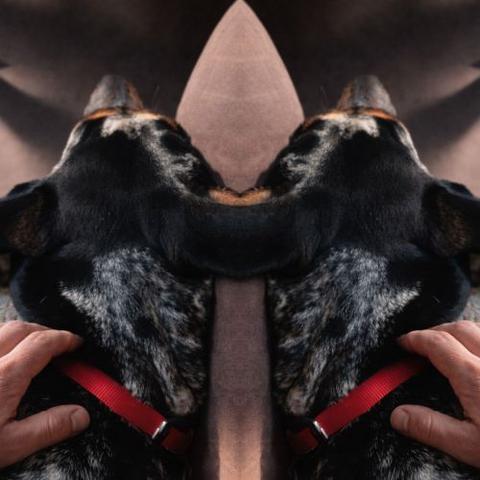
She had come in from her walk with the cold still caught in the long velvet tips of her ears. A bluetick coonhound, broad-chested, heavy-pawed, soft-eyed, and possessed of those famously oversized ears that made her at once noble and faintly comical, she was called many names by her owners, sometimes Pup though she was long past that stage, sometimes Hound, sometimes Girl, and sometimes, when the mood was especially tender, simply Sweetie. She did not trouble herself over names. It was enough that the voices warmed when they used them.

Their walk had been a long one by the standards of the morning, through the damp margins of the little town, along the edge of yards and roadside ditches and bare spring trees where every trunk and post and tuft of grass was rich with messages. Her humans called such walks snifaris, and though she did not know the word as a word, she understood the spirit of it. It was a grand survey of the world. The news of rabbits. The scandal of squirrels. The old musk of raccoon passage in the night. The thin and fading trace of a cat. The cold iron tang of dew on culvert mouths. The living and the dead all left their signatures there, and she read them with grave devotion.

When at last they returned, she drank, circled once in the living room, and then, as was her wont, climbed onto the sofa beside him with the untroubled certainty of a creature much forgiven.

It was a quiet room, made golden now by the morning. The large picture windows on the eastern wall received the rising sun with such openness that it seemed at times less a house than a lantern. Dust motes drifted in the slanted light like ash that had forgotten its fire. The furniture was simple, worn by use rather than age, and warmed by the small evidences of habitation: a folded throw on the chair arm, a mug on the side table, a book left face down, a blanket not quite put away. In the corners sat  plants bright green and blooming. Near the window hung a small tapestry from the recent time when  they had gone away, and she had spent time in the place with others of her kind. She hadn’t minded, but being a shelter dog, there had been a faint fear of they not returning for her.

Now she lay close beside him as he sat with coffee in one hand and his phone in the other, though from time to time he set the phone aside and took up a pen, scribbling in a notebook on his knee. His mornings belonged to prayer, reflection, writing, and the small untidy labor of trying to make sense of being alive. He did not always succeed. Indeed, lately, he felt he succeeded less and less. The world had become loud with strain, though not always in ways that could be named. It groaned beneath its own arrangements. Even here, in this town that still appeared to outsiders as modest and decent and removed from the great engines of calamity, he could feel it at times: a pressure beneath appearances, as if something immense and ill-disposed were passing below the surface of things.

The dog, however, rested.

At intervals she sighed, long and contented, and her breathing deepened beneath his hand as he scratched absently behind her ears. Sometimes he tapped at the phone. Sometimes he paused to sip from the mug, the quiet clink of ceramic seeming part of the room’s own pulse. Once or twice he looked up at the sun moving over the distant low hills. Once he closed his eyes, and the red warmth on his eyelids seemed almost liturgical.

Beside him, the hound dreamed.

Her paws twitched. Her jowls fluttered faintly. Somewhere in whatever shadowed and boundless territory dogs enter in sleep, she was in pursuit of some endlessly receding quarry. It fled, and she followed, as she had followed countless phantom creatures before it through the chambers of instinct and memory.

Then she woke.

Not all at once. Not with a bark or start or violent convulsion. First a change in breath. Then stillness. Then the slow lifting of the head.

He did not notice immediately.

The dog held herself motionless, one forepaw bent slightly inward against the cushion, her ears lifted, though not yet fully pricked. Her eyes were open but not alarmed. She was listening.

To him, the room remained undisturbed. The same light. The same coffee. The same measured peace of another morning in rural Ohio.

Then he felt rather than saw the shift beside him and glanced down.

“What’s up, girl?”

Her gaze did not come to him. It remained fixed toward the windows.

He smiled faintly and scratched her neck, feeling the warm thickness of her fur and the loose skin there. “What is it?”

The dog rose halfway, then settled again without relaxing. A faint line appeared above her eye. Her nostrils worked once, twice. She was not smelling prey. Not exactly. Nor danger in any old familiar sense. Not stranger, not delivery truck, not another dog passing outside. Nothing so ordinary. Her attention had entered a realm beyond his.

He followed her stare to the eastern windows.

Outside, the day was almost offensively beautiful. The yards still held some lingering wetness from recent rain. Beyond them, the town sat in its usual repose, roofs and steeples and utility lines gradually kindling under the sun. The hills in the distance wore that blue-gray softness which made them seem farther away than they were. A few branches stirred. Somewhere, though not in sight, a vehicle passed. Nothing was wrong. The world, in all its surfaces, remained unbroken.

Yet the dog did not lie back down.

Something in her unease reached him, not by logic but by the old subterranean grammar through which one creature may come to know another. He had always loved animals, especially dogs. There had never been a time in his life when the shape of one had not seemed to him a kind of grace. He had trusted them before he trusted many people. They possessed a moral clarity that humans had too often abandoned. Not innocence, exactly—they could be stubborn, sly, destructive, impolite—but a clarity, a wholeness of intention.

His bond with this hound had deepened more quickly than he would have expected. Perhaps because of her gentleness. Perhaps because of the comic solemnity of her face. Perhaps because he had reached an age where every arrival felt touched by mortality, and every new affection carried with it the ache of its future loss.

His eye drifted, almost without purpose, to the old photograph on the shelf.

There he was, a tiny child by a fence, one hand extended toward the family hound. He had been told the story often. How inseparable they were. How the dog would watch over him. How he, still hardly able to form sentences, would babble to it with grave conviction as if the two shared a private language. Looking at the photograph now, he felt the curious folding of years. More than half a century had passed, and still a hound had found him.

He smiled and looked back at the dog on the sofa.

She had not moved.

A low breath came through her nose. Not yet a whine. Not even distress. Only alertness so complete it seemed almost ceremonial.

He set down his mug.

“What do you hear?”

She turned one ear slightly, as though at the shape of his voice, but her gaze remained outward.

He listened now, not because he heard anything but because she did. The house answered him with its usual murmurs: the faint settling creak in the wall, the hush of forced air moving somewhere deep in the vents, the nearly inaudible hum of appliances carrying on their hidden labor. Beneath it all was the larger silence of morning, which is never truly silent but rather made of countless soft obediences—wood, fabric, glass, breath, heat, distant birds, the earth itself turning toward day.

Nothing.

Still, he found he did not wish to resume writing. The page on his knee now seemed curiously beside the point. What he had been trying to articulate a few moments before—something about sorrow, perhaps, or history, or prayer in an age of noise—had drained of urgency. He slipped the pen into the notebook and rested both on the table.

The dog’s body had grown tense beneath its stillness.

Again he looked outside.

The light had strengthened. The sun, now risen above the hills, reached directly through the windows and painted pale bars across the floorboards. The room, rather than becoming cheerful, seemed instead overexposed, as if too much revelation had entered it. Corners that ought to have softened in morning light appeared stark. The objects around him felt at once more present and less secure, their edges sharpened by illumination. It came to him—not as a thought exactly, but as an intuition—that there are mornings when light itself seems merciless.

He shut his eyes for a moment.

Red flared against the lids. He prayed, if what he did in such moments could still be called prayer. Not always petitions. Often only a held silence, or a wordless lifting of grief, or the simple attempt to remain open to what was good in a world increasingly organized against goodness. Lately even prayer felt burdened, as though heaven itself had grown crowded with the unspeakable.

Beside him, the dog gave a sound.

He opened his eyes at once.

Not a bark. Not even a proper whine. Something smaller. A thin involuntary note, almost embarrassed of itself, drawn from deeper than the throat.

He put his hand on her side.

Her muscles were hard.

He asked again.

“What is it, girl?”

Her ears, those great expressive ears, were fixed now with uncanny intensity toward the east. Their cold tips trembled almost imperceptibly.

He listened again.

And this time, perhaps because he had been tutored by her attention, or perhaps because whatever approached had crossed at last into the gross coarser world of human sense, he thought he perceived something.

Not a sound, exactly.

A pressure.

Then something like a murmur at the farthest edge of hearing, so faint he nearly dismissed it as blood in the ears, or memory, or the mind’s bad habit of inventing patterns when given too much quiet in which to work.

He stood up.

The dog stood too, suddenly, all at once, with startling force for so gentle a creature. Her claws pressed into the cushion. Her chest leaned toward the window. A strand of drool caught briefly at her lip and shone in the sun.

He stepped closer to the glass.

The yard lay ordinary and helpless before him. Grass. Driveway. Fence. The road beyond. The neighbor’s tree. No movement. No vehicle. No person. Above, the sky was a cold, widening blue without visible threat.

Still that murmur remained.

It might have been thunder, he thought.

Yet the sky held no weather.

It might have been an aircraft, though not one he could see.

It might have been nothing. It might have been the old machinery of dread, self-winding and unreasonable, fed by too much reading, too much news, too much inwardness, too many mornings spent tracing fracture lines in the age.

He nearly laughed at himself then.

But the laugh did not come.

The dog emitted a longer sound now, a low strained whine that seemed less vocal than visceral. It vibrated through her whole frame. He turned from the window and looked at her fully.

There was no mistaking it now. She was afraid.

Not excited. Not curious. Not guarding. Afraid.

He crossed back to her and laid a steadying hand upon her neck. Her fur there was warm, and beneath it her pulse beat rapidly. She leaned into him without taking her eyes from the window, as if torn between the need to flee and the need to remain near him. He felt, absurdly and tenderly, that he ought to apologize to her for not understanding.

Outside, the morning seemed to hold its breath.

Inside, the room narrowed around the two of them—the dog, rigid and listening; the man, baffled and beginning at last to feel that old ancestral stirring by which the body knows before the mind permits itself knowledge.

The murmur deepened.

Now it was unmistakable. Not loud, but real. A faraway grinding note. A distant mechanical throat clearing itself in the heavens.

He looked east again, squinting into the hardening light.

Nothing.

Nothing but the bright rim of day and the low line of hills and the whole innocent arrangement of things.

The sound grew.

So gradually at first that one might still have denied it, one might still have said no, that is only wind, only imagination, only some truck on the far road, only some crop duster miles off, only some passing thing with no relation to me. But the body is a poor liar when terror nears. He felt it in his chest now, not as pain but as occupation, as if the air before him were being taken over by a force with intentions of its own.

The dog’s whine sharpened.

He moved toward the glass again, and this time laid a hand upon it as if to feel through the pane what the air itself could not yet declare.

The murmur became a growl.

A second later, a whirring undertone joined it, and then a rising pitch, thin and vicious as a blade being drawn very fast across the sky.

He frowned, trying still to make it make sense.

The sun flashed so fiercely on the window that for an instant he saw only reflection: his own shape dimly superimposed upon the yard, the hound behind him on the sofa, the room suspended like a frail lantern against the day.

Then the dog cried out.

It was not a bark. It was a raw, broken sound, almost human in its terror.

He turned—

—and the great shadow passed before the sun.

For one impossible instant the whole room darkened.

Then the missile hit.

#ApocalypticFiction #bigEars #BluetickCoonhound #CanineIntuition #darkFiction #DogAndHuman #DogStory #DomesticUnease #EverydayApocalypse #GothicAtmosphere #GothicFiction #houndDog #HumanAnimalBond #literaryHorror #MissileStrike #OhioStory #OminousMorning #PeaceAndCatastrophe #QuietHorror #ReflectiveFiction #shadowAndLight #shortStory #SmallTownOhio #StoryIllustration #SuddenHorror #TheDogHeardItFirst #TitlePageArt