 Slow Mover
Cenotaph
A Tale of Love Beyond the Tomb
I went each evening to the tomb because the dead had no one else.
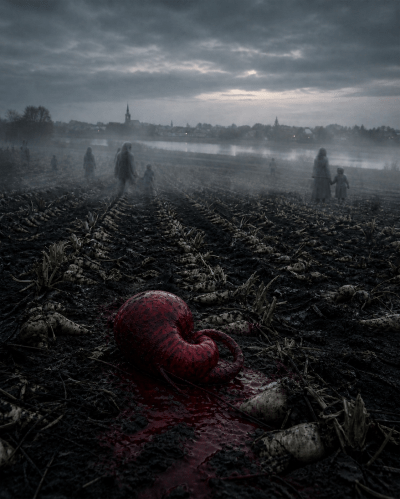
It stood beyond the last lamps of the village, where the road narrowed into a path and the path, in time, surrendered itself to nettles, thorns, and the pale roots of ancient trees. There the hill rose like the back of some buried beast, and in its side, half-swallowed by ivy and weather, was the stone door behind which my beloved lay.
No name remained upon the lintel. The rain had taken it. Or the years. Or perhaps those who had carved it had done so lightly, as if afraid that naming the dead too deeply would make death more permanent. But I knew the place. I knew the stone. I knew the silence that gathered before it like a servant waiting for orders.
I had seen the black carriage pass beneath the sycamores. I had heard the bell. I had stood among the mourners while the wind pressed their coats against their bodies and made their veils tremble like wings. I had watched the door sealed with mortar. I had watched the priest lower his head. I had watched the others turn away.
Afterward, when they returned to their bread, their fires, their sleep, I remained.
Then I came the next evening.
And the next.
And in this way the years began.
I brought what the seasons allowed. In spring, violets. In summer, white roses stolen from the wall of the abandoned rectory. In autumn, red leaves that looked already wounded. In winter, when the earth refused all tenderness, I brought my breath cupped in my hands, warming nothing.
I never came armed.
This was often remarked upon in the village, though never to my face. The road was lonely. Wolves had once been seen in the upper wood. Worse than wolves, it was said, were the men who slept in the ruined mill and came out at dusk with knives beneath their coats. But I carried no pistol, no blade, no staff. I carried only the small candle I lit upon the lowest step.
I do not know why I refused protection. Perhaps because grief itself had rendered me defenseless. Perhaps because one does not visit the beloved as though entering battle. Perhaps because I believed, with a conviction I never spoke aloud, that no evil thing would dare approach a tomb already so well attended.
At the stone door I always said the same words.
“I have come.”
Nothing more.
It seemed enough.
In the beginning I wept. Later I spoke. Later still I sat in silence until the candle guttered and the darkness of the wood became one with the darkness of the tomb. There were evenings when I told small things: that the baker’s daughter had married the cooper’s son; that lightning had struck the church spire but spared the bell; that the old dog who used to follow the funeral processions had died beneath the market table; that the village had forgotten certain songs.
There were other evenings when I confessed what I dared not tell the living: that I had grown envious of those whose dead were buried in the churchyard, near bells, near footsteps, near the innocent disturbances of children; that I sometimes feared the face within the tomb had altered beyond recognition; that I could no longer remember the exact sound of the voice I had loved, only the wound it left by ceasing.
Still I came.
The villagers first pitied me. Then they avoided me. Finally they made of my devotion a superstition.
Mothers frightened their children with me. Do not linger after dusk, they said, or you will see the mourner on the hill. Young men, drunk on harvest ale, dared one another to follow me, but none came farther than the black pond where the reeds whispered without wind. Once I found a crude figure made of straw hanging from a branch near the path. It wore a scrap of mourning cloth. I took it down, carried it to the tomb, and burned it in my candle flame.
The smoke drifted beneath the door.
That was the first time I thought I heard movement within.
It was faint. So faint that a sensible mind would have named it settling stone, or a root shifting in the earth, or the sigh of air through cracks. But grief does not possess a sensible mind. Grief has ears everywhere. Grief hears the dead turning over beneath the world.
I placed my palm against the door.
The stone was cold.
“I have come,” I whispered.
From within there came nothing.
Yet after that night, the tomb seemed changed.
Not opened. Not visibly disturbed. But alert. The ivy appeared to have loosened its grip around the lintel. The candle flame bent toward the door though no wind touched it. The flowers I laid upon the step vanished by morning, though no animal tracks marked the earth.
At first I thought the villagers had stolen them to mock me. But who among them would climb that path before dawn? Who would dare lay fingers upon offerings given to the dead? No. Something received them.
This knowledge, if knowledge it was, neither comforted nor terrified me. It merely deepened the ritual. I brought better flowers. I trimmed the candle wick. I brushed dead leaves from the threshold. I spoke less and listened more.
Years passed.
The village altered as villages do, by slow betrayals. The mill collapsed inward. The inn changed hands. Children became adults and looked at me with the same uneasy curiosity their parents once had. The priest died and was replaced by a younger man with pale eyes and clean hands. He once stopped me near the church gate and asked, gently, whether I thought my nightly pilgrimage was good for my soul.
“For my soul?” I asked.
“Yes.”
I looked past him to the churchyard, where the dead lay safely labeled beneath crosses and stones, each one accounted for, each one furnished with a place among the living.
“My soul,” I said, “is not buried here.”
He did not trouble me again.
There were nights when I almost believed the tomb loved me in return.
In rain, the threshold remained strangely dry. In winter, no snow gathered against the door. Once, when fever shook me so violently that I could scarcely climb the hill, I found the stone warm beneath my hand. Another night, upon arriving late, I discovered my candle already lit.
I knelt before it a long while.
I told no one.
For who could have understood? Those who have never loved the silent dead think silence is empty. They do not know how crowded it is. They do not know the multitude that gathers in one withheld word, one vanished face, one unopened door.
My body failed before my devotion did.
First the breath. Then the knees. Then the hands, which trembled so badly that I spilled wax upon the stone. I began to leave earlier each evening and return later, for the path grew longer though the hill did not move. Some nights I slept beside the tomb, waking before dawn with frost in my hair and my cheek against the step.
It was then that the dreams began.
I dreamed I stood inside the tomb. Not outside, not kneeling at the threshold, but within. The chamber was larger than it could possibly be, descending far beneath the hill by corridors of black stone. Niches lined the walls, and in each niche lay something I had lost: a child’s shoe; a broken instrument; a letter never sent; a lock of hair; a bowl of soup cooling beside an empty chair; a song I had once intended to write; a prayer abandoned halfway through because no answer came.
At the end of the corridor was a door.
Behind it, someone breathed.
I would wake with soil beneath my fingernails.
The last evening came in November.
All day the sky had lowered until it seemed the world was trapped beneath a lid of iron. Crows gathered on the church roof. The air smelled of rain and extinguished lamps. Villagers later said they watched me pass and knew something final moved beside me, though I walked alone.
I carried no flowers. None remained. I carried no candle either, for my hands could no longer shield the flame.
I climbed slowly.
The black pond gave back no reflection. The trees did not stir. Even the brambles seemed to withdraw from the path, as though making way for what had already been decided.
When I reached the tomb, the door stood open.
Not wide. Only a little. Enough for the dark to show itself.
I was not afraid.
Or if I was, fear had become indistinguishable from longing.
For many years I had spoken through stone. Now the stone had answered.
I pressed my shoulder to the door. It yielded with a sound like a breath being taken after long restraint. The darkness inside was complete, yet not hostile. It surrounded me with the intimacy of closed eyes.
I stepped in.
The chamber was smaller than my dreams. Bare walls. Low ceiling. A shelf cut into the rock. Earth beneath my feet. The air held no corruption, no sweetness of decay, no ancient bitterness of sealed flesh. It was cold and pure.
I reached toward the shelf.
My hand found nothing.
I searched the chamber wall to wall. My fingers swept stone, dust, root, emptiness. There was no coffin. No shroud. No bone. No ring. No remnant of the beloved body to which I had given my years.
Nothing.
Only then did I understand what the word meant.
Not tomb.
Not grave.
Cenotaph.
The realization did not strike like lightning. It opened beneath me like a floor giving way.
All those evenings. All those flowers. All those whispered reports from the world. All the candles. All the kneeling. All the weather endured. All the love poured through stone into a chamber that had never held the dead.
I laughed then.
The sound horrified me.
It rose from my chest like something winged and wounded. I laughed until I could not breathe, and then the laughter broke apart and became weeping. I lowered myself to the floor and pressed my forehead to the dust.
“Not here,” I said.
The words seemed to pass through the chamber and into some deeper hollow beneath the hill.
“Not here.”
And then, after a long while, I felt beneath my hands what I had never felt outside the door.
Warmth.
It came not from the shelf, nor from the walls, nor from any body hidden there. It came from the earth itself, faint but living, as though all the years of attendance had gathered under the stone and kindled there.
My eyes adjusted.
Upon the empty shelf lay the flowers.
All of them.
The violets. The roses. The cedar. The red leaves. The pitiful winter twigs. The offerings of every season lay in a heap of impossible preservation, neither dead nor alive, neither fresh nor withered. Each retained the form of the day I had brought it. Each remembered my hand.
The tomb had been empty.
But it had not been indifferent.
I understood then—not with the mind, which is always late to mercy, but with the ruined heart—that I had not kept vigil over bones. I had kept vigil over faithfulness itself. I had honored the absent. I had loved without proof. I had returned to the place that could not answer until the returning became its own reply.
The beloved was not there.
Yet love had been there.
And perhaps love, having nowhere else to lay its head, had made of that emptiness a dwelling.
At dawn they found the tomb open.
They found the flowers.
They found my coat folded on the threshold and my shoes placed neatly beside the stone, as though I had entered some house where footwear was not permitted.
They did not find me.
Some said I had wandered into the wood and died beneath leaves. Some said I had thrown myself into the black pond, though the pond gave up nothing. Some said the devil had taken me, for the villagers preferred damnation to mystery.
But the young priest, older by then and less certain, stood a long while before the open chamber. He saw the flowers. He saw the two dark impressions in the dust where knees had rested. He touched the stone shelf and drew back his hand.
It was warm.
After that, the path changed.
Not all at once. Gothic mercies do not hurry. But the brambles loosened. The pond cleared. In spring, flowers grew thick around the tomb, though none had ever rooted there before. Those who grieved without graves began to come: mothers whose sons were lost at sea; wives whose husbands vanished in war; children who remembered faces no one else would name; old men mourning the selves they had outlived.
They came ashamed at first.
Then less so.
Each stood before the empty chamber and whispered into it what I had whispered for years.
“I have come.”
And though no corpse rested there, and though no voice replied, many left with lighter steps.
For the tomb held no body.
It held attendance.
It held the honor of loving what could not be recovered.
It held the terrible mercy of absence made holy by return.
And beneath the stone, where no beloved had ever lain, something like a heart continued to keep warm.

 Mackans Film