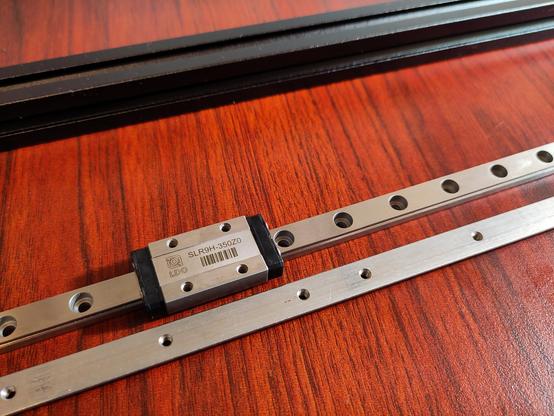
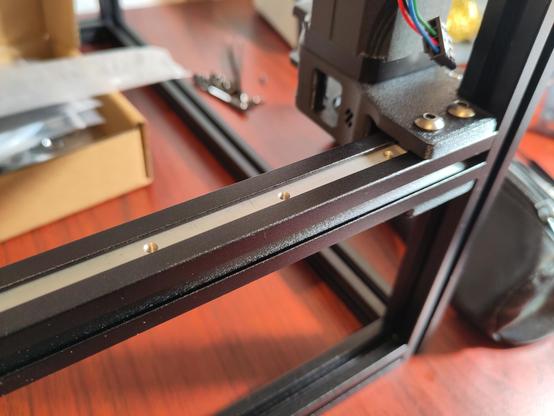
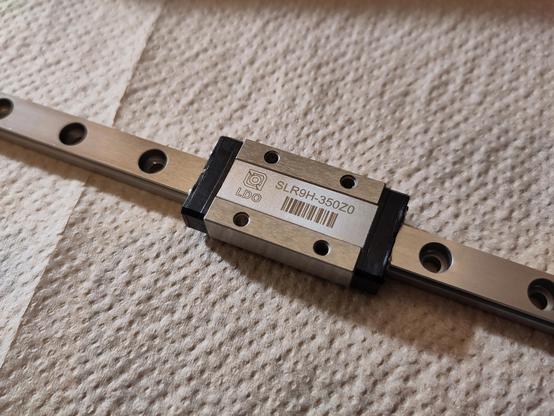
I just learned, that LDO included mounting bars for the linear rails, which seem to be much better than the default roll-in nuts.

However, in contrast to the roll-in nuts, the mounting bars have to be installed _before_ mounting the extrusions. Unfortunately, this is not documented in the LDO notes for the kit.

Well, since "practice" means doing something over and over again...

#voron #ldo #linearrail

Yay, it's already time for some linear rails!

You may now bet on how many of the carriages I will be dropping...

#voron #linearrail #murphyslaw

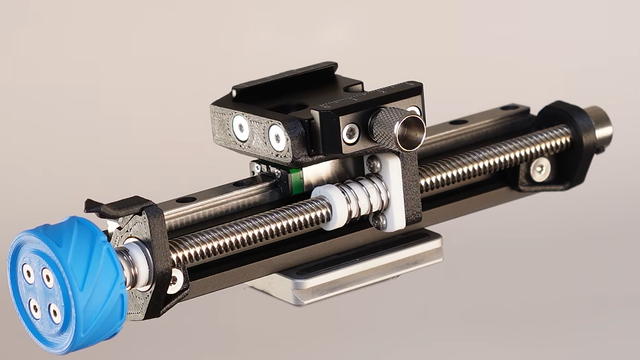
Tiny Moves, Big Depth: An Open-Source Macro Focus Slider

When taking macro photographs, you often need just a tiny bit of controlled motion — so little that it’s tough to pull off by hand. To address this, [Salveo] designed a small open-source macr…

Hackaday
Tiny Moves, Big Depth: An Open-Source Macro Focus Slider

When taking macro photographs, you often need just a tiny bit of controlled motion — so little that it’s tough to pull off by hand. To address this, [Salveo] designed a small open-source macr…

Hackaday
EnderSpark: Convert Your Broken Creality FDM Printer Into An EDM Machine!

EDM (Electrical Discharge Machining) is one of those specialised manufacturing processes that are traditionally expensive and therefore somewhat underrepresented in the DIY and hacker scenes. It&#8…

Hackaday

Here is how extrusions are made:
https://www.youtube.com/watch?v=76NcaTxFdE8

As you can see it's not a super accurate process. This is why it's not recommended to screw on linear rails and why some companies offer a machining service to make a flat surface. Another common practice is to let customers discover over-wrapped/twisted extrusions and then help via support.

#machines #3dprinting #extrusion #linearrail #motion

Custom Aluminum: Extrusion

YouTube
Rube Goldberg Floppy Disk Cleaner

Floppies were once the standard method of information exchange, but decades of storage can render them unreadable, especially if mold sets in. [Rob Smith] wanted to clean some floppies in style and…

Hackaday

I'm learning about 3D printing! My printer needs to be lubricated. It has linear rails.

I didn't know that linear rails had ball bearings supporting them.

That is awesome.

This video is about how to lubricate linear rails common in 3D printers, but it contains great views of the ball bearings in the linear rail, which I thought was super awesome to see. News to me, and now I totally understand the lubrication process for linear rails a lot more.

https://yewtu.be/watch?v=GWzz6fQiWmw

#linearrail #3dprinter #machine

Video De-shaker Software Measures Linear Rail Quality

Here's an interesting experiment that attempts to measure the quality of a linear rail by using a form of visual odometry, accomplished by mounting a camera on the rail and analyzing the video with open-source software usually used to stabilize shaky video footage. No linear rail is perfect, and it should be possible to measure the degree of imperfection by recording video footage while the camera moves down the length of the rail, and analyzing the result. Imperfections in the rail should cause the video to sway a proportional amount, which would allow one to characterize the rail's quality.

To test this idea, [Saulius] attached a high-definition camera to a linear rail, pointed the camera towards a high-contrast textured pattern (making the resulting video easier to analyze), and recorded video while moving the camera across the rail at a fixed speed. The resulting video gets fed into the Deshaker plugin for VirtualDub, of which the important part is the deshaker.log file, which contains X, Y, rotate, and zoom correction values required to stabilize the video. [Saulius] used these values to create a graph characterizing the linear rail's quality.

It's a clever proof of concept, especially in how it uses no special tools and leverages a video stabilizing algorithm in an unusual way. However, the results aren't exactly easy to turn into concrete, real-world measurements. Turning image results into micrometers is a matter of counting pixels, and for this task video stabilizing is an imperfect tool, since the algorithm prioritizes visual results instead of absolute measurements. Still, it's an interesting experiment, and perfectly capable of measuring rail quality in a relative sense. Can't help but be a bit curious about how it would profile something like these cardboard CNC modules.

#cnchacks #videohacks #cnc #linearrail #odometry #stabilization #video #virtualdub

Video De-shaker Software Measures Linear Rail Quality

Here’s an interesting experiment that attempts to measure the quality of a linear rail by using a form of visual odometry, accomplished by mounting a camera on the rail and analyzing the vide…

Hackaday