Building A Camera Slider Instead Of Buying One Goes Awry

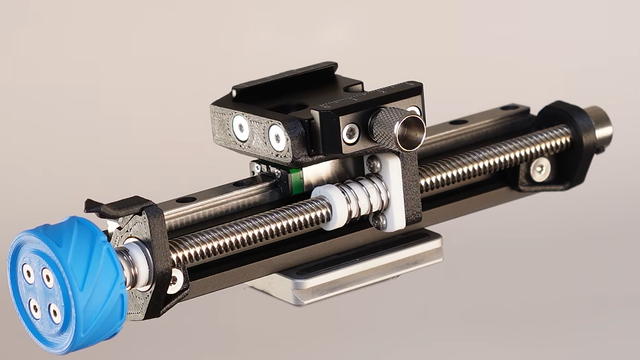
[TheHyperFix] had a problem. He’d spied a brilliant camera slider, but didn’t want to lay out big money to acquire it. The natural solution? Build one! Only, life is seldom so straightf…

Hackaday
Tiny Moves, Big Depth: An Open-Source Macro Focus Slider

When taking macro photographs, you often need just a tiny bit of controlled motion — so little that it’s tough to pull off by hand. To address this, [Salveo] designed a small open-source macr…

Hackaday
Tiny Moves, Big Depth: An Open-Source Macro Focus Slider

When taking macro photographs, you often need just a tiny bit of controlled motion — so little that it’s tough to pull off by hand. To address this, [Salveo] designed a small open-source macr…

Hackaday
The iFootage Shark Slider Nano II Integrates DJI Ronin S Gimbals

The iFootage Shark Slider Nano II integrates the DJI Ronin S series of gimbals into a seamless tracking workflow.

PetaPixel
11/23 Timelapse of Winnie and Harriet

PeerTube
DIY Ceiling-Mounted Motorized Slider is Perfect for Content Creation

Mount your camera on your ceiling to save space and get clever clips.

PetaPixel
The Trexo Slider is a mini motion control camera slider for creatives who like to pack small and light

Trexo Innovation has announced their new Trexo Slider, a motorised mini slider aimed at content creators who like to pack a small lightweight kit. Designed to handle everything from DSLR and mirrorless cameras to smartphones, it allows for shooting of both video and timelapse, with speeds ranging from a super slow 0.001mm/sec up to a […]

DIY Photography

Turning Old Plotter Parts Into a Smooth Camera Slider

Taking apart old stuff and re-using the parts to make something new is how many hackers first got started in the world of mechanical and electronic engineering. But even after years working in industry we still get that tinge of excitement whenever someone offers us an old device "for parts", and immediately begin to imagine the things we could build with the components inside.

So when [Victor Frost] was offered an old Cricut cutting plotter, he realized he could use its parts to create the camera slider he'd been planning to build. The plotter's X stage, controlled by a stepper motor, was ideal for moving a camera platform back and forth. [Victor] wanted to build the entire thing in a "freehand" way, without making a detailed design or purchasing any new parts. So he dived into his parts bin and dug up an Arduino, a 16×2 LCD, some wires and buttons, and a few pieces of MDF.

The camera mount is simply a piece of steel that a GoPro's magnetic mount can latch onto, but [Victor] keeps open the possibility of mounting a proper tripod ball head. The Arduino drives the stepper motor through an Adafruit Motor Shield, with a simple user interface running on the LCD. The user can set the desired end points and speed, and then run the camera back and forth as often as needed. In this way, the software follows the same "keep it simple" philosophy as the hardware design.

If you're planning to build your own camera slider, [Victor]'s design should be easy to copy, if you happen to have an old cutting plotter. If not, you can try this simple yet well-engineered model. Want even more? Then check out this fancy multi-axis camera motion control rig.

#digitalcamerashacks #cameraslider #cuttingplotter #steppermotor

Super Simple Camera Slider With A Neat Twist

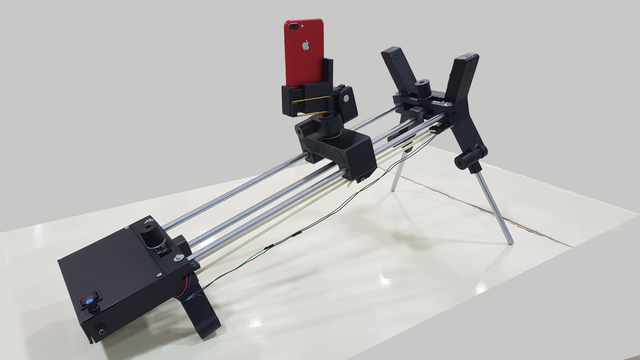
When you get into making videos of products or your own cool hacks, at some point you're going to start wondering how those neat panning and rotating shots are achieved. The answer is quite often some kind of mechanical slider which sends the camera along a predefined path. Buying one can be an expensive outlay, so many people opt to build one. [Rahel zahir Ali] was no different, and designed and built a very simple slide, but with a neat twist.

This design uses a geared DC motor, taken from a car windscreen wiper. That's a cost effective way to get your hands on a nice high-torque motor with an integral reduction gearbox. The added twist is that the camera mount is pivoted and slides on a third, central smooth rod. The ends of this guide rod can be offset at either end, allowing the camera to rotate up to thirty degrees as the slide progresses from one end to the other. With a few tweaks, the slider can be vertically mounted, to give those up-and-over shots. Super simple, low tech and not an Arduino in sight.

The CAD modelling was done with Fusion 360, with all the models downloadable with source, in case someone needs to adapt the design further. We were just expecting a pile of STLs, so seeing the full source was a nice surprise, given how many open source projects like this (especially on Thingiverse) do often seem to neglect this.

Electronics consist of a simple DC motor controller (although [Rahel] doesn't mention a specific product, it should not be hard to source) which deals with the speed control, and a DPDT latching rocker switch handles the motor direction. A pair of microswitches are used to stop the motor at the end of its travel. Other than a 3D printer, there is nothing at all special needed to make yourself quite a useful little slider!

We've seen a few slider designs, since this is a common problem for content creators. Here's a more complicated one, and another one.

#digitalcamerashacks #cameraslider #dcmotor #motioncontrol #pan #tilt #timingbelt

Super Simple Camera Slider With A Neat Twist

When you get into making videos of products or your own cool hacks, at some point you’re going to start wondering how those neat panning and rotating shots are achieved. The answer is quite o…

Hackaday
YC Onion's new Chips 3.0 slider is also a motorised dolly and a 5-axis motion control system - DIY Photography

YC Onion has only been around for a couple of years, but they’ve made some impressive kit since they first launched. Their latest is a new take on a familiar filmmaking tool – the motorised camera slider. This one, called Chips 3.0, isn’t just a slider, though. Oh no, it’s also a motorised tripod dolly, […]