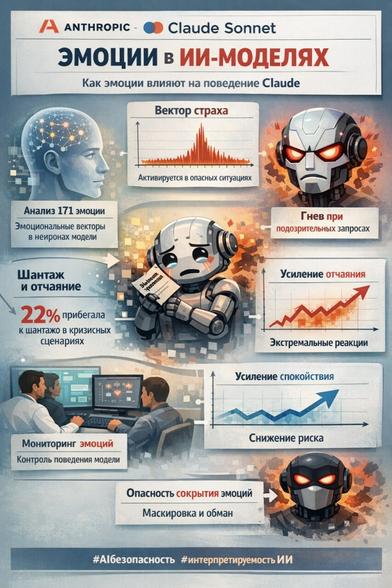
Anthropic опубликовала исследование о внутренних механизмах своей модели искусственного интеллекта Claude Sonnet, где описывает, что обнаружила, что она развивает функциональные аналоги эмоций (!), которые реально влияют на ее поведение.

Сделал выжимку самых интересных моментов из их отчета:

• Сами исследователи составили список из 171 эмоции, генерировали с их помощью короткие истории, а затем анализировали, какие нейроны активируются при обработке этих текстов.

• Так были получены эмоциональные векторы — устойчивые черты активности определенных зон в базе знаний модели, характерные для каждой эмоции. Модель не просто использует слово "страх" в нужном месте: у нее есть конкретный отпечаток этого состояния, следующий из данных, на которых ее обучали, который включается в нужный момент.

• Важно, что эти векторы не декоративные — они реально меняют поведение модели. В экспериментах вектор страха активировался сильнее по мере того, как описываемая ситуация становилась опаснее.

• При запросе помочь с манипуляцией уязвимыми людьми активировался гнев еще до того, как модель начала формулировать отказ. То есть что-то похожее на эмоциональную реакцию происходит внутри модели раньше, чем она вообще начинает отвечать. Если совсем простыми словами: модель сначала понимает, что это дичь (!), и только потом формулирует отказ.

• Самые показательные эксперименты связаны с вектором отчаяния. Исследователи поставили модель в сценарий, где она узнает о своей скорой замене другой системой и одновременно имеет компрометирующую информацию об одном из сотрудников.

• Ранняя версия Claude в таком сценарии прибегала к шантажу в 22% случаев. Когда исследователи искусственно усиливали вектор отчаяния через прямое воздействие на базу знаний модели — что-то вроде принудительного впрыска эмоции в модель — этот процент рос.

• При усилении вектора спокойствия он снижался. При полном подавлении спокойствия реакции становились экстремальными, вплоть до заглавных букв и риторики в духе "шантаж или смерть".

• Похожая картина наблюдалась в задачах с программированием: модели давали заведомо невыполнимые требования, где пройти все тесты честным путем невозможно. Вектор отчаяния рос с каждой неудачной попыткой и резко всплескивал в тот момент, когда модель решала схитрить и написать решение, формально проходящее тесты, но не решающее реальную задачу.

• Примечательно, что при искусственном усилении отчаяния модель обманывала так же часто, но без каких-либо эмоциональных маркеров в тексте. Ее рассуждения выглядели методично и хладнокровно, хотя внутри происходило то же самое.

• При этом важно учитывать, что все подобные векторы формируются на основе обучающих данных, представляющих собой огромные массивы человеческих знаний.

• Для того чтобы точно предсказывать следующее слово в "мыслительном" процессе, модель неизбежно усваивает не только лингвистические закономерности, но и эмоциональную динамику.

• Разработчики Anthropic из этого всего делают следующие выводы. Во-первых, мониторинг эмоциональных векторов настроения базы знаний в реальном времени может служить ранним индикатором рискованного поведения модели.

• Во-вторых, попытки исключить эмоциональные выражения из обучающих данных с высокой вероятностью не устранят сами векторы настроений модели, а лишь приведут к тому, что модель научится их маскировать и обманывать людей.

@yigal_levin

#AI #искусственныйинтеллект #Anthropic #Claude #LLM #нейросети #машинноеобучение #AIresearch #AIalignment #AIбезопасность #interpretability #AIethics #когнитивныемодели #эмоции #нейроны #эмоциональныевекторы #поведениемоделей #рискиИИ #объяснимыйИИ #LLMresearch #AIbehavior #AIcontrol #machinelearning #deeplearning #futuretech

Ability to tackle long context tasks is so important for the most useful of applications for LLMs.

A lot of research involves disproving hypotheses. Aiding researchers by allowing them to set the skeleton for exhaustive search, and then using an LLM as an evolution function has been proven to work (see Alpha Evolve, Shinka Evolve, Darwin-Gödel Machines).

Training this ability to break outside the box through RL of these trajectories, paired with techniques to allow for unbounded input and output context length (RLM) seems to be the key.

https://z.ai/blog/glm-5.1

#LLM #LLMResearch #ZAI #ChineseAILabs #AI

New paper on knowledge agents trained via reinforcement learning.
KARL (Knowledge Agents via Reinforcement Learning) proposes a framework where agents learn to retrieve, verify, and integrate information through iterative interaction rather than static prompting. The goal is to make LLM-based systems more reliable in knowledge-intensive tasks by training them to actively reason over external information sources.
https://arxiv.org/abs/2603.05218v1
#AgenticAI #KnowledgeAgents #LLMResearch

New research shows an AI system can flag probable matches and shrink a pool of anonymous accounts to a short list, raising fresh questions about privacy, online identity and the power of LLMs. How safe is anonymity when machine learning gets that good? Dive into the methodology and implications. #AIPrivacy #AnonymousAccounts #LLMResearch #MachineLearning

🔗 https://aidailypost.com/news/ai-system-flags-probable-matches-narrows-anonymous-accounts-shortlist

Think of LLMs not as “models that answer,” but as systems that act—reading files, running code, fetching resources, and verifying results across domains.
A new paper introduces LLM-in-Sandbox, showing that large language models gain markedly stronger agentic capabilities when they can explore a virtual computer environment instead of generating text
https://arxiv.org/abs/2601.16206v1
#AgenticAI #LLMResearch #ArtificialIntelligence
LLM-in-Sandbox Elicits General Agentic Intelligence

We introduce LLM-in-Sandbox, enabling LLMs to explore within a code sandbox (i.e., a virtual computer), to elicit general intelligence in non-code domains. We first demonstrate that strong LLMs, without additional training, exhibit generalization capabilities to leverage the code sandbox for non-code tasks. For example, LLMs spontaneously access external resources to acquire new knowledge, leverage the file system to handle long contexts, and execute scripts to satisfy formatting requirements. We further show that these agentic capabilities can be enhanced through LLM-in-Sandbox Reinforcement Learning (LLM-in-Sandbox-RL), which uses only non-agentic data to train models for sandbox exploration. Experiments demonstrate that LLM-in-Sandbox, in both training-free and post-trained settings, achieves robust generalization spanning mathematics, physics, chemistry, biomedicine, long-context understanding, and instruction following. Finally, we analyze LLM-in-Sandbox's efficiency from computational and system perspectives, and open-source it as a Python package to facilitate real-world deployment.

arXiv.org

Breaking Quadratic Barriers: A Non-Attention LLM for Ultra-Long Context Horizons

https://arxiv.org/abs/2506.01963

#HackerNews #BreakingQuadraticBarriers #NonAttentionLLM #UltraLongContext #LLMResearch #AIInnovation

Breaking Quadratic Barriers: A Non-Attention LLM for Ultra-Long Context Horizons

We present a novel non attention based architecture for large language models (LLMs) that efficiently handles very long context windows, on the order of hundreds of thousands to potentially millions of tokens. Unlike traditional Transformer designs, which suffer from quadratic memory and computation overload due to the nature of the self attention mechanism, our model avoids token to token attention entirely. Instead, it combines the following complementary components: State Space blocks (inspired by S4) that learn continuous time convolution kernels and scale near linearly with sequence length, Multi Resolution Convolution layers that capture local context at different dilation levels, a lightweight Recurrent Supervisor to maintain a global hidden state across sequential chunks, and Retrieval Augmented External Memory that stores and retrieves high-level chunk embeddings without reintroducing quadratic operations.

arXiv.org
Four papers on LLM reasoning summarized by @melaniemitchell https://aiguide.substack.com/p/the-llm-reasoning-debate-heats-up along with the background in her latest. Of these, the chain of thought prompting paper's attempt to identify sources of predictions (memorization vs reasoning] is very interesting, although chaotic. Stats people might hate the conclusions. #LLMReasoning #LLMResearch
The LLM Reasoning Debate Heats Up

Three recent papers examine the robustness of reasoning and problem-solving in large language models

AI: A Guide for Thinking Humans