 Media Japan
https://www.wacoca.com/media/613817/ JPRO 4月から「BooksPRO」に新機能 未管理著作物裁定制度は「Books」対応 – The Bunka News デジタル #book #books #BooksPRO #CRIC #JPO #JPRO #出版情報データベース #出版情報登録センター #文化庁 #日本出版インフラセンター #書籍 #未管理著作物裁定制度 #版元ドットコム #著作権 #著作権情報センター

Thanks for your thoughtful input, @ptribble 👋
You're right — JavaFX doesn’t target every platform, but it covers the major ones well:
✅ Linux
✅ macOS
✅ Windows
✅ iOS
✅ Android
✅ Web
No framework truly runs everywhere, yet JavaFX offers strong cross-platform reach. The key now is community growth and ecosystem evolution — and it’s happening! 💪
#JavaFX #Java #Gluon #JPro #OpenJDK #CrossPlatform #DesktopDev #MobileDev
@CommonGround_2048 Thanks for mentioning #WebFX 🙏
I’m aware of it but haven’t tried it yet in a real project.
Indeed, #JavaFX is truly cross-platform — running across #Windows, #Linux, #macOS, #Android, #iOS, and #Web.
I’ll definitely explore #WebFX soon.
Right now, I’m focusing on building and testing for #iPhone and #macOS — using both the classic #JavaFXMobile-plugin and the latest #GluonFX toolchain.
#JPro is already working great for me 🚀
🚀 The real power of #Java & #JavaFX is not just Desktop (Windows, Linux, macOS) — but true cross-platform:
🖥️ Desktop (Win/Linux/macOS)
📱 Mobile (Android/iOS)
🌐 Web
⚙️ Embedded devices
With @gluonhq (GluonFX, Substrate, Attach, VMOne, GraalVM) & @jpro, this vision is reality — powered by #OpenJDK + #OpenJFX.
#JavaEverywhere #Java #JavaFX #CrossPlatform #MobileDev #WebDev #GluonHQ #JPro
How to select relevant items for monitoring? Case example of a pragmatic process for mapping immune checkpoint inhibitor #SideEffects to items from existing item libraries ( #CTCAE #EORTC #FACIT )
https://jpro.springeropen.com/articles/10.1186/s41687-025-00855-8

Background Monitoring for the side effects of novel therapies using patient-reported outcomes (PROs) is critical for ensuring patient safety. Existing static patient-reported outcome measures may not provide adequate coverage of novel side effects. Item libraries provide a flexible approach to monitoring for side effects using customized item lists, but the ideal process for matching side effects to items sourced from multiple item libraries is yet to be established. We sought to develop a pragmatic process for mapping side effects to items from three major item libraries using immune checkpoint inhibitor (ICI) side effects as an example. Methods Using a consumer- and clinician-driven list of 36 ICI side effects, two authors independently mapped side effects to Common Terminology Criteria for Adverse Event (CTCAE) terms, and then to three item libraries: the Patient-Reported Outcome version of the Common Terminology Criteria for Adverse Events (PRO-CTCAE), the European Organisation for Research and Treatment of Cancer (EORTC) Item Library, and the Functional Assessment of Chronic Illness Therapy (FACIT) searchable library. The rates of inter-rater agreement were recorded. Following item collation from the item libraries, we devised criteria for selecting the optimal item for each side effect for inclusion in a future electronic PRO system based on guidance from the above groups. Results All 36 side effects mapped to at least one CTCAE term, with eight mapping to more than one term. Twenty-three side effects mapped to at least one PRO-CTCAE term, 35 side effects mapped to at least one EORTC item, and 31 side effects mapped to at least one FACIT item. The inter-rater agreement rate was 100% (PRO-CTCAE), 83% (EORTC) and 75% (FACIT). Pre-determined criteria were applied to select the optimal item for each side effect from the three item libraries, producing a final 61-item list. Conclusion Using ICI side effects as an example, we developed a pragmatic approach to creating customized item lists from three major item libraries to monitor for side effects of novel therapies in routine care. This process highlighted the challenges of using item libraries and priorities for future work to improve their usability.
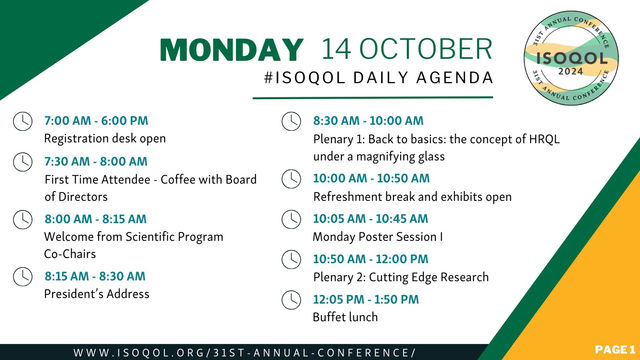
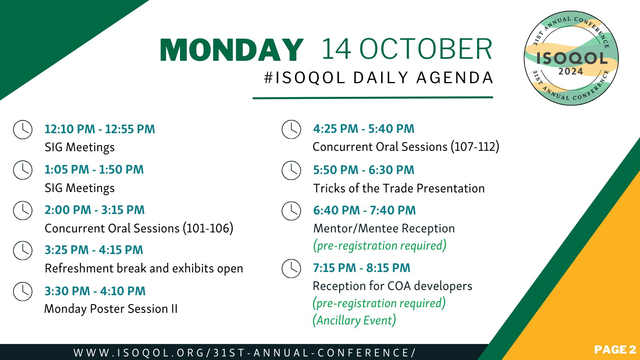
Monday programme at #ISOQOL starting with the official opening and president's address.
The conference abstracts have been published just in time:
https://link.springer.com/article/10.1007/s11136-024-03786-x
Today, I'll chair my last QLR board meeting and Oral Session 109 on guidelines and good practices.
For the evening #ISOQOL_NewInvestigators kindly invited me and #JPRO Rasa Ruseckaite to present on manuscript writing.
I am looking forward to meeting my 2024 mentees at the #Mentoring reception.
Edit:
#HRQL #HealthEconomics
 CTO Abid Maqbool
 Jan R. Boehnke
 PierreFasbender