Something Strange Is Living—and Thriving—Below Fukushima’s Dead Reactors

Ionizing radiation apparently didn’t prevent some types of bacteria from breeding in the water, but they are not the expected radiation-resistant types.

Popular Mechanics

@celeste_42bit yeah, given that there were radar technicians who died from cancer prematurely because they had to deal with beams in the 5-15kW range and had to calibrate them whilst on the caution is warranted...

That's why doctors will evacuate the room with any X-ray machine whilst taking a photo because it does make a difference if someone's getting a single X-ray made in a decade vs. standing near stray radiation multiple times a day...

Please contain it and wear shielding as you limit long term exposure. Thank. https://www.vinted.co.uk/items/6681393189

#Uranium #Fever #HazMat #Vintage #Antique #IonisingRadiation #IonizingRadiation

Stunning Vintage Art Deco Uranium Glass Ring Holder - Vibrant Glow!

✨ Stunning Art Deco Uranium Glass Ring Holder - Vibrant Glow! ✨ Discover a captivating piece of history with this exquisite Art Deco uranium glass ring holder. Dating from the 1920s-1930s, this is a genuine vintage gem that perfectly embodies the elegant and streamlined aesthetics of the Art Deco era. As it hails from this period, it could be considered antique, or is certainly almost antique, showcasing its remarkable age and enduring charm. Crafted from authentic uranium glass (also known as Vaseline glass), this piece possesses an extraordinary and extremely vibrant glow under UV (black) light, as clearly shown in the photos. This intense luminescence makes it a truly enchanting and eye-catching addition to any collection or display. The classic design features a central spire, perfectly shaped to hold your rings securely, set within a graceful dish base ideal for smaller earrings, pins, or other delicate trinkets. It's not just a beautiful decorative item but also a practical way to keep your precious jewellery organised. Condition: This ring holder is in excellent vintage condition. Despite its age, it shows beautifully with that remarkable glow. There is one tiny, almost imperceptible "flea bite" on the inner rim, a very minor imperfection that does not detract from its overall beauty or functionality and is not visible when a ring is placed on the holder. Whether you're a dedicated collector of Art Deco treasures, a fan of unique glowing glass, or simply seeking a sophisticated and historical piece for your home, this uranium glass ring holder is a rare find. Features: * Authentic Art Deco Era (1920s-1930s) * Genuine Uranium/Vaseline Glass * Emits an extremely vibrant glow under UV light * Classic and elegant ring holder design * A functional and beautiful piece of history Don't miss the opportunity to own this truly unique and glowing historical item!

New type of handheld detector for all types of ionizing radiation improves radiation safety

The University of Jyväskylä (Finland), in collaboration with the Finnish Radiation and Nuclear Safety Authority (STUK), has developed a new type of handheld multi-purpose radiation detector that comprehensively detects all types of ionizing radiation. The device can be used by industrial and medical radiation users, regulatory authorities, the nuclear energy industry, first responders and military users. The technology has been patented and is currently being explored for commercialization.

Phys.org

Irradiation can cause cancer
The first case of cancer resulting from irradiation was described in 1904. In 1944, it was noticed that doctors working with X-rays were 10 times more likely to die from leukemia compared to other doctors. In the survivors of the bombing of Hiroshima in 1945, the first cases of leukemia were seen in 1948. As a rule, leukemia occurs after 8 years from exposure, while other types of tumors after 20, 30 or 40 years from exposure.

#cancer #irradiation #Ionizingradiation

Geiger tube J305 conversion factor: differences between the coefficient for source radiation power and absorbed dose. Technical note

We have previously written about how to calculate the coefficients for the SBM20 tube and the J305, tube that come with our Geiger counter module GGreg20_V3 for DIY / IoT…

#technicalnote #ggreg20_v3 #sbm20 #j305 #geigercounter #ionizingradiation #iot #diy #english #ukrainian #2024

https://iot-devices.com.ua/en/geiger-tube-j305-conversion-factor-difference-for-radiation-source-power-and-absorbed-dose-technical-note-en/

Geiger tube J305: How to calculate the conversion factor of CPM to μSv/h. Technical note

We have already made a similar publication for the SBM20 Geiger tube. This time we bring to your attention an article dedicated to the equally popular J305 tube made in…

#technicalnote #sbm20 #j305
#geigercounter
#ionizingradiation #iot #diy #english #ukrainian

https://iot-devices.com.ua/en/geiger-tube-j305-how-to-calculate-the-conversion-factor-of-cpm-technical-note-en/

Geiger tube J305: How to calculate the conversion factor of CPM to μSv/h. Technical note - IoT-devices, LLC - Electronics manufacturer for IoT

Geiger tube J305: how to calculate the coefficient of conversion of the number of pulses per minute into the value of μSv/h, the equivalent dose of radiation absorbed by the human body.

IoT-devices, LLC - Electronics manufacturer for IoT
How does the Wnt pathway promote resistance to #DNAdamage induced by #IonizingRadiation? @BenForWard3 &co show that #WntSignaling modulates DNA damage response via EGFR in #Drosophila, protecting cells from #apoptosis induced by DNA ds breaks #PLOSBiology https://plos.io/4dduEiq
Wnt signaling modulates the response to DNA damage in the Drosophila wing imaginal disc by regulating the EGFR pathway

The Wnt pathway promotes resistance to DNA damage induced by ionizing radiation in several human cancers, but the mechanisms are not fully understood. This study shows that Wnt signaling in the Drosophila wing imaginal disc modulates the DNA damage response through EGFR, protecting cells from apoptosis induced by DNA double-strand breaks.

@mcc #IonizingRadiation isn't healthy so I always was #sus|ing these things and thought of them like the #Blaux #AC's:

A cheap #scam to fool desperate and #TechIlliterate #consumers into wasting money...

https://www.youtube.com/watch?v=dCkn0o3lrgQ

Fake Portable AC Scams: Blast Auxiliary, BreezeMaxx, Blaux - Krazy Ken's Tech Talk

YouTube

Maybe the Simplest Cloud Chamber

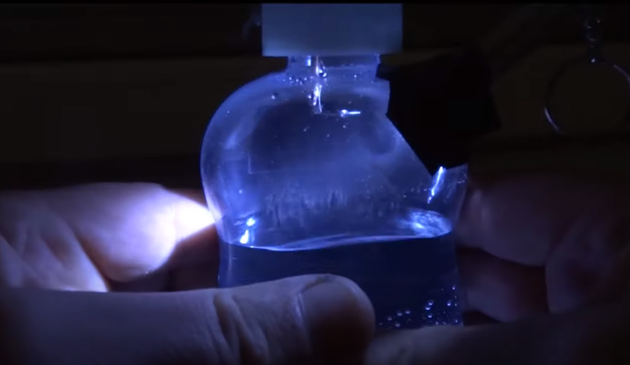
Have you ever seen a Wilson cloud chamber -- a science experiment that lets you visualize ionizing radiation? How hard would it be to build one? If you follow [stoppi's] example, not hard at all (German, Google Translate link). A plastic bottle. some tape, a flashlight, some water, hot glue, and -- the only exotic part -- a bit of americium 241. You can see the design in the video below and the page also has some more sophisticated designs including one that uses a CPU cooler. Even if you don't speak German, the video will be very helpful.

You need to temper your expectations if you build the simple version, but it appears to work. The plastic bottle is a must because you have to squeeze it to get a pressure change in the vessel.

If you are wondering where to get americium-241, check out a junked smoke detector. The second video, below, has details about how to harvest it from that common source. You need something that fits in the bottle cap.

It is hard to see on the video, but different types of ionizing radiation leave telltale tracks in the chamber. Alpha particles tend to leave thick straight tracks whereas beta particles tend to be more delicate and curvy. Although in modern times these are more or less science curiosities, there was a time they were real lab equipment and they participated in the discovery of the positron, the muon, and the kaon.

If you want to try a bigger chamber, we've seen it done. Some chambers use alcohol and dry ice.

#science #cloudchamber #ionizingradiation #wilsoncloudchamber

Maybe The Simplest Cloud Chamber

Have you ever seen a Wilson cloud chamber — a science experiment that lets you visualize ionizing radiation? How hard would it be to build one? If you follow [stoppi’s] example, not har…

Hackaday