It's a festive season on Earth, especially for the Indian subcontinent. The onset of the #IndianMonsoon marks a sharp transition from extreme heat to heavy rainfall. Nature exhibits its beautiful creativity, painting vibrant scenes
https://www.linkedin.com/posts/vu3bpn_monsoon-weather-chaos-activity-7466015375340789761-vl_V
#climate #Chaos
Happy to present our work at Asia Oceania Geosciences Society 2025 in Singapore on the onset of monsoon as a phase transition using network science.
More details can be found at https://arxiv.org/abs/2503.15148
#ClimateScience #NetworkScience #IndianMonsoon #ComplexSystems #PhD #conference
Study: Substantial shift in phase and amplitude of Indian rainfall beyond 2100
This could pose major #foodsecurity and #migration impacts on regional #Climatesecurity
https://www.nature.com/articles/s41612-025-01126-5
#indianmonsoon #ClimateCrisis

Substantial shift in phase and amplitude of Indian rainfall beyond 2100 - npj Climate and Atmospheric Science
Future changes in rainfall over India are critically important, given their impact on millions of people and the country’s agriculture. However, most studies focus only on changes up to the year 2100, leaving long-term projections largely unexplored. In this study, we leverage a 10-member ensemble with an Earth system model under relatively strong emissions to examine rainfall changes over India to 2500. Our results show a pronounced weakening of large-scale monsoon circulation after 2100, mainly due to increased atmospheric stability caused by rapid warming in the upper troposphere over land. At the same time, the Indian monsoon system expands significantly to the north and west. The northward expansion is driven by accelerated warming over the Tibetan Plateau, which pushes the low-level monsoonal winds and pressure systems further north. This, along with the development of a strong anomalous anticyclonic circulation over the Bay of Bengal, leads to more consistent upward motion over northern India and a northward expansion of the monsoon. Meanwhile, the westward expansion is linked to uneven warming in the Indian Ocean as the warm pool shifts westwards. These circulation changes, combined with the asymmetric warming pattern, enhance northward moisture transport and contribute to the intensification of rainfall across northwestern and northern India post-2100. These local expressions of large-scale perturbations provide a mechanistic framework for informing long-term mitigation and adaptation efforts for India.
Happy to share that Dr. Gaurav and Mrs. Shruti from our lab contributed to the discussions at the 2025
@EuroGeosciences General Assembly in Vienna, presenting research on monsoon progression and cyclone dynamics using network theory.
#ClimateScience #NetworkScience #Cyclones #IndianMonsoon #ComplexSystems #EGU2025 Bipin Chandran
 Mathrubhumi English
 Prof. R. I. Sujith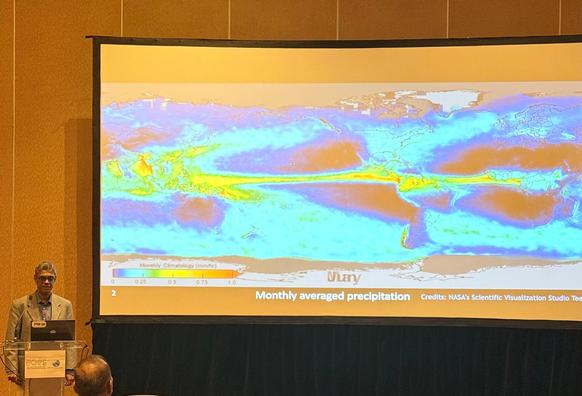
 John Englart