DoomsdaysCW
From Wikipedia, the free encyclopedia
"Nixtamalization (/ˌnɪʃtəməlɪˈzeɪʃən, ˌnɪks-/ nish-tə-mə-lih-ZAY-shən) is a process for the preparation of maize (corn), or other grain, in which the grain is soaked and cooked in an alkaline solution, usually limewater (but sometimes aqueous alkali metal carbonates),washed, and then hulled. The term can also refer to the removal via an alkali process of the pericarp from other grains such as sorghum.
"#NixtamalizedCorn has several benefits over unprocessed grain: It is more easily ground, its nutritional value is increased, flavor and aroma are improved, and mycotoxins are reduced by up to 97–100% (for aflatoxins).
"Lime and #ash are highly alkaline: the alkalinity helps the dissolution of hemicellulose, the major glue-like component of the maize cell walls, and loosens the hulls from the kernels and softens the #maize. The tryptophan in corn proteins is made more available for human absorption, thus helping to prevent niacin deficiency (pellagra). Tryptophan is the metabolic precursor of endogenous niacin (Vitamin B3).
"Some of the corn oil is broken down into emulsifying agents (monoglycerides and diglycerides), while bonding of the maize proteins to each other is also facilitated. The divalent calcium in lime acts as a cross-linking agent for protein and polysaccharide acidic side chains.
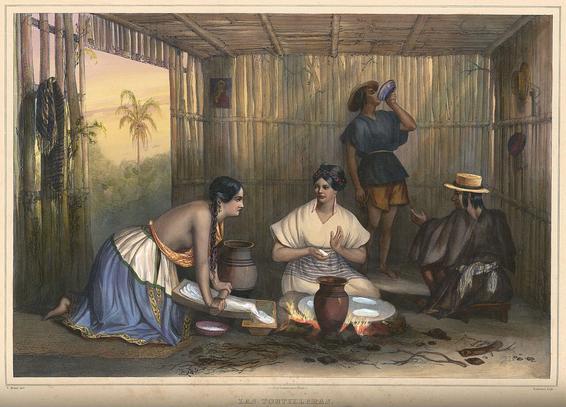
"While cornmeal made from untreated ground maize is unable by itself to form a dough on addition of water, nixtamalized cornmeal will form a dough, called #masa. These benefits make nixtamalization a crucial preliminary step for further processing of maize into food products, and the process is employed using both traditional and industrial methods in the production of #tortillas and #TortillaChips (but not corn chips), #tamales, #hominy, and many other foodstuffs.
Etymology
"In the #Aztec language Nahuatl, the word for the product of this procedure is #nixtamalli or #nextamalli (pronounced [niʃtaˈmalːi] or [neʃtaˈmalːi]), which in turn has yielded Mexican Spanish #nixtamal ([nistaˈmal]). The Nahuatl word is a compound of nextli "lime ashes" and tamalli "unformed/cooked corn dough, tamal". The term #nixtamalization can also be used to describe the removal of the pericarp from any grain by an #alkali process, including maize, #sorghum, and others. When the unaltered Spanish spelling nixtamalización is used in written English, however, it almost exclusively refers to maize.
"The labels on packages of commercially sold tortillas prepared with nixtamalized maize usually list corn treated with #lime as an ingredient in English, while the Spanish versions list maíz nixtamalizado.
Impact on health
"The primary nutritional benefits of nixtamalization arise from the alkaline processing involved. The processing renders the protein more digestible, allowing tryptophan to be absorbed by humans. Humans can convert tryptophan into niacin, thus helping to prevent pellagra. Other measures of protein quality are also improved. It was originally thought that the anti-pellagra action stems from increased availability of niacin (compared to a hemicellulose-bound form called "niacytin"), but multiple experiments have disproven this theory.
"Secondary benefits can arise from the grain's absorption of minerals from the alkali used or from the vessels used in preparation. These effects can increase #calcium (by 750%, with 85% available for absorption), iron, copper, and zinc.[4]
"Nixtamalization significantly deactivates #mycotoxins which are putative carcinogens. #Aflatoxins are reduced by 90–94%. Fumonisins are reduced by 82%."
Source:
https://en.wikipedia.org/wiki/Nixtamalization
#SolarPunkSunday #NativeAmericanFoods #NativeAmericanHistory #Corn #BlueCorn #MesoAmerica #TraditionalFoods #CulinaryAsh #CalciumCarbonate #History #FoodHistory #Corn #PlantAshes
 PapyrusBrigade has moved
 rdfrkian
 AllQuakes - EMSC
 Ruth Chaves Lizano 💗🇨🇷🇨🇷🇨🇷
 Steph Rodriguez