 ADMIN Magazine
Fuzzball 4.0 released by CIQ with several new features
https://www.admin-it.io/fuzzball-4-0-released/?utm_source=mam
#Fuzzball #CIQ #HPC #orchestration #storage #AI #Lustre #GPFS #BeeGFS

Fuzzball 4.0 released by CIQ with several new features
https://www.admin-it.io/fuzzball-4-0-released/?utm_source=mam
#Fuzzball #CIQ #HPC #orchestration #storage #AI #Lustre #GPFS #BeeGFS

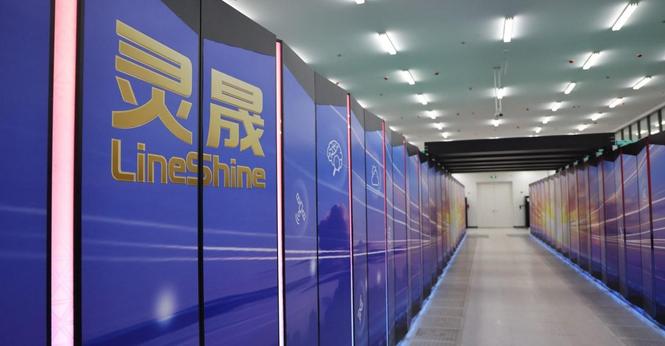
TOP500 at ISC'26: We have a New Number 1
https://chipsandcheese.com/p/top500-at-isc26-we-have-a-new-number
China's LineShine Supercomputer: A Sense of Scale ⚡🖥️
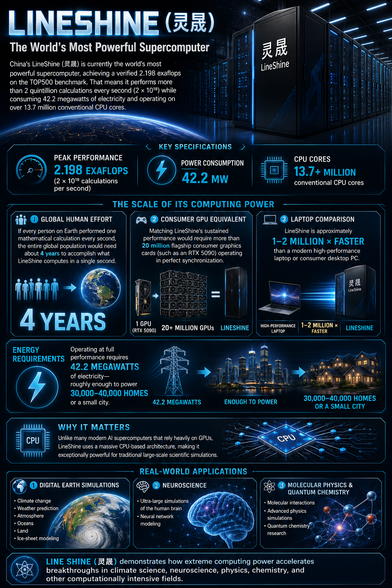
China's LineShine 灵晟 supercomputer is the most powerful supercomputer in the world 🌍, delivering a verified 2.198 exaFLOPS on the TOP500 benchmark. That means it can perform more than 2 quintillion (2×10¹⁸) calculations every second 🚀. The system consumes 42.2 megawatts of electricity ⚡ and is powered by more than 13.7 million conventional CPU cores 🧠.
The Scale of Its Computing Power 📊
Compared to Humanity 👥: If every person on Earth performed one mathematical calculation every second, without stopping ⏱️, it would take the entire global population about 4 years 📅 to equal the amount of computation LineShine completes in a single second.
Consumer Hardware 💻: Matching LineShine's sustained performance would require more than 20 million of today's fastest consumer graphics cards 🖥️, such as an RTX 5090, working together in perfect synchronization 🔗.
LineShine demonstrates the extraordinary scale of modern high-performance computing (HPC), enabling scientific calculations that would be practically impossible using conventional computers 🚀.
#Supercomputer #LineShine #Exascale #Exaflop #HPC #HighPerformanceComputing #Technology #Innovation #Science #Engineering #Computing #CPU #ParallelComputing #ClimateScience #WeatherForecasting #Neuroscience #QuantumChemistry #Physics #MolecularScience #DataScience #ArtificialIntelligence #AI #Research #STEM #FutureTech #DigitalEarth #ComputerScience #TechFacts #NextGenComputing #TOP500
AI isn't just becoming a compute problem anymore—it's becoming a networking problem. Faster GPUs don't help much if data can't move between them efficiently, so it's not surprising to see optical interconnects becoming a strategic technology for future AI data centers.
https://www.trendforce.com/presscenter/news/20260615-13098.html?es_id=aa45ab1fb2
#AI #AIInfrastructure #DataCenter #GPU #OpticalNetworking #SiliconPhotonics #CPO #HighSpeedNetworking #HPC #Semiconductors #TechNews #FutureOfAI

TrendForce’s recent research on silicon photonics (SiPh) shows that the rapid growth of AI training and inference workloads is pushing AI data centers toward increased power use, higher rack densities, and larger clusters. As data transfer becomes a major energy drain, CSPs are treating interconnect technologies as equally important as compute hardware. The architecture of interconnects now plays a key strategic role in determining AI factory growth, energy efficiency, and supply chain management.
As AI clusters become larger and GPUs become faster, networking and optical communication are becoming just as important as the compute hardware itself. Copper connections consume too much power and suffer from signal loss at very high speeds, so the industry is gradually moving toward optical interconnects. TrendForce forecasts the combined CPO/NPO market could grow from roughly $100 million in 2025 to over $39 billion by 2030, illustrating how strategic this technology is expected to become.
AI isn't just becoming a compute problem anymore—it's becoming a networking problem. Faster GPUs don't help much if data can't move between them efficiently, so it's not surprising to see optical interconnects becoming a strategic technology for future AI data centers.
https://www.trendforce.com/presscenter/news/20260615-13098.html?es_id=aa45ab1fb2
#AI #AIInfrastructure #DataCenter #GPU #OpticalNetworking #SiliconPhotonics #CPO #HighSpeedNetworking #HPC #Semiconductors #TechNews #FutureOfAI
TrendForce’s recent research on silicon photonics (SiPh) shows that the rapid growth of AI training and inference workloads is pushing AI data centers toward increased power use, higher rack densities, and larger clusters. As data transfer becomes a major energy drain, CSPs are treating interconnect technologies as equally important as compute hardware. The architecture of interconnects now plays a key strategic role in determining AI factory growth, energy efficiency, and supply chain management.
AI isn't just becoming a compute problem anymore—it's becoming a networking problem. Faster GPUs don't help much if data can't move between them efficiently, so it's not surprising to see optical interconnects becoming a strategic technology for future AI data centers.
https://www.trendforce.com/presscenter/news/20260615-13098.html?es_id=aa45ab1fb2
#AI #AIInfrastructure #DataCenter #GPU #OpticalNetworking #SiliconPhotonics #CPO #HighSpeedNetworking #HPC #Semiconductors #TechNews #FutureOfAI #tech
TrendForce’s recent research on silicon photonics (SiPh) shows that the rapid growth of AI training and inference workloads is pushing AI data centers toward increased power use, higher rack densities, and larger clusters. As data transfer becomes a major energy drain, CSPs are treating interconnect technologies as equally important as compute hardware. The architecture of interconnects now plays a key strategic role in determining AI factory growth, energy efficiency, and supply chain management.
I like that "lazy version" exists for many things! 😍
🌀 **lazyslurm** — A TUI for monitoring and managing Slurm clusters
💯 Track jobs, inspect nodes, tail logs, monitor partitions, & manage workloads
🦀 Written in Rust & built with @ratatui_rs
⭐ GitHub: https://github.com/hill/lazyslurm
 Claudia Blaas-Schenner
 Andreas Herten
 Rodrigue Gbadou
 Lobsters
 Pustam | पुस्तम | পুস্তম🇳🇵
 Alex S.
 ALEXBSR
 BuySellRam.com
 Orhun Parmaksız 👾