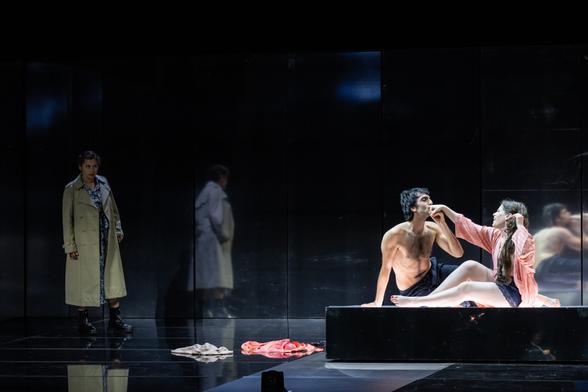
Written on Skin bij De Nederlandse Opera

Afgelopen juli beleefde de opera Written on Skin van de Britse componist George Benjamin zijn wereldpremière in het Festival van Aix-en-Provence. Publiek en pers waren laaiend enthousiast en sommige critici meenden dat dit de beste opera is van de afgelopen twintig jaar. Zaterdag 6 oktober start dezelfde productie bij De Nationale Opera, met het Nederlands Kamerorkest onder leiding van Benjamin zelf. Ik sprak hem op 26 september in het Muziekgebouw in Amsterdam en schreef erover voor Muziekvan.nu

#DeNederlandseOpera #GeorgeBenjamin #MuziekvanNu #TheaDerks #WrittenOnSkin

George Benjamin on his opera Written on Skin: ‘We emphasize the unnatural’

George Benjamin (1960) is composer in focus of the coming Holland Festival. Apart from the Dutch premiere of his recent opera ‘Lessons in Love & Violence’ there’s a semi-staged performance of ‘Written on Skin’. Benjamin composed this highly successful opera in 2012 for the Festival of Aix-en-Provence, where it was premiered by the Mahler Chamber Orchestra. This orchestra will now perform it in Muziekgebouw aan ‘t IJ Amsterdam with a new vocal cast.

George Benjamin with the score for his opera Written on Skin © Faber Music Ltd

In 2012 I interviewed Benjamin on the occasion of the Dutch premiere for Muziekvan.nu, a new-music website that was discontinued in 2015. Here is a translation of my article, originally published on 27 September 2012.

In July 2012, the world premiere of George Benjamin’s opera Written on Skin was the highlight of the Festival in Aix-en-Provence. It is a medieval story about a cruel landowner who hires a young illustrator to record his heroic deeds. When the boy starts an affair with his wife Agnes, he kills him and forces her to eat his heart. Hereafter she commits suicide. Benjamin and librettist Martin Crimp present the characters as a kind of archaeologists, who summon up the old story and simultaneously bring it to life.

When I meet George Benjamin on Wednesday 26 September, he has just been rehearsing with the Nederlands Kamerorkest (Dutch Chamber Orchestra) for four hours. Excited, he says: ‘It was the first Sitzprobe, in which singers and musicians go through their parts together without acting. It was fantastic, the orchestra plays exceptionally well.’

The premiere in Aix-en-Provence was performed by the Mahler Chamber Orchestra, but the singer are largely the same in the production of Dutch National Opera. Benjamin wrote his parts with these specific performers in mind.

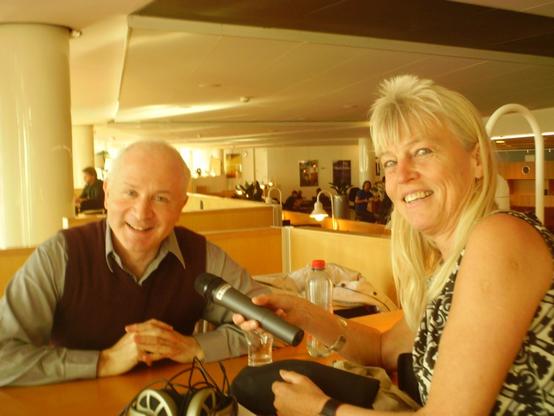
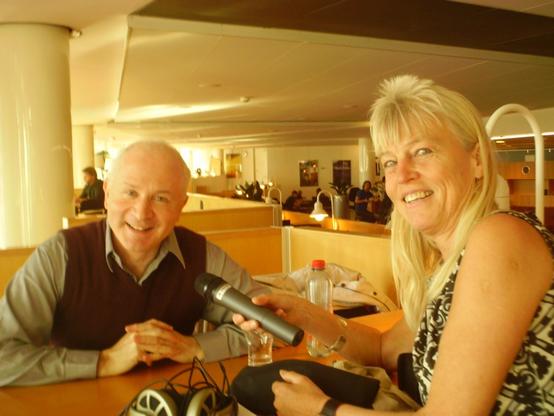
George Benjamin & Thea Derks, Dutch National Opera 26 September 2012

You started working with the singers in 2008. Why so early?

Benjamin: ‘I didn’t want to compose for an abstract, idealized type of voice, but for people of flesh and blood. At the request of Bernard Foccroule, director of the Festival in Aix, we chose a medieval saga from the Languedoc, the region to which the city belongs. In order to fit the characters in with my own composition methods, I went in search of singers even before I had put one note to paper.

Once I’d found them, I invited them to my home, where I made an inventory of their possibilities. Apart from things such as colour, strength, agility and vocal range, I also noted what they like or don’t like to sing. It was very special that all five of them accepted straightaway, because I didn’t disclose anything of the libretto. – While composing I like to keep the horizon close to myself.

The role of the illustrator is sung by the countertenor Bejun Mehta. Why he?

I imagined it would be great to compose a love scene in which a high female voice and a high male voice encircle each other. There is a splendid example in Monteverdi’s Poppea; I find this much more attractive than a combination of a soprano with the usual tenor or baritone. Moreover, Bejun has a beautiful timbre and is a great and intelligent artist. He’s ideal for this role: a seductive, dangerous artist who enters the kingdom and makes trouble is a perfect fit for a countertenor, precisely because it is unusual to hear a man sing so high.’

You wrote the leading role for the soprano Barbara Hannigan, who cannot sing it in Amsterdam. What does that mean for you?

At first I thought it was terribly unfortunate. Barbara is the ultimate star and her interpretation of Agnes in Aix was remarkable. She sings the fiercest passages in complete fearlessness, but can also be intensely lyrical and remain very precise all along. Her interpretation was mesmerizing and enchanting, but she’d been booked for the role of Lulu in Brussels years ago. I regret she cannot be here now, but I’d like to stress I am very happy with the Swedish soprano Elin Rombo. Although she impersonates Agnes very differently I didn’t need to change one note in my score.

Did you give the different characters their own kind of music, use leitmotifs perhaps?

Certainly no leitmotifs, for I hate those: it’s as if the characters continually present their business cards, as Debussy once joked. However, I do associate the characters with certain instruments. For example, I use bassoons and horns for the ruler. In the beginning, when he still radiates a certain nobility and warmth, I accompany his vocal lines with celli.

I try to evoke the splendid colours of the boy’s illustrations with unusual instruments, such as mandolins, glass harmonica and viola da gamba. At times also by combining stopped trumpets playing in a low register with low overtones from the harp. But it is never obvious, it works on an unconscious level. At least that’s what I hope, as a composer I don’t intend to give any clues as to what you should hear and feel at which moment.

Whence the title ‘Written on Skin’?

First of all, the boy draws on parchment, which is made from animal skin. Martin and I requested to view a thirteenth-century document in The British Library. It was moving to touch this: it felt fresh and a little chilly, as if it had been made yesterday. Yet it was eight hundred years old! Furthermore, thanks to the boy, the woman becomes more self-confident and starts rebelling against her husband’s authority. After he has forced her to eat the heart of her loved one, she triumphantly tells him he can never undo what the boy has written on her skin. A metaphor, of course, but with an erotic undertone.

The characters not only act their role, but also comment on it. Does this not create a distance?

I think it works the other way round. Opera is intrinsically unnatural, but a hundred years after Puccini we live in a film age. I find it absolutely unconvincing to see people singing on stage while behaving in a naturalistic way as in a Hollywood production. That is why we have consciously emphasized the artificiality. Three angels tell the story from a contemporary perspective and, in passing, bring it to life. In the first erotic scene Agnes and the boy look deeply into each other’s eyes – nothing has happened yet, but the meaning is clear.

I love how the singers at the same time say their lustful lyrics and comment on them – “says Agnes” – “says the boy”. I find the mixture of warm eroticism and cool artificiality much more interesting than conventional language. Precisely by acknowledging that what happens on stage is artificial, the audience can be absorbed by it all the more spontaneously.

Through his approach Martin lifts the story a few centimetres above the ground. And exactly in that space comes my music. Without this my music would be superfluous.’

Part of our interview can be heard on Soundcloud 

https://www.youtube.com/watch?v=6ie8IJ_1cLg

#BarbaraHannigan #BejunMehta #DutchNationalOpera #GeorgeBenjamin #HollandFestival #LessonsInLoveViolence #MartinCrimb #WrittenOnSkin

George Benjamin on Lessons in Love & Violence: ‘Martin Crimp wrings music from me’ #HF18

The world premiere of George Benjamin’s opera Lessons in Love & Violence unleashed a true flood of 4 and 5 star reviews. Martin Crimp wrote the libretto, as he had done for Benjamin’s earlier operas Into the Little Hill and Written on Skin. Crimp was the first librettist who managed to tap into Benjamin’s compositional vein. On Monday, June 25, Lessons in Love & Violence will have its Dutch premiere at Dutch National Opera, Amsterdam. The composer will conduct the Netherlands Radio Philharmonic Orchestra himself, Barbara Hannigan sings the female leading role.

Lessons in Love & Violence, with Barbara Hannigan (c) ROH/Stephen Cummiskey

Because of his sensual, colourful sound tapestries, George Benjamin (1960) is often called a kindred spirit of Claude Debussy. Although he had been dreaming of becoming an opera composer since his teenage years, it was not until 2006 that he presented his first, the one-act play Into the Little Hill. Martin Crimp’s libretto was based on the saga of Hamelin’s rat-catcher. Only two singers, a mezzo-soprano and a soprano, take on all the roles. This assignment of the Paris Festival d’Automne was an instant success. A cd recording conducted by the composer won a Diapason d’Or in 2017.

In 2012 the second collaboration between Crimp and Benjamin, Written on Skin, created a sensation during its premiere at the Festival d’Aix en Provence. In the ghastly libretto, a ruler forces his adulterous wife to eat the heart of her lover. Written on Skin is considered the undisputed masterpiece of twenty-first century opera. The Dutch audience and members of the press greeted the first performance in the Netherlands with similar enthusiasm. Certainly not a matter of course for contemporary opera.

For his third opera, Lessons in Love and Violence, George Benjamin once again collaborated with librettist Martin Crimp and director Katie Mitchell. Having based Written on Skin on a folk tale from the Provence, this time Crimp sought inspiration in his homeland. The once again gruesome story full of murder and slaughter is loosely based on the life of King Edward II.

Why did you wait so long to compose your first opera?

For years, a quarter of a century to be precise, I was looking in vain for a suitable librettist. I had a list of about fifty themes and spoke to many poets, playwrights, film and theatre directors. I asked them all for advice, but simply didn’t find anyone who could tap into my creative vein. With one or two I took a minuscule step in the direction. We cautiously discussed possible projects, but that was all. Never, really never did we even come near a real cooperation.

At one point, some fifteen years ago I had given up. Not necessarily in despair, but it occurred to me that I would never find a way to write for the stage. Until a few years later I got to know Martin Crimp, who serves me better than I had ever dared to hope for. My fellow teacher Laurence Dreyfus subtly brought us together by organising a joint lunch. The moment I met Martin, I felt: this is someone I can work with!

What does Crimp have that other librettists don’t?

First of all, it is a very delicate matter to work with someone, especially when it comes to something as intense as opera. You invest a large part of your creative personality in the other, you give him access to your world. That applies to both sides. Martin is the ideal partner for me, generous and sensitive.

Moreover, he is a wizard with words. I am a great admirer of the structures he builds and the powerful emotions he expresses in his plays. His use of language is so special, original and idiosyncratic that it stimulates my imagination enormously. Since I got to know him, my creativity has increased considerably. Including Lessons in Love and Violence, this has now yielded some 4.5 hours of music.

In 2012 you told me that Crimp lifted the text off the ground, as it were. How are we to understand this?

His lyrics are essentially very simple. They are about love, hatred, power, death – in short, the essential things of life and of human interaction. He uses few long words and the sentences themselves are often short, as well. That makes them ideally suited for singing. His language is completely understandable, but at the same time there is something peculiar about it. It’s not the way people normally speak. Underneath the easily digestible surface lies something weird, something scary that I find attractive.

It’s hard to say precisely what this is, but when you read three sentences from him you know they are his. The words of the characters are part of a passionate and spontaneous drama as well as of an architectural construction, almost like a crystal. This ambivalence between comprehensibility and artificiality invites me to write music. As if you were giving electricity to a lightbulb. If his texts were normal and predictable, how and why would I set them to music? Martin’s words inevitably wring music from me.

Both Into the Little Hill and Written on Skin contain a lot of cruelty. What is the attraction of morbidity?

I fear that Lessons in Love and Violence is even more fierce, cruelty is part of our lives. This was already the case with the Greeks, who invented the theatre. I have always found opera considerably more moving than any other art form. More gripping than literature, painting or concert music. Opera – if it works – has an overwhelming emotional eloquence. You have to tap into that ability, both in the choice of subjects and in the way in which you shape the themes and stories.

When Martin and I started working together, he asked me to make a list of the reasons why people sing. I had to dig deep to think of all the possible circumstances that make people burst into song. Both in real life and on stage. You don’t sing when everything is normal, but at moments of extreme happiness or total despair. The operas that are most dear to me – Kát’a Kabanová; Boris Godunov; Pelléas et Mélisande; Wozzeck – do not shy away from the deepest and most essential events in our lives.

That also includes horrible things. If – and I really mean if – you manage to create something coherent, to see something through to the bitter end, then even the most terrible story potentially brings great joy. Because you don’t collapse under the load, but face it. It’s much less satisfying to avoid something dark because you can’t handle it. Paradoxically, the very opposite is a source of happiness.

What are the dark things in ‘Lessons in Love and Violence’?

I won’t give away too much, but it is loosely inspired by the life of the British King Edward II, his lover Gaveston and his wife Isabel. It takes place at about the same time as Written on Skin. Only this time we haven’t tried to evoke a medieval atmosphere.

In ‘Written on Skin’, the characters are simply called ‘the ruler’, ‘the boy’, only the wife has a name. Does ‘Lessons in Love and Violence’ have the same approach?

That’s something Martin does. It is not just a peculiarity, by the way, but also has real meaning. When the woman in Written on Skin sings: “My name is Agnès!”, that is a turning point in the opera, she rebels against her husband. That would not have been possible if she had been called by her name from the outset. In Lessons in Love and Violence, about half of the characters are referred to by a generic description. After our talk, for example, I will rehearse with “the stranger”.

You will work again with Katie Mitchell, who also directed ‘Written on Skin’. What do you value in her?

 She has a great deal of attention to detail and her work is very coherent. She has no vanity and can read and write with Martin, with whom she has been working for over twenty years. She gets to the heart of what she directs and is completely subservient to the text. Katie doesn’t want to impose things that are foreign to the work, but brings it to life in a powerful and clear way. I find this absolutely admirable.

I also appreciate her receptivity, her sensitivity to music and her emotional response to it. You hear so often that a director mutilates a new opera because he or she decides to go in a different direction. Intent on realizing their own Creator’s Dream, they distort the desires and dreams of the composer and librettist. That’s terrible, when a pieces has taken 4 to 5 years to create. That’s unthinkable with Katie. She’s completely, passionately loyal to the ideas behind the work, and the nature of the work. I can’t stress enough how happy I am with her.

https://www.youtube.com/watch?v=O-YeMyESTAs

George Benjamin: Lessons in Love & Violence, 25 June to 5 July, Dutch National Opera/Holland Festival.

#DutchNationalOpera #GeorgeBenjamin #KatieMitchell #LessonsInLoveAndViolence #MartinCrimp
Lessons in Love and Violence: smouldering music fails to animate icy drama

‘Love is poison’, Mortimer tells the king in the first scene of Lessons in Love and Violence. The military adviser denounces his relationship with Gaveston, on whom he heaps favours while his subjects are starving. ‘Don’t bore me with the price of bread’ the king retorts. He rather treats his lover to poetry and music than to care for his people. ‘Love makes us human.’ In this third opera by composer George Benjamin and librettist Martin Crimp, however, there is no trace of love. It received its Dutch premiere on Monday 25 June at Dutch National Opera, as part of the Holland Festival where Benjamin is composer in focus.

Lessons in Love and Violence (c) Hans van den Boogaard

Lessons in Love and Violence, loosely based on a play about Edward II by Christopher Marlowe, is a dark and chilly tragedy that knows only losers. The king forces Gaveston to swim under ice until his lungs burst and holds his hand above a flame. Conversely, Gaveston’s ‘love’ is rooted in his own self-interest. He leads a reign of terror against the people, causes Mortimer to be expelled and confiscates his property. Queen Isabel, for her part, sets up house with Mortimer, with whom she raises her son to become a puppet king. Together they pronounce the death sentence on both Gaveston and her husband. But in the end Isabel, too, is left behind empty-handed.

Love is never selfless

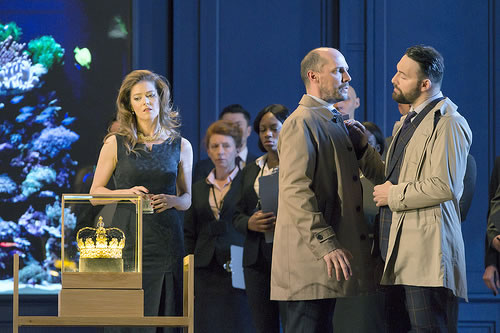
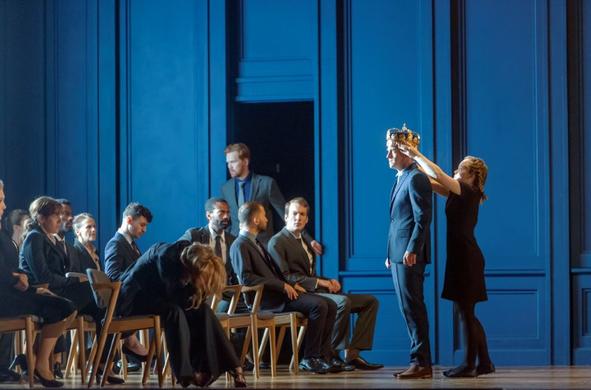
The cynical notion that love is never selfless runs like a thread through the performance. The pursuit of power dominates everything. – Beautifully symbolized by the illuminated royal crown that is continuously ridden on and off the stage on a trolley. As soon as the ‘young king’ is crowned, he decides to kill Mortimer and stab out his eyes. The son has learned his ‘lessons in love and violence’.

Crimp may be Benjamin’s dreamed librettist, that does not necessarily apply to the opera itself. Although his texts are poignant and musical, they are too abstract to give the characters psychological depth. Therefore you can’t identify with even one single character, they’re all equally cold and heartless. Only the little daughter – simply ‘the girl’ – manages to evoke some compassion. As a silent bystander she makes her childlike attachment to and concern for her father emotionally palpable – a brilliant performance of Ocean Barrington-Crook.

Sultry music

Benjamin juxtaposes the ghastly atmosphere on stage with sultry music full of subtle and luscious timbres. The subcutaneous tension is present from start to finish in terrifyingly dissonant sound fields, cleverly packaged in sweet-voiced harmonies. – However paradoxical this may sound. This softly smouldering fire is pierced by loudly flaring eruptions of brass and percussion. Benjamin closely follows the text and his music sometimes reminds us of the expressionism of Berg or Schoenberg. The lyrical, parlando vocal lines recall the operas of Benjamin Britten.

Wagner peeps through when the orchestra tells a different story than the singers. For instance in the brilliant duet between Isabel and the king in the fourth scene. While he bitterly shouts out his anger at the murder of Gaveston, we hear deceptively sweet and hushed strings. Beautiful are the muted hammering on a cimbalom and stately harmonies in the sixth scene. The king is dead, but Gaveston, as ‘the stranger’, lovingly embraces him one last time. Earlier, a lonely hand drum had already announced their death.

Stifling universe

It is quite obvious that Benjamin wrote his parts with these specific singers in mind. The baritone Stéphane Degout is an imposing king, Gyula Orendt convinces as Gaveston despite a small rasp in his voice. Barbara Hannigan enchants us as Isabel, her tone is full and creamy even in the highest registers. The clear and powerful tenor of Peter Hoare perfectly suits his role a Mortimer. Samuel Boden is a wonderfully pure boy/young king.

The staging of Katie Mitchel is effective. The seven scenes take place in a bedroom, viewed from different perspectives. Fish swim in a colourful illuminated aquarium at first, but after a few scenes this only contains a barren pile of stones. Windows are missing: in this bleak universe death prevails. The stifling atmosphere is emphasized by the fact that the characters often move in slow motion.

George Benjamin himself leads the Radio Philharmonic Orchestra, which once again shows its class with a subtle interpretation of his smouldering music. Unfortunately, however, it can’t bring to life the icy tragedy.

The National Opera/Holland Festival
George Benjamin/Martin Crimp: Lessons in Love and Vio9lence
The opera runs until July 5th.

#BarbaraHannigan #GeorgeBenjamin #GyulaOrendt #LessonsInLoveAndViolenc #MartinCrimp #PeterHoare #SamuelBoden #StéphaneDegout

George Benjamin: ‘I appreciate detail and spontaneous incursion’

Just out: ‘Een os op het dak: moderne muzizek na 1900 in vogelvlucht’. Despite VAT increase still available for € 14,95.

Amsterdam School of Architecture: Museum Het Schip (photo from own website)

In 2015 George Benjamin, the Royal Concertgebouw Orchestra, female singers of the Dutch Chamber Choir and countertenor Bejun Mehta brought the world premiere of Dream of the Song. On 17 and 18 January this highly successful song cycle sounds again. Now it forms part of a programme around the idealistic architecture that was initiated in 1919 by Gaudí in Spain and the Amsterdam School in the Netherlands. Benjamin was kind enough to answer some questions.

What, to you, is the relationship between architecture and music – if any?

In essence, they could not be more different. Architecture works with physical materials within space, while in music intangible sound passes through time. Yet architecture is often used as a metaphor for music. And indeed, musical structures need foundations – deep rhythmic and harmonic underpinning – to function; some modern music requires something akin to scaffolding in order to be realized. If you look at it on a formal scale, the proportions in music are not far removed from those of architecture. So there are many analogies, but also vast differences.

How important is architecture in your own work? Do the structures arise intuitively or do you make a design in advance that you ‘fill in’ with notes?

For me, architecture is essential. Indeed, even the most beautiful musical invention is worthless if it is presented within a flawed global structure. I will never simply design prefabricated structures and ‘fill up’ them with music. This is an idea contrary to my nature, although several composers I highly respect have worked along these lines. The crucial concern here is what precisely the pre-designed model involves, and with what attitude (and liberty) it is applied.

Personally I appreciate too much the potential of detail, the spontaneity of invention and the element of surprise to let myself be imprisoned within too rigid a frame. Equally, I don’t simply grope my way forward into a piece, merely improvising from moment to moment. I need a fairly detailed conception of the nature of a composition – above all on a technical level – before I can actually start composing. Perhaps a good analogy to my own personal procedure is this: I invent a musical ‘organism’ without having accurately defined far in advance how it will behave.

A hundred years ago, both the Catalan Antoni Gaudí and the architects of the Amsterdam School developed a new architecture with the aim of providing workers with better living conditions. What do you think of their architecture?

I admire both schools for their eccentricity and exceptional individuality. In Gaudí’s work I’m also touched by the way the study of nature has tangibly influenced and inspired his work. When I was in Amsterdam last summer for my opera Lessons in Love & Violence, I was taken to Museum Het Schip, dedicated to the Amsterdam School. I was very charmed by the building’s sense of fantasy, both in detail and in the overall scale. Especially the brickwork exudes a capricious sense of delight, humour and charm. – Characteristics that I would not necessarily expect from a twentieth-century building with such utopian social ambitions.

Oliver Harrison designed images to be shown along with ‘Dream of the Song’. Are they related to Gaudí and/or the Amsterdam School?

No, the visuals around the Amsterdam School are tailored to Christiaan Richter’s new composition, Wendingen. Oliver Harrison’s work is related to my own piece and is in a different direction altogether. Harrison plays with calligraphy in highly imaginative and playful ways. He deconstructs and multiplies individual letters, exploiting them as mere particles and regrouping them in ways that evoke figurative images in a semi-abstract way. This relates in particular to the first song in my score, ‘The Pen’, which is about calligraphy.

What do you expect from the interaction between the images and the music?

It simply depends on how it is done. Music that sounds simultaneously with song, dance and play has achieved universal acclaim over centuries, so why not music with animation? It remains such a fresh and fascinating art form – as it happens my passion for classical music was triggered when I saw the film Fantasia as a young child.

In Dream of the Song the animation functions as a frame. The visuals only appear in the interstices between movements, announcing the titles of the individual songs with a flourish of intricate calligraphy. Except for one single moment, the images never coincide with the singing. So hopefully they will not detract from the rapport between our great soloist Bejun Mehta and the audience.

On Friday 18 January I’ll give a pre concert talk from 7.15-7.50 pm, in which I’ll also speak with Christiaan Richter, whose commissioned piece ‘Wendingen’ will be premiered, and to Blai Soler, whose ‘Sol’ will be performed in Holland for the first time.

#AmsterdamseSchool #BejunMehta #BlaiSoler #ChristiaanRichter #DreamOfTheSong #GeorgeBenjamin #RoyalConcertgebouwOrchestra

Winkelwagen - Boekenbestellen.nl

(C&P aus Bluesky:)

#GeorgeBenjamin
"Written on Skin" #DeutscheOperBerlin #Berlin
WP 2012 in Aix-en-Provence

Was für ein packendes Opernwerk, nicht nur wegen der Horror-Handlung, deren Abgang bis zur letzten Sekunde für eine volle Spannung sorgt, sondern auch kompositorisch. Die Musik ist ungemein ästhetisch ebenso durchdacht, dass ein Pianissimo manchmal mehr Impakt hervorruft als ein Fortissimo.
Countertenor A.N.Cohen 👏 Bravo!
Die Insz. von Mitchell dürfte die der Premiere sein. (1

(C&p aus Bluesky:)

#GeorgeBenjamin
"Written on Skin" #DeutscheOperBerlin
Besetzung. #Berlin #Opernreisen
Ein literarisch geiler (👈 *antiintellektuell*) Stoff.

Am 27.01.2024 hat die Oper
Written on Skin
von #GeorgeBenjamin
Premiere an der Deutschen Oper #berlin

Dieser Trailer hat mich schon sehr neugierig gemacht, so dass ich mit das Stück, das nach der Premiere noch bis zum 15.02.204 gespielt wird, ansehen werde.
#Oper #DeutscheOper #Premiere #WrittenOnSkin
👇
https://video.culturebase.org/m/a/r/c/_/marc_albrecht_und_aryeh_nussbaum_cohen_ueber_written_o.2024.film.lang_de.sub_en.mp4.mp4?ecmUid=406043&ecmId=445860083822&campaign=52268152&utm_medium=newsletter&newsletter=CAM_20240112_WrittenOnSkin_BildHeadline

‘I threw my pop records in the bin’: George Benjamin on his defining moments – and his latest opera
https://www.theguardian.com/music/2023/sep/13/george-benjamin-picture-a-day-like-this-crimp-messiaen-disney?CMP=Share_AndroidApp_Other
#GeorgeBenjamin
‘I threw my pop records in the bin’: George Benjamin on his defining moments – and his latest opera

As Picture a Day Like This comes to the London stage, the composer speaks about finding his dream collaborator, entering ‘a different dimension’ with Olivier Messiaen – and the day Disney changed his life

The Guardian
15-02-20 @[email protected], #Ópera, #IntoTheLittleHill, de #GeorgeBenjamin, a cargo de @[email protected] de @[email protected] y @[email protected] dirigida por #TimMurray. Impresionantes voces de #JennyDaviet (soprano) y #CamilleMierckx (mezzo). Mención a la escenografía de #MaxGlaenzel. ¡Maravillosos!