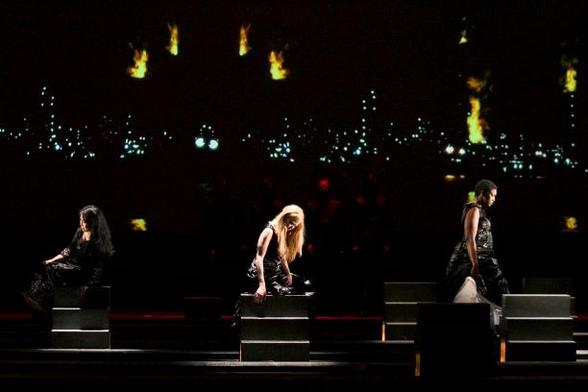
Julia Bullock sings Anne Trulove in #TheRakesProgress: ‘Anne is a very mature woman’

Julia Bullock (c) Christian Steiner

At the first opportunity he abandons her. He leads a debauched life, marries someone else and ends up in the madhouse. Yet Anne Trulove keeps loving Tom Rakewell, the main character in The Rake’s Progress. On 1 February, Dutch National Opera will present its fourth production of Stravinsky’s opera, staged by Simon McBurney.

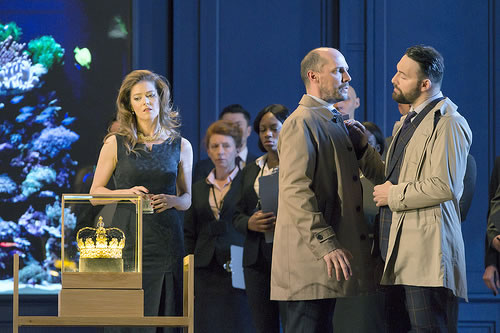
It’s a collaboration with Aix-en-Provence, where the opera was premièred in July 2017. The same vocal cast performs in Amsterdam, accompanied by the Dutch Chamber Orchestra under Ivor Bolton. The young American soprano Julia Bullock sings the role of Anne Trulove. Bullock: ‘Anne faces her emotions, learns from them and continues. She is a very mature woman.’

Reading the libretto of W.H. Auden and Chester Kallman I can’t help asking myself what on earth Anne sees in the weakling Tom. Julia Bullock laughs exuberantly at my bewilderment, but then carefully chooses her words. ‘Tom is an intelligent, ambitious and warm person; Anne is attracted by his energy, his liveliness. The opening scene at once offers various dynamics, but most important is the dynamics between Tom and Anne. They express their mutual love. And whatever this implies, it must be presented as sincere and real’.

Tom is an unfaithful rake, who is seduced by Nick Shadow to lead a debauched life in London. Yet Bullock abstains from condemning him outright. ‘He is someone with great ambitions, getting the chance to realise them. If you get every conceivable possibility handed to you on a silver platter, this brings along quite a lot of temptations. This applies to everyone, but some can handle this better than others. Tom is less stable and self-confident than Anne, though I do not believe she is trying to save him.’

‘I consider it important to convey that their love relationship really goes deep, that their concern for each other is sincere. Despite the unholy path he follows, she remains faithful to him.’ Anne’s behaviour set Bullock thinking about her own life: ‘I recently got engaged myself. If Christian were going through a difficult time, or even if we were splitting up, I would still like to be there for him.’

The soprano finds a new challenge in every piece: ‘I learn from each composer and from any character I perform. Anne is a remarkable person. She copes with the many difficult personalities and situations that come her way. Moreover, she has the gift of constantly growing her compassion and love. Anne is certainly not a silly girl, but a mature and thoughtful human being.’

Once more Bullock’s contagious laugh fills the room: ‘It’s refreshing to have to train that muscle in myself while working on this piece. The more so because of the intimate way director Simon McBurney works. This sometimes leads to tensions, but there is great mutual respect. Perhaps he goes home and gets really furious at his performers, but during rehearsals he is very patient. I regularly cry out: this is not going to work! Yet we always find a solution. Simon was a performer himself and acquaints you step by step with the character you are interpreting.’

‘As for Anne, of course she has intense and also negative feelings. Sometimes she is extremely angry, bitter or deeply sad. Simon helps me to shape all these layers emotionally, psychologically and physically. He strives for authenticity, it must never be artificial. Thus I learn to internalize my character and make contact with the Anne inside me. She is able to admit strong emotions; she learns from them and goes on. Tom, on the other hand, carries circumstance after circumstance with him. I think that’s also what is haunting him and ultimately driving him mad. If you can’t let go of a trauma, you will disassociate from yourself, because it becomes too hard to bear.’

Tom imagines being Adonis and ends up in the madhouse. Anne plays along with this delusion at first and pretends to be Venus, but leaves him alone in the end. Is she choosing for herself after all? Bullock: ‘You could say that, but what can she do really? No matter how important her presence is to Tom, in his new world Anne remains peripheral. She may have been tempted to be part of their love story again, but he is in a place where she just cannot follow him. Once again, it testifies to her adulthood that she acknowledges this.’

But what development does Tom make? After all, the title of the opera is The Rake’s Progress. ‘You should ask Paul Appleby, who sings his role,’ says Bullock, thoughtfully raking her fingers through her curls. ‘For me, his progress lies in a form of self-realisation. Tom reaches a point where he sees who he was, what he wanted to achieve and where he ended up landing.’

‘He wanted to take up an elevated position throughout his life, hence the fantasy of the gods. But that’s not the sort of place a human being can function within, at least not permanently. We can have moments of ecstasy, but Tom wanted to always be in this heightened reality, this heightened world. Towards the end he increasingly reaches that insight. He is not totally lost, but accepts the reality of his life. You hear this in the music, which ends calm and simple. Tom has finally found his peace, he is not wrestling anymore.’

Like this blog? Buy me a coffee or tea via PayPal (friends option), or a direct transfer to NL82 INGB 0004261694, TJM Derks Amsterdam. Thanks!!

#AnneTruelove #DutchNationalOpera #IgorStravinsky #JuliaBullock #NederlandsKamerorkest #SimonMcBurney #TheRakeSProgress

Julia Bullock

Contemporary Classical - Thea Derks

George Benjamin on his opera Written on Skin: ‘We emphasize the unnatural’

George Benjamin (1960) is composer in focus of the coming Holland Festival. Apart from the Dutch premiere of his recent opera ‘Lessons in Love & Violence’ there’s a semi-staged performance of ‘Written on Skin’. Benjamin composed this highly successful opera in 2012 for the Festival of Aix-en-Provence, where it was premiered by the Mahler Chamber Orchestra. This orchestra will now perform it in Muziekgebouw aan ‘t IJ Amsterdam with a new vocal cast.

George Benjamin with the score for his opera Written on Skin © Faber Music Ltd

In 2012 I interviewed Benjamin on the occasion of the Dutch premiere for Muziekvan.nu, a new-music website that was discontinued in 2015. Here is a translation of my article, originally published on 27 September 2012.

In July 2012, the world premiere of George Benjamin’s opera Written on Skin was the highlight of the Festival in Aix-en-Provence. It is a medieval story about a cruel landowner who hires a young illustrator to record his heroic deeds. When the boy starts an affair with his wife Agnes, he kills him and forces her to eat his heart. Hereafter she commits suicide. Benjamin and librettist Martin Crimp present the characters as a kind of archaeologists, who summon up the old story and simultaneously bring it to life.

When I meet George Benjamin on Wednesday 26 September, he has just been rehearsing with the Nederlands Kamerorkest (Dutch Chamber Orchestra) for four hours. Excited, he says: ‘It was the first Sitzprobe, in which singers and musicians go through their parts together without acting. It was fantastic, the orchestra plays exceptionally well.’

The premiere in Aix-en-Provence was performed by the Mahler Chamber Orchestra, but the singer are largely the same in the production of Dutch National Opera. Benjamin wrote his parts with these specific performers in mind.

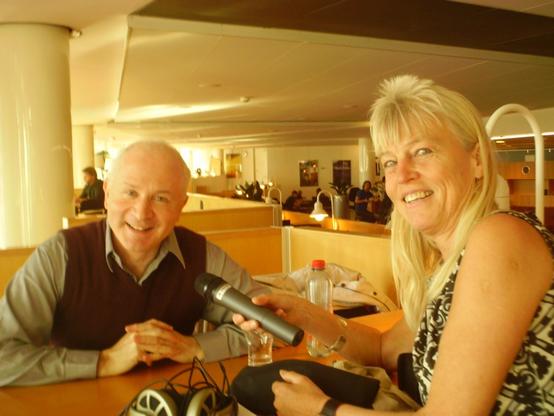
George Benjamin & Thea Derks, Dutch National Opera 26 September 2012

You started working with the singers in 2008. Why so early?

Benjamin: ‘I didn’t want to compose for an abstract, idealized type of voice, but for people of flesh and blood. At the request of Bernard Foccroule, director of the Festival in Aix, we chose a medieval saga from the Languedoc, the region to which the city belongs. In order to fit the characters in with my own composition methods, I went in search of singers even before I had put one note to paper.

Once I’d found them, I invited them to my home, where I made an inventory of their possibilities. Apart from things such as colour, strength, agility and vocal range, I also noted what they like or don’t like to sing. It was very special that all five of them accepted straightaway, because I didn’t disclose anything of the libretto. – While composing I like to keep the horizon close to myself.

The role of the illustrator is sung by the countertenor Bejun Mehta. Why he?

I imagined it would be great to compose a love scene in which a high female voice and a high male voice encircle each other. There is a splendid example in Monteverdi’s Poppea; I find this much more attractive than a combination of a soprano with the usual tenor or baritone. Moreover, Bejun has a beautiful timbre and is a great and intelligent artist. He’s ideal for this role: a seductive, dangerous artist who enters the kingdom and makes trouble is a perfect fit for a countertenor, precisely because it is unusual to hear a man sing so high.’

You wrote the leading role for the soprano Barbara Hannigan, who cannot sing it in Amsterdam. What does that mean for you?

At first I thought it was terribly unfortunate. Barbara is the ultimate star and her interpretation of Agnes in Aix was remarkable. She sings the fiercest passages in complete fearlessness, but can also be intensely lyrical and remain very precise all along. Her interpretation was mesmerizing and enchanting, but she’d been booked for the role of Lulu in Brussels years ago. I regret she cannot be here now, but I’d like to stress I am very happy with the Swedish soprano Elin Rombo. Although she impersonates Agnes very differently I didn’t need to change one note in my score.

Did you give the different characters their own kind of music, use leitmotifs perhaps?

Certainly no leitmotifs, for I hate those: it’s as if the characters continually present their business cards, as Debussy once joked. However, I do associate the characters with certain instruments. For example, I use bassoons and horns for the ruler. In the beginning, when he still radiates a certain nobility and warmth, I accompany his vocal lines with celli.

I try to evoke the splendid colours of the boy’s illustrations with unusual instruments, such as mandolins, glass harmonica and viola da gamba. At times also by combining stopped trumpets playing in a low register with low overtones from the harp. But it is never obvious, it works on an unconscious level. At least that’s what I hope, as a composer I don’t intend to give any clues as to what you should hear and feel at which moment.

Whence the title ‘Written on Skin’?

First of all, the boy draws on parchment, which is made from animal skin. Martin and I requested to view a thirteenth-century document in The British Library. It was moving to touch this: it felt fresh and a little chilly, as if it had been made yesterday. Yet it was eight hundred years old! Furthermore, thanks to the boy, the woman becomes more self-confident and starts rebelling against her husband’s authority. After he has forced her to eat the heart of her loved one, she triumphantly tells him he can never undo what the boy has written on her skin. A metaphor, of course, but with an erotic undertone.

The characters not only act their role, but also comment on it. Does this not create a distance?

I think it works the other way round. Opera is intrinsically unnatural, but a hundred years after Puccini we live in a film age. I find it absolutely unconvincing to see people singing on stage while behaving in a naturalistic way as in a Hollywood production. That is why we have consciously emphasized the artificiality. Three angels tell the story from a contemporary perspective and, in passing, bring it to life. In the first erotic scene Agnes and the boy look deeply into each other’s eyes – nothing has happened yet, but the meaning is clear.

I love how the singers at the same time say their lustful lyrics and comment on them – “says Agnes” – “says the boy”. I find the mixture of warm eroticism and cool artificiality much more interesting than conventional language. Precisely by acknowledging that what happens on stage is artificial, the audience can be absorbed by it all the more spontaneously.

Through his approach Martin lifts the story a few centimetres above the ground. And exactly in that space comes my music. Without this my music would be superfluous.’

Part of our interview can be heard on Soundcloud 

https://www.youtube.com/watch?v=6ie8IJ_1cLg

#BarbaraHannigan #BejunMehta #DutchNationalOpera #GeorgeBenjamin #HollandFestival #LessonsInLoveViolence #MartinCrimb #WrittenOnSkin

Teodor Currentzis: Music to die for

Teodor Currentzis (c) Anton Zavyalov

He is praised and reviled for his idiosyncratic approach to classical masterpieces. According to Teodor Currentzis (1972) this is ‘a myth, I only do what the composer wants’. On Monday 7 May he will make his debut at Dutch National Opera with his own musicAeterna in Mozart’s  La clemenza di Tito. The production is directed by Peter Sellars and was premiered in Salzburg in August 2017.

Organizing a talk with the controversial conductor turns out to be quite a challenge. After weeks of intensive correspondence, Teodor Currentzis agrees to an interview – the following day. When I call him at the agreed time in Vienna, I am kindly asked to wait another five to ten minutes, the rehearsal with Camerata Salzburg lasts somewhat longer than planned. Two hours and many repeated calls later I finally get him on the phone. But then he takes all the time to answer my questions.

Creating spaces in music

He politely but resolutely parries my observation that he is apparently a perfectionist, given the ever-expanding rehearsal. ‘You can put it that way, but I would put it differently. I am dedicated to music and always try to achieve what I have in mind, that takes time. For me, music is not simply a way to fill in the empty spaces in my life. The exact opposite is true: my life is at the service of the spaces I create in music.’

How are we supposed to understand this, I can’t help asking, being a typically down-to-earth Dutchwoman. My question sparks off an enthusiastic plea from the Greek-Russian maestro about the metaphysical value of music. It represents nothing less than the Good, the True and the Beautiful, and makes us into better people. With this conviction, Currentzis fits in seamlessly with Russian composers who counterbalanced the barbarity of the Soviet dictatorship with spiritually inclined works.

Natural harmony

‘I don’t see music as a series of sounds, but as a new form of communication that brings about natural harmony’, says Currentzis. ‘Our language, which has been developed over thousands of years, can only describe everyday matters that are absolutely necessary. It is becoming increasingly poorer and clumsier, and cannot express the really important things. We are stuck to our mobile phone all day, physical contact disappears. Instead of going for a walk with friends and enjoying the sunset, we have a conversation via Skype or Facebook. But music expresses the very essence of life.’

Contrary to this spirit of the times, Currentzis founded his orchestra and choir musicAeterna in 2004, with which he initiates an ever-expanding audience into these deeper layers of meaning. In preparation for a concert, visitors are a week long immersed in public rehearsals, master classes, workshops and lectures by philosophers, musicologists and psychologists.

Laboratory

‘I’ve created a laboratory in which we work with sensitive people’, says the conductor. ‘They are open, willing to look for the truth within and to enter into a relationship with what is happening on stage. This gives them as much insight into the performed works as the musicians themselves.’

Starting in Novosibirsk, the capital of Siberia, he moved musicAeterna to Perm in 2011, some two thousand kilometres westwards. At the time, this relatively small city presented itself as the centre of a cultural revolution and offered Currentzis the opportunity to develop his idealistic concepts in peace and quiet. All his musicians and singers followed suit. The public also keeps coming in: ‘Our concerts in Moscow and St. Petersburg are sold out months in advance, people come from all over Russia and even Europe.’

Renewing listening practice

Currentzis denies that with his approach he would preach mainly for his own parish. ‘I am not only looking for communication with intellectuals, we also play in squares, in hospitals and prisons, or for junkies. I notice that non-experts are often more open than the usual white audience, who think they already know everything.’

He is convinced that our listening practice should be renewed. ‘Listening to music is not about an opera fan who visits the same opera again and again, only with other singers, to judge how he or she takes the high note. Music is not a joke, it can transform us, it can teach us to love, forgive, help, show pity and compassion, cherish hope.’

Unconditional dedication

Too many orchestras ignore this transcendent quality, he believes. ‘They approach music as a nine-to-five job, playing as if they are office clerks. Instead of conveying emotion, they erect a wall between performer and listener.’ For him, the success of musicAeterna lies in the unconditional dedication of both musicians and singers. ‘We make music to die for, every concert anew.’

Still, he calls it a myth that his performances are contrary. ‘I do exactly what the composer asks. The usual concert practice is stuck in twentieth-century performing habits, as we know them from recordings on Deutsche Grammophon or EMI. When Mozart indicates “thunder” in his score, the strings play hushed sixteenths, so you don’t hear a thunderstorm at all. Tchaikovsky asks for ecstasy and scores six times forte, yet they play mezzoforte. They make completely different music than the composer intended.’

Mozart: contemporary composer

À propos Mozart: Currentzis once called him a contemporary composer. ‘I still think so. Historically speaking, the world has not evolved in essential matters, only in superficial things such as clothing, medicine, gadgets. But all the good and bad things we had ages ago are still the same today. Mozart does not speak in concrete terms about aesthetics, but about the asymmetrical beauty of our lives. He is contemporary because he has found the golden spot of harmony, where different energies are combined into one all-encompassing energy. Therefore he will never become old-fashioned.’

Read my review.

Liked my interview? Any support is welcome through PayPal, or transfer to my bank account: T. Derks, Amsterdam, NL82 INGB 0004 2616 94. Thanks!

#DutchNationalOpera #LaClemenzaDiTito #Mozart #PeterSellars #TeodorCurrentzis

Teodor Currentzis (c) Anton Zavyalov

Contemporary Classical - Thea Derks

George Benjamin on Lessons in Love & Violence: ‘Martin Crimp wrings music from me’ #HF18

The world premiere of George Benjamin’s opera Lessons in Love & Violence unleashed a true flood of 4 and 5 star reviews. Martin Crimp wrote the libretto, as he had done for Benjamin’s earlier operas Into the Little Hill and Written on Skin. Crimp was the first librettist who managed to tap into Benjamin’s compositional vein. On Monday, June 25, Lessons in Love & Violence will have its Dutch premiere at Dutch National Opera, Amsterdam. The composer will conduct the Netherlands Radio Philharmonic Orchestra himself, Barbara Hannigan sings the female leading role.

Lessons in Love & Violence, with Barbara Hannigan (c) ROH/Stephen Cummiskey

Because of his sensual, colourful sound tapestries, George Benjamin (1960) is often called a kindred spirit of Claude Debussy. Although he had been dreaming of becoming an opera composer since his teenage years, it was not until 2006 that he presented his first, the one-act play Into the Little Hill. Martin Crimp’s libretto was based on the saga of Hamelin’s rat-catcher. Only two singers, a mezzo-soprano and a soprano, take on all the roles. This assignment of the Paris Festival d’Automne was an instant success. A cd recording conducted by the composer won a Diapason d’Or in 2017.

In 2012 the second collaboration between Crimp and Benjamin, Written on Skin, created a sensation during its premiere at the Festival d’Aix en Provence. In the ghastly libretto, a ruler forces his adulterous wife to eat the heart of her lover. Written on Skin is considered the undisputed masterpiece of twenty-first century opera. The Dutch audience and members of the press greeted the first performance in the Netherlands with similar enthusiasm. Certainly not a matter of course for contemporary opera.

For his third opera, Lessons in Love and Violence, George Benjamin once again collaborated with librettist Martin Crimp and director Katie Mitchell. Having based Written on Skin on a folk tale from the Provence, this time Crimp sought inspiration in his homeland. The once again gruesome story full of murder and slaughter is loosely based on the life of King Edward II.

Why did you wait so long to compose your first opera?

For years, a quarter of a century to be precise, I was looking in vain for a suitable librettist. I had a list of about fifty themes and spoke to many poets, playwrights, film and theatre directors. I asked them all for advice, but simply didn’t find anyone who could tap into my creative vein. With one or two I took a minuscule step in the direction. We cautiously discussed possible projects, but that was all. Never, really never did we even come near a real cooperation.

At one point, some fifteen years ago I had given up. Not necessarily in despair, but it occurred to me that I would never find a way to write for the stage. Until a few years later I got to know Martin Crimp, who serves me better than I had ever dared to hope for. My fellow teacher Laurence Dreyfus subtly brought us together by organising a joint lunch. The moment I met Martin, I felt: this is someone I can work with!

What does Crimp have that other librettists don’t?

First of all, it is a very delicate matter to work with someone, especially when it comes to something as intense as opera. You invest a large part of your creative personality in the other, you give him access to your world. That applies to both sides. Martin is the ideal partner for me, generous and sensitive.

Moreover, he is a wizard with words. I am a great admirer of the structures he builds and the powerful emotions he expresses in his plays. His use of language is so special, original and idiosyncratic that it stimulates my imagination enormously. Since I got to know him, my creativity has increased considerably. Including Lessons in Love and Violence, this has now yielded some 4.5 hours of music.

In 2012 you told me that Crimp lifted the text off the ground, as it were. How are we to understand this?

His lyrics are essentially very simple. They are about love, hatred, power, death – in short, the essential things of life and of human interaction. He uses few long words and the sentences themselves are often short, as well. That makes them ideally suited for singing. His language is completely understandable, but at the same time there is something peculiar about it. It’s not the way people normally speak. Underneath the easily digestible surface lies something weird, something scary that I find attractive.

It’s hard to say precisely what this is, but when you read three sentences from him you know they are his. The words of the characters are part of a passionate and spontaneous drama as well as of an architectural construction, almost like a crystal. This ambivalence between comprehensibility and artificiality invites me to write music. As if you were giving electricity to a lightbulb. If his texts were normal and predictable, how and why would I set them to music? Martin’s words inevitably wring music from me.

Both Into the Little Hill and Written on Skin contain a lot of cruelty. What is the attraction of morbidity?

I fear that Lessons in Love and Violence is even more fierce, cruelty is part of our lives. This was already the case with the Greeks, who invented the theatre. I have always found opera considerably more moving than any other art form. More gripping than literature, painting or concert music. Opera – if it works – has an overwhelming emotional eloquence. You have to tap into that ability, both in the choice of subjects and in the way in which you shape the themes and stories.

When Martin and I started working together, he asked me to make a list of the reasons why people sing. I had to dig deep to think of all the possible circumstances that make people burst into song. Both in real life and on stage. You don’t sing when everything is normal, but at moments of extreme happiness or total despair. The operas that are most dear to me – Kát’a Kabanová; Boris Godunov; Pelléas et Mélisande; Wozzeck – do not shy away from the deepest and most essential events in our lives.

That also includes horrible things. If – and I really mean if – you manage to create something coherent, to see something through to the bitter end, then even the most terrible story potentially brings great joy. Because you don’t collapse under the load, but face it. It’s much less satisfying to avoid something dark because you can’t handle it. Paradoxically, the very opposite is a source of happiness.

What are the dark things in ‘Lessons in Love and Violence’?

I won’t give away too much, but it is loosely inspired by the life of the British King Edward II, his lover Gaveston and his wife Isabel. It takes place at about the same time as Written on Skin. Only this time we haven’t tried to evoke a medieval atmosphere.

In ‘Written on Skin’, the characters are simply called ‘the ruler’, ‘the boy’, only the wife has a name. Does ‘Lessons in Love and Violence’ have the same approach?

That’s something Martin does. It is not just a peculiarity, by the way, but also has real meaning. When the woman in Written on Skin sings: “My name is Agnès!”, that is a turning point in the opera, she rebels against her husband. That would not have been possible if she had been called by her name from the outset. In Lessons in Love and Violence, about half of the characters are referred to by a generic description. After our talk, for example, I will rehearse with “the stranger”.

You will work again with Katie Mitchell, who also directed ‘Written on Skin’. What do you value in her?

 She has a great deal of attention to detail and her work is very coherent. She has no vanity and can read and write with Martin, with whom she has been working for over twenty years. She gets to the heart of what she directs and is completely subservient to the text. Katie doesn’t want to impose things that are foreign to the work, but brings it to life in a powerful and clear way. I find this absolutely admirable.

I also appreciate her receptivity, her sensitivity to music and her emotional response to it. You hear so often that a director mutilates a new opera because he or she decides to go in a different direction. Intent on realizing their own Creator’s Dream, they distort the desires and dreams of the composer and librettist. That’s terrible, when a pieces has taken 4 to 5 years to create. That’s unthinkable with Katie. She’s completely, passionately loyal to the ideas behind the work, and the nature of the work. I can’t stress enough how happy I am with her.

https://www.youtube.com/watch?v=O-YeMyESTAs

George Benjamin: Lessons in Love & Violence, 25 June to 5 July, Dutch National Opera/Holland Festival.

#DutchNationalOpera #GeorgeBenjamin #KatieMitchell #LessonsInLoveAndViolence #MartinCrimp

Tannhäuser at DNO: no ‘director’s theatre’ but subtle view on hypocrisy around love

Daniel Kirch, Ekaterina Gubanova, Björn Bürger (c) Monika Rittershaus

Recently, a petition was launched for the restoration of Olivier Keegel’s press accreditation by Dutch National Opera. They no longer provide press tickets because he fiercely attacked Pierre Audi’s programming on the Flemish blog Operagazet and in the Dutch newspaper Het Parool. Moreover, he denounced Audi’s predilection for ‘director’s theatre’, in which to his view content falls prey to a far-fetched ‘vision’ of the director.

I often strongly disagree with Keegel. As with his ludicrous crusade against the production Aus Licht around Karlheinz Stockhausen in the coming Holland Festival. Nor do I like the harsh tone of voice in which he formulates his objections. Nevertheless, I signed the petition. Dissenting opinions are necessary for artists and art institutions, for they provide an opportunity to define one’s own mission even more sharply.

Keegel might not find fault with the new production of Richard Wagner’s Tannhäuser. Director Christof Loy closely follows Wagner’s libretto. With subtle gestures he makes the hypocrisy around courtly versus sensual love poignantly perceptible. In doing so, he makes use of mirror effects, as simple as they are inventive.

Beneath the neat surface, carnal lust is rampant

First of all, there is the stage setting. For four hours we see the imposing salon of a nineteenth-century gentlemen’s club. It functions as the sultry lovers’ den of Venus and Tannhäuser, as the abode of the fraternity of singers, and even as a church.

During the overture the singers make love to extremely young ballerinas and each other – in tailcoats. Later they react with horror to Tannhäuser’s carefree laudation of sexual intercourse; only thanks to Elisabeth he is not lynched. The message is clear: beneath the neat surface, carnal lust is rampant.

Secondly, there are the costumes. Love goddess Venus (the impressive mezzo-soprano Ekaterina Gubanova) wears a voluminous black dress and a glamorous white fur coat. Her earthly rival Elisabeth (the soprano Svetlana Aksenova) is dressed in an equally flamboyant white dress. In the sinister third act she appears in a somewhat shabby black women’s suit.

Saint or sinner: two sides of the same coin

When Elisabeth sacrifices her life for Tannhäuser’s salvation, Venus watches over her for minutes. Her posture resembles the painting of Madonna and Child that Elisabeth previously clutched in her arms. In the end, Venus lovingly covers her rival with her white cloak.

Thus Loy once again pinpoints bourgeois morality. For indeed things are never simply black or white: saint or sinner, ascetic or lecher, they are two sides of the same coin. No surprise then that at the end the seductive ballerinas once again throw themselves in the arms of the gentlemen.

Loy further illustrates the ubiquitous hypocrisy in Elisabeth’s ambivalent attitude towards Wolfram (the excellent baritone Björn Bürger). Even while expressing her love for Tannhäuser, she caresses him like a lover. This is reflected in Tannhäuser’s double-hearted behaviour. He finds no satisfaction in the physical lovemaking with Venus, nor in Elisabeth’s chaste love. Unfortunately the tenor Daniel Kirch is not an ideal Tannhäuser, his voice is rather shrill.

Graceful cantilenas

Still there is much to enjoy musically. The bass Stephen Milling is an impressive father of Elisabeth, the young soprano Julietta Aleksanyan is a beautiful lyrical shepherd. The DNO Choir is deeply moving in their flawless, subdued interpretations of the Pilgrim’s Choir and the Siren Choir. Also effective are the brass fanfares blasting into the hall from the balconies; you literally imagine yourself to be in the Wartburg. Thus the strings of the Netherlands Philharmonic Orchestra even gain extra depth.

The woodwind instruments play a starring role. Many times (bass)clarinet, (alto)oboe and or flute encircle the voices of the singers with graceful cantilenas. The harp also has appealing solo passages in this romantic score by Wagner. Hats off to conductor Marc Albrecht who sustains the tension from beginning to end, keeping the textures transparent even in the loudest fortissimo passages.

In short: a successful production by Tannhäuser.  – I’d be really interested in reading Olivier Keegel’s opinion.

Tannhäuser runs through 1 May.

#BjörnBürger #ChristofLoy #DanielKirch #DutchNationalOpera #EkaterinaGubanova #MarcAlbrecht #NederlandsPhilharmonischOrkest #OlivierKeegel #Tannhäuser #Wagner

Monika Rittershaus

Contemporary Classical - Thea Derks

La Cenerentola Rossini: coloraturas by linear metre


La Cenerentola (c) Matthias Baus

The first thing that catches the eye when entering the Dutch National Opera is the large number of young people who crowd into the cloakroom. The organisation has emphatically advertised its new production of La Cenerentola (Cinderella) as a ‘family performance’. A special information sheet provides insightful explanations of the voice types used and the story of Cinderella, as told in different cultures. The overwhelming cheering afterwards illustrates that Laurent Pelly has managed to strike the right chord with his witty and imaginative directing.

Unlike in Grimm’s fairy tales, Angelina/Cinderella in Rossini’s La Cenerentola does not suffer under a harsh stepmother, but under her surly stepfather Don Magnifico. He pampers daughters Tisbe and Clorinda from his second marriage, but squanders Angelina’s inheritance it and treats her like a doormat. Her two stepsisters constantly boss Angelina around and shower her with curses. Meanwhile, she dreams of a better life.

While she mops the floor in her apron, Angelina sings a folk song about a king who wants to get married. Three candidates compete for his crown, but he prefers ‘innocence and goodness’ to ‘pride and beauty’. Angelina tells and predicts her own story in a nutshell. No wonder her sisters are irritated and order her to stop singing.

But their disdain comes at a price, of course, as it goes in fairy tales. Before he chooses his wife, Prince Ramiro conducts some field research. Disguised as a beggar, his counsellor Alidoro knocks on Don Magnifico’s door. The sisters hone him away, but Angelina feeds him. Signalled by Alidoro, Ramiro changes roles with his chamberlain Dandini to take get a personal impression. As soon as he meets Angelina, the two immediately fall in love, and after a seemingly endless series of entanglements they get married.

In this opera Rossini commented on the enormous differences between rich and poor, a theme that is still topical today. But librettist Jacopo Feretti argues: whoever is born for a dime like Angelina can eventually become a quarter. Laurent Pelly has shaped this hopeful message with great humour. – Although he wisely leaves it open whether the happy end is real or imagined: at the end Angelina is alone again, mopping the floor in her filthy apron.

The daily life of Angelina and her family takes place in a 1950s setting, with rundown washing machines, frayed sofas and an old-fashioned TV. Prince Ramiro’s world is set in pink, in an 18th century atmosphere, right down to the costumes of his lackeys. Also in pink are the princely props, consisting of chandeliers, a royal banquet and lush ballroom that magically descend from the ceiling. – A striking depiction of Angelina’s dream world, even though the association girl-pink may be somewhat clichéd.

Laurent Pelly seamlessly interweaves parody with seriousness, which ties in nicely with Rossini’s own attitude towards ingrained opera conventions. His characters often sing head-on towards the audience, with grand gestures that mercilessly illustrate their vanity. Pelly accentuates the many accents in Rossini’s music with sudden head jerks, arm movements and rhythmically placed steps. Often to hilarious effect, especially in the ensembles and choral passages.

The cast is excellent. The mezzo-soprano Isabel Leonard is a captivating Cinderella. With her somewhat small but warm and agile voice, she seemingly effortlessly interprets Rossini’s neck-breaking coloraturas. As Ramiro, the tenor Lawrence Brownlee also tackles Rossini’s super-fast word sequences with apparent ease. With his imposing stature and ditto baritone, Nicola Alaimo is a wonderfully self-righteous Don Magnifico.

The baritone Alessio Arduini shines as the chamberlain who is allowed to play the role of prince for a while and the stepsisters are venomously portrayed by soprano Julietta Aleksanyan and mezzo-soprano Polly Leech. Both are studying at the National Opera Studio and know how to convince on slippers as well as on towering pumps under ridiculous hoop skirts. But the most impressive is the Italian bass Roberto Tagliavini, who glorifies with his deep, sonorous voice and great stage presence.

The Netherlands Chamber Orchestra and the men’s choir of Dutch National Opera, conducted by the 36-year-old Italian conductor Daniele Rustioni, bravely plod their way through Rossini’s incredibly difficult score. If truth be told, La Cenerentola is not a masterpiece: it contains a lot of interchangeable passagework and Rossini delivers coloraturas per linear metre. The rhythmic complexity sometimes leads to unevenness in orchestra and choir, and at times the soloists are out of sync. If Rustioni would not gesticulate so wildly, he might better master the musical complexities.

Though judging from the frenzied support, this was of no concern at all to the audience.

The above is a slightly adapted translation o my review of the opening night on 3 December, as published in Theaterkrant

#DutchNationalOpera #LaCenerentola #LaurentPelly #RobertoTagliavini #Rossini

La Cenerentola | Nationale Opera & Ballet

De uitbundige opera La Cenerentola (Assepoester) belooft een onvergetelijke decemberproductie te worden voor de hele familie (8+). 

Nationale Opera & Ballet

Mathilde Wantenaar on her new opera A Song for the Moon: ‘With music you can achieve anything’

Mahtilde Wantenaar (c) Karen van Gilst

In 2013 Mathilde Wantenaar (Amsterdam, 1993) participated in the project Boom|Amsterdam is an opera, two years later she wrote the mini-opera Personar for the first edition of the Opera Forward Festival. In March her family opera Een lied voor de maan (A Song for the Moon) was to have its world premiere in that very festival. Like all concerts in the Netherlands the performances were cancelled because of the outbreak of Covid-19. Let’s hope the planned performances in Madrid, Munich and Aix-en-Provence in May and June will proceed. Here’s the interview I conducted in February.

Mathilde Wantenaar’s love for music was instilled by her parents. Her mother teaches singing, her father plays the accordion, piano and bandoneon, and as long as she can remember she was surrounded by music at home. She played the guitar and cello herself, accompanied her mother’s students and sometimes sang along with them. She also composed her own pieces early on. – Something she initially considered to be her ‘own crazy little thing’; the idea of becoming a composer only arose when she took part in a composition project by Asko|Schönberg at secondary school.

Human voice

In 2011 she enrolled for the preparatory course at the Conservatory of Amsterdam, where she subsequently studied composition, with cello, piano and singing as secondary subjects. Already during her studies she won several prizes, among others in the Alba Rosa Viëtor Composition Competition and the Princess Christina Competition. After graduating in 2016 she applied for a follow-up study in singing at the Royal Conservatoire in The Hague.

From early childhood Wantenaar has had a great affinity with the human voice. In recent years this has led to a series of successful vocal works for renowned Dutch musicians and ensembles such as the soprano Johannette Zomer, the quintet Wishful Singing, the Netherlands Chamber Choir and the Dutch Radio Choir. It was obvious that one day there would be a sequel to her 20-minute opera Personar with which she concluded her composition studies.

Opera

‘As a child I regularly went to operas with my parents’, says Wantenaar. ‘I secretly dreamed of composing one myself, even though I initially considered my children’s pieces and rumblings at the piano to be a private thing. In that respect I lived completely in my own fantasy world. – Until I started thinking about what I would become when I grew up. When I auditioned for the Conservatory of Amsterdam, I was asked where I saw myself in ten years’ time. I answered I hoped to write an opera for Dutch National Opera. – For the big stage.’ She smiles furtively, as if she were ashamed of her youthful hubris.

That’s why she immediately accepted when Dutch National Opera offered her to take part in the workshop ‘composing for a youthful audience’ of the European Network of Opera Academies. The idea of creating a fairy-tale opera originated in 2017, during a workshop conducted by dramaturge Willem Bruls at La Monnaie in Brussels. ‘We formed a team, in which this idea bubbled up. But the question was what kind of fairy-tale exactly? So we started reading a lot of books and someone from the team tipped A Song for the Moon by Toon Tellegen, which she had read to her children herself.’

Toon Tellegen

‘I’ve known Toon Tellegen’s work for a long time, my parents used to read his stories to me when I was little. I still enjoy them. – Occasionally I read them to my boyfriend before we go to sleep. During a period when I was out of my depth at the conservatory I read the collection Misschien wisten zij alles (Maybe they knew everything) in one go. The stories are at the same time comforting, uplifting, wonderful and above all very beautiful. They lifted me above my grief and made me calm.’

However, she did not yet know A Song for the Moon when it was proposed. ‘When I read it, I was immediately touched. It appealed to me that Tellegen broaches themes like loneliness, identity, disappointment and friendship. I especially like the fact that music plays a central role in it, ideal for an opera. The Mole, the main character, undergoes a true development. In the beginning he is a bit shy and insecure, but in the end he crawls out of his shell thanks to the music, makes friends and goes out into the wide world.’

Cheering up the Moon

Wantenaar wrote the libretto herself, together with Willem Bruls, keeping as close as possible to the original: ‘Toon Tellegen’s language is already very musical and imitable. There are five singers and six instrumentalists and the opera lasts about an hour.’

‘In the first act, the Mole is on stage alone. He is lonely and seeks contact with the Moon, but when he greets it he gets no response. He wonders why. Can’t the Moon talk, doesn’t he want to talk, or doesn’t he know what to say? All those things of course also concern the Mole himself, but he doesn’t want to face his own loneliness. He decides to write a song to cheer up the Moon. This proves not to be easy, but in the end he succeeds and shows it to the Grasshopper, who is a conductor.’

‘Together they form an orchestra in the second act, with singing mice and Frog, the diva-tenor. This act is a somewhat comical counterpart to the quiet and sad first movement. They rehearse the song and perform it for the Moon, but when they look up expectantly afterwards, it looks rather sad. Everyone is deeply disappointed and the Mole crawls back into his little hole defeated. He wonders if the Moon is angry now, and may come down to shine straight in his face.’

The power of music

‘In the third and final act the Mole receives composition lessons from the wise Cricket. He looks at the song and says: “I know! It’s a beautiful song, but gloomy.” He changes a lowered tone (a flat tone is calles “mol” in Dutch) into a sharp one (a raised tone), upon which the song suddenly becomes cheerful. Yet the Mole doesn’t quite dare to believe in it yet. He needs the courage of the Grasshopper to present the new version to the Moon.’

‘This time the Moon does looks happy afterwards, he even glows! For a moment the Mole still has doubts about himself, but then he realizes he is good as he is: “I am the Mole and I remain the Mole. Sometimes I’m gloomy, but sometimes I’m cheerful.” He finds the courage to step up to the Earthworm and make his first real friendship. So everything turns out all right at the end of the opera.’

‘The great thing is that the story is easy for children to follow, but at the same time has so much philosophical depth that it is also interesting for adults. The Cricket sings: “With music you can achieve anything”. To me, that’s the core of this opera.’

More info and playlist here

#ASongForTheMoon #DutchNationalOpera #MathildeWantenaar #ToonTellegen #WillemBruls

Mathilde Wantenaar: Lush harmonies in new piece for Dutch Radio Choir

This season NTRZaterdagMatinee makes up for decades of neglecting female composers, featuring well-known names such as Kaija Saariaho and Unsuk Chin next to lesser-known composers such as Calliope …

Contemporary Classical - Thea Derks

Aida goes Black Lives Matter

It is night. Behind the windows of an immense hall, some scanty cars and cyclists pass by. The deserted space is filled with what seem to be rows of beds waiting for patients. An improvised covid-19 hospital? Then the camera zooms in and we see the contours of design tables.

Against a soundtrack of departing underground trains, fragments from Aida and a cacophony of interplaying instruments, the rest of the building is also explored. Our gaze skims past stacked chairs, steel tubes, wooden palisades, technology rooms and clothing racks. The penny drops: we are in a decor studio.

In Proximity (c) DNO/Kim Krijnen

With this opening of In nabijheid (In proximity) the artistic team hits the bull’s eye in this fourth production of OFFspring, a project of Dutch National Opera (DNO) in which the latest generation of theatre makers responds to performances that were cancelled due to corona. After all, in this bleak-industrial setting the sets and costumes are made that take us into the artificial world displayed in performances. In this case the Egypt of Aida, the opera Verdi composed in 1871 for the opera house of Cairo without ever setting foot in Egypt. Although the libretto recounts the rapprochement between an Ethiopian princess and an Egyptian soldier, the music remains stuck in ‘orientalism’, composed as it is from a typically Western, colonial view.

We can do better, opined the artistic team commissioned to formulate a response to Verdi’s classic. While demonstrating in the Nelson Mandela park in the context of Black Lives Matter, the four up-and-coming talents became even more acutely aware of Aida’s ‘imperialist discourse’. When, during the demonstration, they heard a performance by the men’s choir Black Harmony, they immediately decided to enter into dialogue with them and their different, unfamiliar world.

As a matter of course they strove to work on the basis of equality and mutual respect. Five singers of Black Harmony find their match in as many men of the choir of DNO. The two groups meet in territory that is both familiar and unknown. Like DNO’s set design studio, Black Harmony is based in Bijlmer, but has no experience with opera; DNO singers normally rehearse in the Music Theatre in the centre of Amsterdam, but now commuted to this district in the Southeast of town.  

The composer Sílvia Lanao Aregay uses the sound of underground trains to connect both worlds. The metro also appears in Gershwin Bonevacia’s poem about a man who describes how he is going to explore the world via the underground railway. ‘Hope you want to help me find my way’ says a voice on tape (Danny Westerweel), while a lonely dancer (Dan Radulescu) meanders through the different spaces. Some singers sing excerpts from the same poem, embedded in polyphonic, sustained tones of the others.

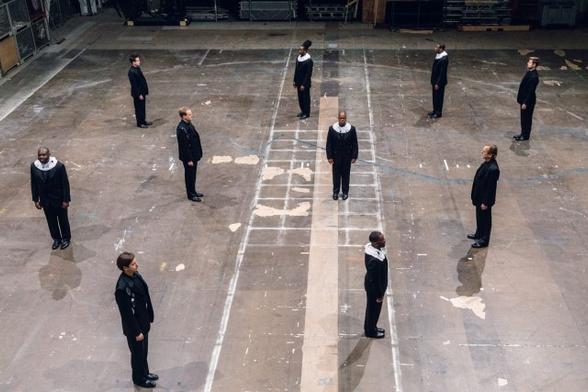
While singing, the ten men form intermingling geometric patterns, always respecting social distancing and dressed in black gala costumes. They don striking accents of costume designer Allysia van Duijn: the men of DNO wear a white cummerbund, the members of Black Harmony have white lace collars. These are reminiscent of the portraits that painters such as Frans Hals and Rembrandt made of the ruling class. A witty reversal, since the elite portrayed largely owed their wealth to slavery.

Director Stijn Dijkema and scenographer Han Ruiz Buhrs cross-cut the images with earlier shots of duos of one black and one white singer facing each other in casual attire. Contemplative, level-headed, challenging, sometimes dismissive, but gradually more trusting, culminating in a liberating smile at the end.

While the white singers continue walking their patterns, larding their polyphonic singing with muttered lyrics, Orlando Ceder, leader of Black Harmony, starts an Afro-Surinamese song, now answered with polyphonic singing by the other members of Black Harmony. Their colourful tunics refer to African clothing.

Even if you don’t understand a word of Sranontongo, their interpretation is compelling. They perform a melancholic, orally transmitted song from their ancestors, who worked on the plantations of Dutch rulers. The DNO singers gradually join in. Lanao Aregay manages to forge the two essentially different singing styles into a wonderfully coherent whole.

After the liberating smiles of the duos have broken through, the ten gentlemen form a queue. While singing they traverse the building, in the swaying pass we know from funeral rites in St. Louis; the dancer makes exuberant whirls in the empty hall. The singing dies away and the electronic music returns, including the underground sounds. These now carry a hopeful message: no matter how great a distance may seem, it can always be bridged.

With In proximity the four young makers and their team powerfully illustrate the social relevance of opera. This fourth production within the framework of OFFspring definitely tastes like more.

This review was first publishes in the Dutch magazine Theaterkrant

#Aida #BlackHarmony #BlackLivesMatter #DanRadulescu #DannyWesterweel #DutchNationalOpera #HanRuizBuhrs #OFFspring #OrlandoCeder #SílviaLanaoAregay #StijnDijkema

Rob Zuidam zooms in on Joanna the Mad in his opera Rage d’Amours: ‘Joanna took me by the hand’

In 2005, Dutch National Opera and Holland Festival presented Rob Zuidam’s opera Rage d’Amours. Five years later, he received the Kees van Baaren Prize for this blood-curdling production about the life of Joanna The Mad. The award ceremony was part of the Festival Dag in de Branding, with a performance by Residentie Orkest conducted by Otto Tausk.

In its next edition on 10 April, Dag in de Branding will present a video recording of this performance from its archives. In 2005, I interviewed Zuidam about his opera for the programme book of Dutch National Opera. Below is an abridged version.

Amsterdam, June 2005, interview with Rob Zuidam on Rage d’Amours

Rob Zuidam (c) Maarten Slagboom

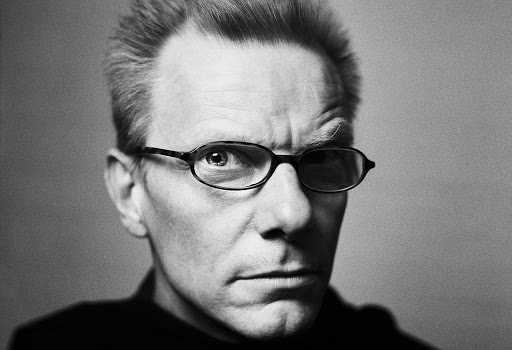
Rob Zuidam (1964) began his career in a rock band, but his interests did not quite run parallel to those of the other band members: ‘I wanted mainly to rehearse, preferably all day, but they were more interested in blowing and drinking than in making music. Besides, I soon felt the need to break through the usual rock schemes, but that required an alertness they couldn’t muster. So I started messing around with tape recorders myself.’

In the process, Zuidam became interested in all the music he could find in Rotterdam’s Central Discotheque, from Aboriginals and Eskimos via the usual classics up to and including the twentieth century: ‘Modern music particularly appealed to me, and through record sleeves I discovered new names all the time. When I read that someone had studied composition with Olivier Messiaen, I suddenly realized you could apparently learn to compose. Shortly afterwards I went to the Conservatory in Rotterdam, where the doorman referred me to Klaas de Vries.’

Even though he was hardly technically gifted, he was accepted. He was taught by the Belgian composer Philippe Boesmans and Klaas de Vries and soon developed into someone who, with flair, combined modern composition techniques with direct eloquence. In no time he became an internationally renowned composer.

In 1994 the Munich Biennale commissioned him to compose his first opera, Freeze. The libretto, written by Zuidam himself, tells the story of the millionaire’s daughter Patricia Hearst, who is kidnapped and joins the ranks of her captors. In this opera, Zuidam effortlessly combines juicy film music, cabaret and ripping guitar solos with the great intervals so typical of the post-war avant-garde.

Love beyond death

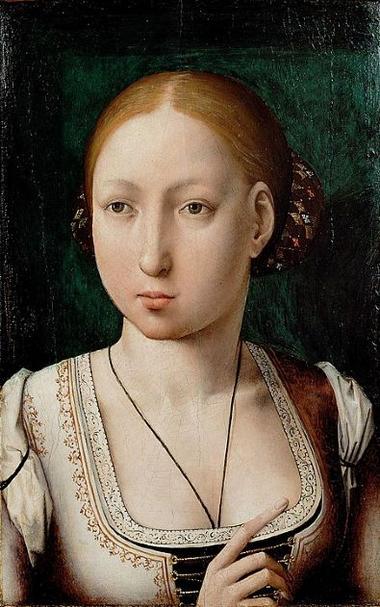
His second opera, Rage d’Amours, about the life of Joanna The Mad (1479-1555), followed in 2003 and was composed for the Boston Symphony Orchestra. ‘A friend once drew my attention to the wife of Philip the Handsome (1478-1506), who, after his death, dragged his corpse through Spain in the hope that he would come back to life. In the end they locked her up, after which she looked out from a dungeon on her husband’s grave for forty-six years.’

Joanna The Mad painted by Juan de Flandes

Zuidam was immediately captivated by her passion: ‘She asked nothing more of life than to be with her husband forever. I find this devotion both admirable and disturbing. Her love is truly imperishable: no matter what state Philip’s body is in, she continues to love him. This is contrary to our human nature, for which appearance is of great importance. We all have moments when we have to decide whether or not to give in to our impulses. Joanna decides to devote her life to her lover and does so with total abandon. That ecstasy fascinates me.’

For Rage d’Amours Zuidam again wrote the libretto himself, basing it on contemporary Spanish, French and Latin writings. ‘In a book about Joanna The Mad I found references to sixteenth-century sources. I came across the account of an anonymous chronicler, who describes Joanna’s life from the inside, in old French, the language of the court. It is a kind of fairy-tale French, so beautiful that I based a large part of the libretto on it.’

The reporting is detailed and straightforward, says Zuidam: ‘The author was clearly an intimate of the couple. He describes, for instance, how Philip slept with about every young lady that crossed his path, and the raging jealousy – ‘rage d’amours’ – this incited in Joanna. We also get a detailed description of how Philip’s corpse is cut apart and embalmed, and of how Joanna then travels across Spain with his coffin, neglecting her personal hygiene, not washing herself and peeing in her clothes.’

‘I have given these texts to the composer Pierre da la Rue, who acts as narrator’, continues Zuidam. ‘As a member of the Royal Chapel he was on intimate terms with both Philip and Joanna: they affectionately called him Pierchon. In the seventh scene, when Joanna kisses the corpse, I have quoted part of his motet Delicta juventutis, which he composed on the occasion of Philip’s death.’

Three Joanna’s

Interestingly the role of Joanna is divided among three sopranos. Zuidam: ‘The opera is set in a dungeon, which functions as a metaphor for her head. The three voices bring her obsession and torment to the surface. Joanna 3 has a solo in the second scene, in which she and Philip are threatened with shipwreck. While the bystanders scream murder, she remains deadly calm: she does not care if they drown, for after all, she is together with her husband. She is the unshakeable one.’

Joanna 2 represents her exalted side: while the monks dismember her husband’s corpse, she sings ‘mi amado’, my beloved over and over again. The carnal, necrophilic aspect is represented by Joanna 1, who embraces the corpse in the seventh scene. More often they are together Joanna, as at the beginning, when they sing a lament. I found that a moving image, three lamenters mourning over a coffin. Once I had the idea of having Joanna sung by three singers, inspiration started flowing immediately.’

The story of the Spanish queen’s life is indeed poignant, but it doesn’t generate much action. How has Zuidam created tension nevertheless? ‘I sailed by my inner compass. For example, in the intense fifth scene Joanna 2 sings her passionate declaration of love, and it wouldn’t be wise to continue with something laden after this. So I inserted a short scene in which a cleaning lady polishes the floor, accompanied by her own brushing and a contrabass clarinet. This is followed by the passage in which the coffin is opened so that Joanna can kiss the corpse.’

Rage d’Amours (c) Hans Hijmering

Philip, although already dead at the beginning of the opera, is sometimes shown alive. As in the eighth scene, in which he sings a heartrending love duet with Joanna 1, later joined by the other two Joanna’s. ‘I wanted to capture something of the first, happy period of the young couple. I searched for suitable texts for a long time, and finally found them in the Song of Songs. They have exactly the sublime purity that I was looking for.’

Although Zuidam did not consciously strive for local colour, the music of Rage d’Amours is very much in keeping with the Renaissance, with subtle references to Flemish polyphony and quasi-Gregorian chant. And some of the embellishments of the vocal lines sound unmistakably Spanish. The composer considers this inevitable: ‘Music and subject are interwoven. Freeze is set in 1970s California, so that opera is much poppier. Rage d’Amours is set in the sixteenth century, the pace is slower and the overall sound is different.’

‘In any case, I now have the idea I have come to the core of what I wanted to say. On the one hand because I have more experience, on the other because of the theme. Although I was fascinated by Patricia Hearst, deep down I still thought she was a silly rich girl, whereas Joanna touched me intensely: I really started to love her.’

This helped Zuidam while composing: ‘Take the fifth scene, for instance, which came about quite intuitively: everything was ready and waiting. Sometimes I wondered whether the music would become too exalted, but in those dark moments Joanna took me by the hand. Then the music wrote itself.’

My blog was named one of the 60 best classical music blogs worldwide on Feedspot.
If you’d like to support me: any gift is welcome through PayPal, or transfer to my bank account: T. Derks, Amsterdam, NL82 INGB 0004 2616 94. Thanks!

The scene picture shows the premiere in 2005, with from left to right: sopranos Young-Hee Kim, Barbara Hannigan and Claron McFadden. Reinbert de Leeuw conducted Asko|Schönberg, Guy Cassiers staged the opera. In 2019 a recording was released on CD.

https://www.youtube.com/watch?v=BH2Wa8__2v4

#DagInDeBranding #DutchNationalOpera #JoannaTheMad #OttoTausk #PhilipTheHandsome #PierreDeLaRue #RageDAmours #ResidentieOrkest #RobZuidam

Loss of an engaging sphinx – Pierre Audi died unexpectedly in Beijing

Pierre Audi, the headstrong opera director who brought Dutch National Opera world fame with his adventurous productions, died on the night of May 2 to 3. He suffered a heart attack in Beijing, where, according to The New York Times, he was ‘for meetings related to future productions’, but was ‘preparing a reprise of one of his productions’, according to Le Figaro. With his demise, Audi leaves a huge void in the international theatre scene.

Pierre Audi (c) Sarah Wong

In the Netherlands, Audi, born in Beirut in 1957, shook up the mothballed Netherlands Opera (later renamed De Nationale Opera) considerably. He was hired in 1988 as a complete unknown director –lacking any experience in opera– by then director Truze Lodder, who had recognized his amazing talents as director of the avant-garde Almeida Theatre he had set up in London in his twenties. Audi grabbed his opportunity and set to work relentlessly.

Earthly elements

Audi at once made a name for himself with his staging of Il ritorno d’Ulisse in patria in 1990. He soon developed a completely unique signature, in which empty playing surfaces, fire and other earthly elements play a prominent role. Perhaps best known are his several times repeated productions of Wagner’s integral Der Ring des Nibelungen and the gigantic enterprise Aus Licht in 2019. This production in the Holland Festival presented no less than 15 hours out of the 29 hours of Karlheinz Stockhausen’s opera Licht, die sieben Tage der Woche in the Amsterdam Gashouder.

https://www.youtube.com/watch?v=QI3A0Er5Agw&ab_channel=NationaleOpera%26Ballet

When he left Dutch National Opera in 2018, after 30 years of service, it occupied a prominent place on the theatrical world map. In recent years, Audi was both artistic director of Festival D’Aix en Provence and Park Avenue Armory in New York. Nevertheless, he continued to live in Amsterdam with his wife and two children.

I myself got to know Audi during my study of musicology, when in 1995 I was involved as an intern in his production of the Schoenberg trilogy, with the one-acts Erwartung, Die glückliche Hand and Von heute auf morgen. For Erwartung, he had the stage filled with real trees, forming the forest through which the female protagonist wanders confused.

Amiable

Audi also remained a fixture in my later life as a music journalist. Many times I interviewed him for NPOKlassiek, the Dutch classical radio station, and in 2019 I made a reportage on his spectacular production Aus Licht, which included the controversial Helikopter-Streichquartett.

https://open.spotify.com/episode/7JP6kQ8LRYLutrherA653I

Audi was distinctly amiable, and despite his ever busy schedule, he always found time for a talk. Calmly and thoughtfully he formulated his views on the subjects at hand. His brown eyes invariably gazed penetratingly into mine, yet nevertheless he also remained somewhat distant and elusive, like a sphinx. When once I teased him in a column that he invariably spoke English despite his long stay in our country, he presented his next press conference in Dutch.

In 2004 I browsed through his record closet with him, for the magazine of the Asko Ensemble and the Schönberg Ensemble (later merged into Asko|Schönberg and renamed Het Muziek as of season 2025-26). With his somewhat nasal voice and French-tinged Dutch, he declared that he intended to listen to the many CDs still wrapped in cellophane after his retirement. –

Unfortunately, Audi never made it that far. He died in harness, aged 67. I will miss him.

Below our talk on his cd-collection, published in 2005 in the Asko-Schönberg magazine.

Amsterdam, 1 November 2004

THE RECORD COLLECTION OF PIERRE AUDI

When I ring his bell at the appointed time, someone from television opens the door: the recordings for a documentary are running late. I wait in a room furnished with baroque furniture, but otherwise Spartan; there are no carpets, no paintings on the walls. After a while Audi arrives, excuses himself and leads me into an immense study, where he points to an eighteenth-century semainire. Once its seven drawers secured aristocrats’ shirts for each day of the week; now they serve as a record cabinet. Audi invites me to browse through them, while he once again speaks with the camera crew.

Beethoven alongside Ligeti

Like a thief in the night, I open drawer after drawer. Each of these turns out to be crammed with two rows of CDs, in which the complete string quartets of Beethoven and Haydn are egalitarian juxtaposed with such incendiary operas as Ligeti’s Le Grand Macabre and Birtwistle’s Punch and Judy. The integral symphonies of Bruckner and Sibelius are flanked by recordings of Louis Andriessen, Claude Vivier, Giacinto Scelsi and Mauricio Kagel; compilation boxes of Callas, Furtwängler and Celibidache are sandwiched between albums of Philip Glass, Arvo Pärt and Charles Ives.

Just when I wonder how Audi manages to find a CD of his liking in this chaos, he enters: ‘No problem, because I rarely listen to music.’ – Not even to the operas he stages? ‘I do, but then it only concerns fragments, which I analyse.’ Suddenly fierce: ‘A recording is not the ultimate statement about how an opera should sound, as some critics believe. They come with the sound of a particular CD in their ears, and if the production deviates from that, they don’t like the singers, or the conductor, or both. That shows mental laziness: a recording only gives an impression of the vision of a certain group of people at a certain time under a certain conductor.’

Wrapped CDs

At least a third of his CDs are still  wrapped in cellophane. Why does he buy so many if he doesn’t listen to them anyway? ‘That’s for when I retire, I’m afraid they will no longer be available then. They form a time document: they represent a need I felt at certain times in my life; that way I can relive this later.’ But when I ask him what his first purchase was, he replies, puzzled: ‘I don’t remember…’

We go to a side room filled from floor to ceiling with books and LPs. He stares at the records and says, ‘It started with film music. I wanted to be a film director and from the age of ten I collected everything I could find in that field.’

Among the soundtracks of films by Fellini, Pasolini, French and American filmmakers, there are also some LPs with music by Scelsi, Handel and Bach. ‘Around age 16, I also became interested in modern and classical music.’ Rock music and jazz are missing. ‘Don’t ask me why, but that never interested me…’

No opera!

What music will he listen to first after retirement? ‘Definitely not opera, the human voice forces one to think, because of the text. Also no Mahler, because his music is so theatrical, it is too close to the voice… Bach, but especially modern composers, I want to really immerse myself in their pieces.’

‘In addition, I long for a more meditative form of listening, for music with which I feel synergy. For instance that of Russian composers, their work is evocative and spiritual.’ Does he mean composers such as Pärt and Gubaidulina? ‘No, I’m thinking of Tchaikovsky, Mussorgsky, the classics.’

With a longing smile, ‘Maybe I’ll start listening even before my retirement, when I finally have a home in the country…’

https://www.youtube.com/watch?v=eu0uDOPAgFc&ab_channel=NationaleOpera%26Ballet

#DutchNationalOpera #GyörgyLigeti #KarlheinzStockhausen #PierreAudi #TruzeLodder