George Benjamin on Lessons in Love & Violence: ‘Martin Crimp wrings music from me’ #HF18
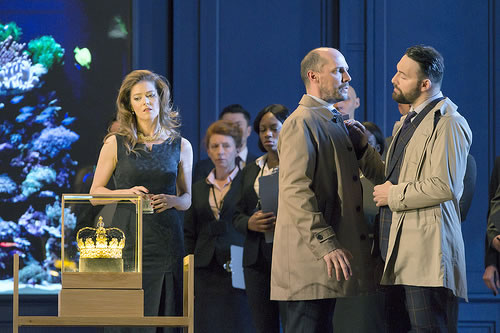
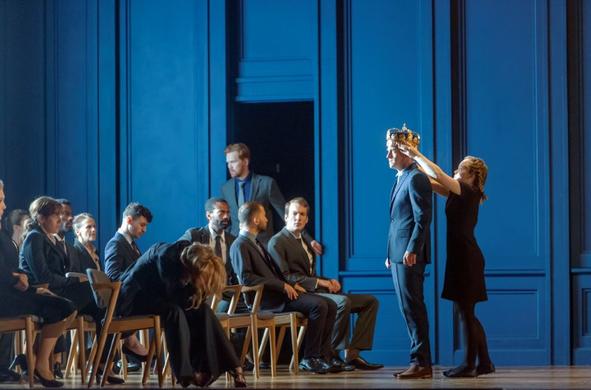
The world premiere of George Benjamin’s opera Lessons in Love & Violence unleashed a true flood of 4 and 5 star reviews. Martin Crimp wrote the libretto, as he had done for Benjamin’s earlier operas Into the Little Hill and Written on Skin. Crimp was the first librettist who managed to tap into Benjamin’s compositional vein. On Monday, June 25, Lessons in Love & Violence will have its Dutch premiere at Dutch National Opera, Amsterdam. The composer will conduct the Netherlands Radio Philharmonic Orchestra himself, Barbara Hannigan sings the female leading role.
Lessons in Love & Violence, with Barbara Hannigan (c) ROH/Stephen Cummiskey
Because of his sensual, colourful sound tapestries, George Benjamin (1960) is often called a kindred spirit of Claude Debussy. Although he had been dreaming of becoming an opera composer since his teenage years, it was not until 2006 that he presented his first, the one-act play Into the Little Hill. Martin Crimp’s libretto was based on the saga of Hamelin’s rat-catcher. Only two singers, a mezzo-soprano and a soprano, take on all the roles. This assignment of the Paris Festival d’Automne was an instant success. A cd recording conducted by the composer won a Diapason d’Or in 2017.
In 2012 the second collaboration between Crimp and Benjamin, Written on Skin, created a sensation during its premiere at the Festival d’Aix en Provence. In the ghastly libretto, a ruler forces his adulterous wife to eat the heart of her lover. Written on Skin is considered the undisputed masterpiece of twenty-first century opera. The Dutch audience and members of the press greeted the first performance in the Netherlands with similar enthusiasm. Certainly not a matter of course for contemporary opera.
For his third opera, Lessons in Love and Violence, George Benjamin once again collaborated with librettist Martin Crimp and director Katie Mitchell. Having based Written on Skin on a folk tale from the Provence, this time Crimp sought inspiration in his homeland. The once again gruesome story full of murder and slaughter is loosely based on the life of King Edward II.
Why did you wait so long to compose your first opera?
For years, a quarter of a century to be precise, I was looking in vain for a suitable librettist. I had a list of about fifty themes and spoke to many poets, playwrights, film and theatre directors. I asked them all for advice, but simply didn’t find anyone who could tap into my creative vein. With one or two I took a minuscule step in the direction. We cautiously discussed possible projects, but that was all. Never, really never did we even come near a real cooperation.
At one point, some fifteen years ago I had given up. Not necessarily in despair, but it occurred to me that I would never find a way to write for the stage. Until a few years later I got to know Martin Crimp, who serves me better than I had ever dared to hope for. My fellow teacher Laurence Dreyfus subtly brought us together by organising a joint lunch. The moment I met Martin, I felt: this is someone I can work with!
What does Crimp have that other librettists don’t?
First of all, it is a very delicate matter to work with someone, especially when it comes to something as intense as opera. You invest a large part of your creative personality in the other, you give him access to your world. That applies to both sides. Martin is the ideal partner for me, generous and sensitive.
Moreover, he is a wizard with words. I am a great admirer of the structures he builds and the powerful emotions he expresses in his plays. His use of language is so special, original and idiosyncratic that it stimulates my imagination enormously. Since I got to know him, my creativity has increased considerably. Including Lessons in Love and Violence, this has now yielded some 4.5 hours of music.
In 2012 you told me that Crimp lifted the text off the ground, as it were. How are we to understand this?
His lyrics are essentially very simple. They are about love, hatred, power, death – in short, the essential things of life and of human interaction. He uses few long words and the sentences themselves are often short, as well. That makes them ideally suited for singing. His language is completely understandable, but at the same time there is something peculiar about it. It’s not the way people normally speak. Underneath the easily digestible surface lies something weird, something scary that I find attractive.
It’s hard to say precisely what this is, but when you read three sentences from him you know they are his. The words of the characters are part of a passionate and spontaneous drama as well as of an architectural construction, almost like a crystal. This ambivalence between comprehensibility and artificiality invites me to write music. As if you were giving electricity to a lightbulb. If his texts were normal and predictable, how and why would I set them to music? Martin’s words inevitably wring music from me.
Both Into the Little Hill and Written on Skin contain a lot of cruelty. What is the attraction of morbidity?
I fear that Lessons in Love and Violence is even more fierce, cruelty is part of our lives. This was already the case with the Greeks, who invented the theatre. I have always found opera considerably more moving than any other art form. More gripping than literature, painting or concert music. Opera – if it works – has an overwhelming emotional eloquence. You have to tap into that ability, both in the choice of subjects and in the way in which you shape the themes and stories.
When Martin and I started working together, he asked me to make a list of the reasons why people sing. I had to dig deep to think of all the possible circumstances that make people burst into song. Both in real life and on stage. You don’t sing when everything is normal, but at moments of extreme happiness or total despair. The operas that are most dear to me – Kát’a Kabanová; Boris Godunov; Pelléas et Mélisande; Wozzeck – do not shy away from the deepest and most essential events in our lives.
That also includes horrible things. If – and I really mean if – you manage to create something coherent, to see something through to the bitter end, then even the most terrible story potentially brings great joy. Because you don’t collapse under the load, but face it. It’s much less satisfying to avoid something dark because you can’t handle it. Paradoxically, the very opposite is a source of happiness.
What are the dark things in ‘Lessons in Love and Violence’?
I won’t give away too much, but it is loosely inspired by the life of the British King Edward II, his lover Gaveston and his wife Isabel. It takes place at about the same time as Written on Skin. Only this time we haven’t tried to evoke a medieval atmosphere.
In ‘Written on Skin’, the characters are simply called ‘the ruler’, ‘the boy’, only the wife has a name. Does ‘Lessons in Love and Violence’ have the same approach?
That’s something Martin does. It is not just a peculiarity, by the way, but also has real meaning. When the woman in Written on Skin sings: “My name is Agnès!”, that is a turning point in the opera, she rebels against her husband. That would not have been possible if she had been called by her name from the outset. In Lessons in Love and Violence, about half of the characters are referred to by a generic description. After our talk, for example, I will rehearse with “the stranger”.
You will work again with Katie Mitchell, who also directed ‘Written on Skin’. What do you value in her?
She has a great deal of attention to detail and her work is very coherent. She has no vanity and can read and write with Martin, with whom she has been working for over twenty years. She gets to the heart of what she directs and is completely subservient to the text. Katie doesn’t want to impose things that are foreign to the work, but brings it to life in a powerful and clear way. I find this absolutely admirable.
I also appreciate her receptivity, her sensitivity to music and her emotional response to it. You hear so often that a director mutilates a new opera because he or she decides to go in a different direction. Intent on realizing their own Creator’s Dream, they distort the desires and dreams of the composer and librettist. That’s terrible, when a pieces has taken 4 to 5 years to create. That’s unthinkable with Katie. She’s completely, passionately loyal to the ideas behind the work, and the nature of the work. I can’t stress enough how happy I am with her.
https://www.youtube.com/watch?v=O-YeMyESTAs
George Benjamin: Lessons in Love & Violence, 25 June to 5 July, Dutch National Opera/Holland Festival.
#DutchNationalOpera #GeorgeBenjamin #KatieMitchell #LessonsInLoveAndViolence #MartinCrimp
 DAS OPERNMAGAZIN
 Contemporary Classical - Thea Derks