Our paper on "Hellinger loss function for Generative Adversarial Networks" is posted in arXiv at http://arxiv.org/abs/2512.12267
#Statistics
#HellingerDistance
#NeuralNetworks
#GenerativeAdversarialNetworks
#RobustStatistics
#InfluenceFunction
Hellinger loss function for Generative Adversarial Networks

We propose Hellinger-type loss functions for training Generative Adversarial Networks (GANs), motivated by the boundedness, symmetry, and robustness properties of the Hellinger distance. We define an adversarial objective based on this divergence and study its statistical properties within a general parametric framework. We establish the existence, uniqueness, consistency, and joint asymptotic normality of the estimators obtained from the adversarial training procedure. In particular, we analyze the joint estimation of both generator and discriminator parameters, offering a comprehensive asymptotic characterization of the resulting estimators. We introduce two implementations of the Hellinger-type loss and we evaluate their empirical behavior in comparison with the classic (Maximum Likelihood-type) GAN loss. Through a controlled simulation study, we demonstrate that both proposed losses yield improved estimation accuracy and robustness under increasing levels of data contamination.

arXiv.org
🎓 Ah yes, another 8-minute math lecture turned #snoozefest where "Generative Adversarial Networks" are explained like a bedtime story for data science insomniacs. 🤖💤 Spoiler: it's just another epic battle between a generator and a discriminator, but don't hold your breath for any worthwhile entertainment or clarity. 🥱
https://jaketae.github.io/study/gan-math/ #GenerativeAdversarialNetworks #MathLecture #DataScience #AIEntertainment #HackerNews #ngated
The Math Behind GANs

Generative Adversarial Networks refer to a family of generative models that seek to discover the underlying distribution behind a certain data generating process. This distribution is discovered through an adversarial competition between a generator and a discriminator. As we saw in an earlier introductory post on GANs, the two models are trained such that the discriminator strives to distinguish between generated and true examples, while the generator seeks to confuse the discriminator by producing data that are as realistic and compelling as possible.

Jake Tae

Explore Generative Adversarial Networks (GANs). Learn about their components, types, and real-world use cases in image generation, video editing, and more.

More details: https://solguruz.com/generative-ai/what-is-generative-adversarial-networks-gans/

#generativeadversarialnetworks
#gans
#genAI

What is Generative Adversarial Networks (GANs)?

Explore Generative Adversarial Networks (GANs). Learn about their components, types, and real-world use cases in image generation, video editing, and more.

I find #GenerativeAdversarialNetworks (GANs) to be a form of meta-speculation: a speculative framework which operates at the core of speculative #AI apparatus. No wonder this speculative logic is redundantly used for #deepfakes.
Die Neugestaltung der Plattformökonomie: Synergie von KI-Innovationen und Data Governance

In diesem aufregenden Umfeld ist es die Data Governance, die als zentrales Element des Fortschritts auftaucht.

now.digital | mind the data

I was curious whether it would be possible to let #GANs generate samples conditioned on a specific input type. I wanted the GAN to generate samples of a specific digit, resembling a personal poor man’s mini #DALLE 😅. And indeed, I found a GAN architecture, that allows so-called #ConditionalGANs 💫

🌎 https://www.fabriziomusacchio.com/blog/2023-07-30-cgan/

#MachineLearning #GenerativeAdversarialNetworks

Conditional GANs

I was wondering whether it would be possible to let GANs generate samples conditioned on a specific input type. I wanted the GAN to generate samples of a specific digit, resembling a personal poor man’s mini DALL•E. And indeed, I found a GAN architecture, that allows what I was looking for: Conditional GANs.

Fabrizio Musacchio

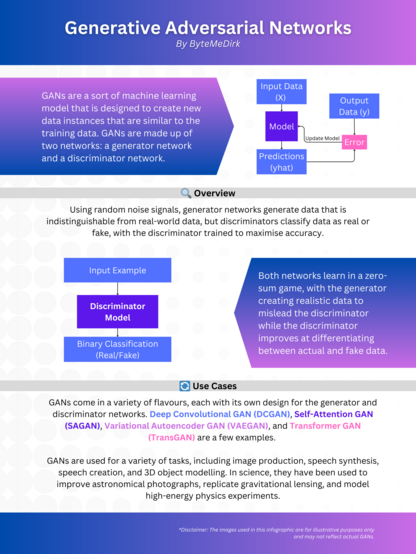
GANs - Generative Adversarial Networks, the boundary-pushing machine learning model that crafts new data instances resembling the training data. 🧠

#GenerativeAdversarialNetworks #MachineLearning #AIInnovation #TechBreakthrough #DataGeneration #MastodonAI #TechWonder #ShareTheKnowledge

The #Wasserstein #metric (#EMD) can be used, to train #GenerativeAdversarialNetworks (#GANs) more effectively. This tutorial compares a default GAN with a #WassersteinGAN (#WGAN) trained on the #MNIST dataset.

🌎 https://www.fabriziomusacchio.com/blog/2023-07-29-wgan/

#MachineLearning

Wasserstein GANs

We apply the Wasserstein distance to Generative Adversarial Networks (GANs) to train them more effectively. We compare a default GAN with a Wasserstein GAN (WGAN) trained on the MNIST dataset and discuss the advantages and disadvantages of both approaches.

Fabrizio Musacchio

Drag Your GAN: Interactive Point-based Manipulation on the Generative Image Manifold

a new point tracking approach, anyone can deform an image with precise control over where pixels go, thus manipulating the pose, shape, expression, and layout of diverse categories such as animals, cars, humans, landscapes, etc.

#video #deepfake #generativeadversarialnetworks #GAN #machinelearning #artificialintelligence #AI #generativeAI #technology #tech #innovation

https://vcai.mpi-inf.mpg.de/projects/DragGAN/

Drag Your GAN: Interactive Point-based Manipulation on the Generative Image Manifold

Synthesizing visual content that meets users' needs often requires flexible and precise controllability of the pose, shape, expression, and layout of the generated objects. Existing approaches gain controllability of generative adversarial networks (GANs) via manually annotated training data or a prior 3D model, which often lack flexibility, precision, and generality. In this work, we study a powerful yet much less explored way of controlling GANs, that is, to