@Gaming on the Fediverse That's quite a bit simplified. For one, four server applications and one protocol were lumped together. Besides, Zap is dead, and Forte isn't even mentioned.

So here's an attempt at telling the whole story (server applications are in bold type, protocols are in bold type and italics):

tl;dr:

2010:
  • DFRN
  • Mistpark/Friendika/Friendica
    (DFRN)
2011:
  • Zot
  • Free-Friendika
    (DFRN)
    (forked from Friendika)
  • several other Friendika forks
    (DFRN)
    (forked from Friendika)
    (discontinued 2011)
  • Red/Red Matrix
    (DFRN, from 2012 Zot)
    (forked from Free-Friendika)
    (rebuilt into Hubzilla 2015)
2015:
  • Hubzilla
    (Zot, later Zot6)
    (rebuilt from the Red Matrix)
2018:
    Zot6
  • Osada
    (Zot6)
    (forked from Hubzilla)
    (discontinued in 2018)
  • Zap
    (Zot6)
    (forked most likely from Osada, maybe from Hubzilla)
    (discontinued in 2022)
  • Osada
    (Zot6)
    (forked from Zap)
    (discontinued in 2019)
2020:
    Zot8
  • Redmatrix 2020
    (Zot8)
    (forked from either Zap or Mistpark 2020 or (the third) Osada)
    (discontinued in 2022)
  • Mistpark 2020 a.k.a. Misty
    (Zot8)
    (forked from either Zap or Redmatrix 2020 or (the third) Osada)
    (discontinued in 2022)
  • Osada
    (Zot8)
    (forked from either Zap or Redmatrix 2020 or Mistpark 2020)
    (discontinued in 2022)
2022:
  • Nomad
    (originally Zot11)
  • Roadhouse
    (Nomad)
    (forked from either Redmatrix 2020 or Mistpark 2020 or (the third) Osada)
    (discontinued in 2022)
  • (streams)
    (Nomad)
    (forked from Roadhouse)
2024:
Forte
(ActivityPub)
(forked from (streams))[/list]
So as far as Fediverse server applications go, he created Friendica, Free-Friendika, a few more Friendika forks, the Red Matrix, Hubzilla, three Osadas, Zap, Redmatrix 2020, Mistpark 2020, Roadhouse, (streams) and Forte. Depending on how you want to count them, that's at least 13 or 14 server applications. Four of these are still being maintained (Friendica by a new team, Hubzilla by another new team, (streams) and Forte by himself).

The long version:

In 2010, he created
  • the DFRN protocol
  • Mistpark (renamed first into Friendika later in 2010 and then into Friendica in 2011)

In 2011, he made several forks of Friendika. The reason was licensing: Friendika was getting quite some attention. As it was under the MIT license, chances were that it was tempting to fork it and turn the fork into a commercial, proprietary, closed-source monolith or something. On the other hand, the GPL in any shape or form would have hindered further development.

So Mike made a number of forks and relicensed all but one: Free-Friendika kept the MIT license and became the main development platform for Friendika. Friendika itself was relicensed under the AGPLv3.

Shortly afterwards, Mike discontinued all forks except Free-Friendika.

The same year, Mike needed something to keep people from losing everything whenever their Friendika home node was shut down. So he invented nomadic identity and created the Zot protocol.

Also the same year, Mike forked Free-Friendika into Red (spanish la red = the network). It would be renamed Red Matrix in late 2012 because "Red" is hard to Google.

In 2012, Mike rewrote Red almost completely. The whole backend was rebuilt against Zot.

However, the Red Matrix didn't take off. Most Friendica users were hosting their own private nodes. Nomadic identity made no sense for them. Besides, it seemed like many Friendica users didn't understand nomadic identity anyway, so they saw no advantage in the Red Matrix over Friendica, seeing as the features were almost identical otherwise. The Red Matrix had to be made more popular for hosting public servers.

So in 2015, the Red Matrix was rebuilt and greatly expanded into Hubzilla.

In 2018, Mike wanted to develop the Zot protocol further into Zot6. But this would have meant compatibility-breaking changes, also because what he wanted to do with nomadic identity over Zot6 was likely to not work with non-nomadic protocols anymore. So he couldn't do that on Hubzilla.

Instead, he made two new forks:
  • first Osada, forked from Hubzilla, which was the original Zot6 development platform and then evolved into a non-nomadic "gateway" between Zot6 and everything else
  • then Zap, forked most likely from Osada or maybe from Hubzilla, which got the whole Zot6 feature set, including nomadic identity, but which lost support for any and all non-nomadic protocols

A bit later, Zot6 became compatible enough with non-nomadic protocols. Forwarding content from Zap via Osada to the rest of the Fediverse was clunky anyway, forwarding content from the rest of the Fediverse via Osada to Zap even more so. So Osada was discontinued.

Instead, a new Osada was forked from Zap and got ActivityPub support. This and the branding were the only differences between Osada and Zap.

In 2019, when both Osada and Zap had become stable, Zap got ActivityPub support itself. The only difference between the two was now that Osada servers had ActivityPub turned on by default, and Zap servers had it turned off by default. It simply didn't make much sense to keep both alive, so Osada was discontinued again.

I think it was also in 2019 that Hubzilla was upgraded to Zot6.

In 2020, Mike made three more forks to develop Zot8, at least one of which was forked from Zap, and those that weren't were forked from one another: Redmatrix 2020, Mistpark 2020 a.k.a. Misty and Osada.

There was a rumour that Zap was the stable one, Misty was a bit more up-to-date, but potentially less stable, Osada was experimental with ActivityPub support on by default, and Redmatrix 2020 was experimental with ActivityPub support off by default. In fact, however, Misty, Osada and Redmatrix 2020 were absolutely identical in all but branding. Mike kept four server applications around to mess with brand fetishists.

In 2022, Mike forked one of the three into Roadhouse to develop Zot11. But Zot11 was no longer compatible with Zot6 as implemented on Hubzilla and Zap, so he declared it a new protocol named Nomad. Roadhouse got additional support for Zot6.

Now Mike had five server applications, still in order to mess with brand fetishists.

Later the same year, Mike forked Roadhouse into something intentionally nameless and brandless. Again, this was done to troll brand fetishists, this time also to facilitate forking and make people think up their own individual names for the fork rather than keeping the existing one. However, the code repository absolutely required a name, so Mike called it streams.

The community needed something to name this nameless thing by, so they took the name of the repository and wrapped it in parentheses to make sure that this is not actually the name. Ever since, it is colloquially being called (streams). By the way, (streams) is running on what would be Zot12 if it wasn't Nomad now.

On New Year's Eve 2022, Mike discontinued Zap, Redmatrix 2020, Misty, Osada and Roadhouse. (streams) was stable enough, and the other five could be upgraded not only to each other by rebasing the server code, but also to (streams). He asked all admins of Zap, Redmatrix 2020, Misty, Osada and Roadhouse servers to upgrade to (streams).

In 2024, (streams) got bogged down by some identity confusion after the stable release branch introduced decentralised IDs as per FEP-ef61, a part of the development of nomadic identity via ActivityPub. Partially in order to be able to sort this out, partially because the time seemed to have come for this to actually work, Mike forked the streams repository into Forte and removed all support for any protocols other than ActivityPub while still keeping it nomadic. And so Forte became the very first Fediverse server application that establishes nomadic identity via ActivityPub.

#Long #LongPost #CWLong #CWLongPost #FediMeta #FediverseMeta #CWFediMeta #CWFediverseMeta #DFRN #Zot #Zot6 #Zot8 #Nomad #Mistpark #Friendika #FreeFriendika #Friendica #Red #RedMatrix #Hubzilla #Osada #Zap #Redmatrix2020 #Mistpark2020 #Misty #Roadhouse #Streams #(streams) #Forte
Netzgemeinde/Hubzilla

#Fediverse-Plattform #Friendica

#Friendica (ehemals #Friendika, ursprünglich #mistpark, erschienen 2010) ist eine freie #Software für ein verteiltes soziales Netzwerk. Der Fokus liegt auf wirkungsvollen Datenschutzeinstellungen und leichter Installation auf eigenen Servern, welche insgesamt unabhängig operierend das dezentrale Netzwerk des #Fediverse formen. Wie auch #Mastodon versteht Friendica das Protokoll #ActivityPub.

https://friendi.ca/

friendica – A Decentralized Social Network

@prex Sit down, get a snack and a drink, for this will be long.

I wish someone made the federated G+
"The federated G+" was literally made before Google+ itself.

diaspora*


Have you ever heard of diaspora*?

If not, let me take you back to 2010. Back then, it first came out that Facebook was spying on its users and selling their private data. In spring, four students asked for $12,000 of crowdfunding for an ambitious project: a free, open-source, non-commercial, non-corporate, decentralised alternative to Facebook named diaspora*.

The word spread like wild fire. Tech media jumped upon it. Non-tech mass media jumped upon it. These four guys were about to develop a Facebook killer! Of the requested $12,000, they got over $200,000.

They started working in May, 2010. In October, they presented a first very early alpha version of diaspora* that could only run on Macs as servers. It would take the likely suicide of the project founder, the replacement of the whole development team and several years to even release a first beta. To this day, diaspora* did not have a 1.0 stable release.

In general, diaspora* did not become the huge, super-popular Facebook killer. It always remained obscure.

Google+


Then came Google. They saw that people wanted to move away from Facebook, but they thought they had nowhere to go. And Google wanted to exploit the self-same source of income as Facebook. So they launched Google+.

Google+ was a blatant, full-on, all-out rip-off of diaspora*. The circles that almost everyone "knows" were invented by Google? diaspora*'s aspects, stolen by Google. Google's entire new corporate UI design with the black navigation bar at the top? diaspora*'s design.

Like, cirlces? So ahead of its times!

Again: diaspora* had Google+'s circles before Google+ had circles. diaspora* has aspects, and Google stole them and named them circles.

Google got away with it easily. Nobody knew diaspora*. Nobody knew what diaspora* looks like. And diaspora* itself had other things to take care of than a multi-billion-dollar lawsuit against a power-mongering Silicon Valley teracorporation or even a C&D against Google.

The slow death of diaspora*


But seriously, diaspora* isn't worth looking at nowadays. It may have released a 0.9 beta last year, skipping 0.8 altogether. But it's withering away.

Shortly before New Year's Eve 2024, three major diaspora* pods shut down. According to one statistics website, diaspora* lost more than half its user accounts within three days. For April 1st, 2025, the shutdown of diasp.org, one of the biggest and most important pods, has been announced. JoinDiaspora, the old lighthouse pod, has been gone for quite a while now.

But diaspora*'s issues lie not only in its slow development, but also in its design decisions. It's beautiful, but it's minimalist to the point of being lack-lustre. Also, diaspora* does not support ActivityPub and never will. It only supports its own protocol. The developers have explicitly decided against supporting ActivityPub because Fediverse projects don't "implement ActivityPub", they "implement Mastodon". This, however, also means that diaspora* cannot connect to most of the Fediverse by far.

Friendica


But: There's even better than diaspora* and Google+ that's free, open-source, decentralised and federated. And it was there before Google+. I'm not kidding.

Remember, it took four students, $200,000 of crowd-funding and five months (May to October, 2010) to create a first, very unfinished preview of diaspora*.

But the same year, it took one developer and protocol designer with some three decades of experience (@Mike Macgirvin 🖥️), zero crowd-funding and only four months (March to July, 2010) to create a first, very fleshed-out and useable release of something initially called Mistpark.

At this point, when the four diaspora* creators were still tinkering, Mistpark was already more powerful than both diaspora* and Mastodon are today. It already had everything a social network needs. It had diaspora*'s aspects before diaspora* had aspects and long before Google+ had circles; only it called them lists. And Mistpark's lists were diaspora*'s aspects and Google+'s circles on coke.

Since early 2012, Mistpark has been known as Friendica (official website). Since mid-January, 2025, it is the primary go-to alternative to Facebook in the Fediverse. And it has continuously been fully federated with Mastodon for as long as Mastodon has been around. Since January, 2016. Again, I'm not kidding.

Friendica's descendants


But Mike didn't stop there. He went on and improved the same concept further and further by forking his own creations and advancing them technologically.

In 2011, he invented the concept of nomadic identity (something that Bluesky claims to have invented much later, but has yet to prove to be functional) to make identites more resilient against server shutdown, and he created another all-new communication protocol named Zot (today known as Nomad) for that purpose.

In 2012, he handed Friendica over to the community and forked it into something called Red, later the Red Matrix. It was the first not only decentralised, but nomadic social server application in the world. In 2015, it was redesigned, vastly expanded in features and renamed Hubzilla (official website).

To this day, Hubzilla is the one most powerful and feature-rich Fediverse server application. It is not a vague concept or in early development; instead, it has been a rock-solid multi-purpose daily driver for longer than Mastodon has been around.

Another one of its key features is what's the second-most advanced and fine-grained permissions system in the Fediverse, something that Mastodon doesn't have at all. Its privacy groups are diaspora*'s aspects or Google+'s circles on coke and 'roids because you can do things with them that are impossible even on Friendica, much less diaspora* or Google+, not to mention what Mastodon calls lists. They aren't called privacy groups for nothing.

In 2018, Mike handed the development of Hubzilla over to the community to concentrate on the further advancement of Zot. This led to:
  • Osada (2018, discontinued in 2019)
  • Zap (2018, discontinued in 2022)
  • another Osada (2019, discontinued later in 2019)
  • yet another Osada (2020, discontinued in 2022)
  • Redmatrix 2020 (2020, discontinued in 2022)
  • Mistpark 2020 a.k.a. Misty (2020, discontinued in 2022)
  • Roadhouse (2021, discontinued in 2022)
  • (streams) (code repository, 2021)
  • Forte (code repository, 2024)

Except for the first Osada, all of them were or still are nomadic. Except for Zap until some point in 2019, all of them supported or still support ActivityPub. And they all had or still have an advanced permissions system which, at least on (streams) and Forte, even slightly surpasses Hubzilla's. Their access lists are at least on par with Hubzilla's privacy groups.

Finally


If you're looking for a decentralised Google+ drop-in replacement, that'd be diaspora*. But diaspora* is dying, and it will never federate with Mastodon.

If you're also interested in something that's even better than Google+, check Friendica, Hubzilla and (streams).

#Long #LongPost #CWLong #CWLongPost #FediMeta #FediverseMeta #CWFediMeta #CWFediverseMeta #Fediverse #Google+ #GooglePlus #diaspora* #Mistpark #Friendika #Friendica #RedMatrix #Hubzilla #Osada #Zap #Mistpark2020 #Misty #Redmatrix2020 #Roadhouse #Streams #(streams) #Forte #Lists #Aspects #Circles #PrivacyGroups #AccessLists
The diaspora* Project

[spoiler=Caution: Image hidden due to eye contact]

Explanation:


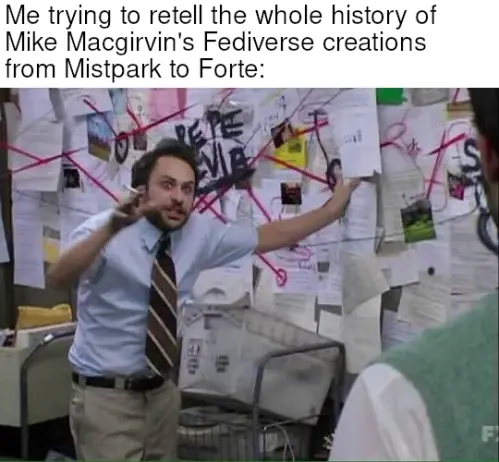
The image is based on the "Pepe Silvia" meme template.

It references the complexity of the history of Fediverse server applications created by @Mike Macgirvin 🖥️ which started in July, 2010 with the release of Mistpark, known today as Friendica. It led through a maze of forks, all created by Mike from his own works, to his most recent project, Forte, from August, 2024. The only other two survivors from this history are Hubzilla from 2015 and the streams repository from 2021. In fact, the streams repository itself adds to the complexity of the history because it is not a project, and the software in it is intentionally without a name and a brand identity.

##Fediverse ##Mistpark ##Friendika ##Friendica ##Red ##Red Matrix ##Hubzilla ##Osada ##Zap ##Mistpark 2020 ##Misty ##Redmatrix 2020 ##Roadhouse ##(streams) ##Forte ##Meme ##FediMeme ##Fediverse Meme ##Image macro ##Exploitable ##Pepe Silvia ##EyeContact ##CWEyeContact ##Sensitive ##⚠️
Jupiter's Fedi-Memes on (streams) - [email protected]

Me on this day 13 years ago:

Note to self: find the time to compare #elgg, #friendika, #gnusocial and #diaspora.web.archive.org/web/20120324231257/http://identi.ca/tag/elgg

(
identi.ca/notice/78531519 but that's a broken link now -- somewhere on identi.ca this post still lives, if you can figure out the URL )

Notices tagged with elgg - Identi.ca

@Katharsisdrill Yes, Diaspora* is two months younger than Mistpark.

But Diaspora* of 2024 is no match for Mistpark of 2010, feature-wise. Mistpark, on the other hand, evolved into Friendica which federated with everything that moved, then into Hubzilla, the nomadic Swiss army knife of the Fediverse, and lastly, into the streams repository which is the home of the technologically most advanced Fediverse software to date.

#Long #LongPost #CWLong #CWLongPost #FediMeta #FediverseMeta #CWFediMeta #CWFediverseMeta #Fediverse #Mistpark #Friendika #Friendica #Hubzilla #Streams #(streams)
Netzgemeinde/Hubzilla

You think decentralised social networking was invented with Mastodon? Think twice.

It was almost exactly 14 years ago, on May 13th, 2010, that @Mike Macgirvin 🖥️ conceived Mistpark. All by itself revolutionary and with features which no-one else has ever built into a decentralised project until today, it was only the first step of a long journey which led to Friendica, nomadic identity, Hubzilla, all three still before Mastodon, and eventually the streams repository.

#Long #LongPost #CWLong #CWLongPost #FediMeta #FediverseMeta #CWFediMeta #CWFediverseMeta #Fediverse #Mistpark #Friendika #Friendica #Hubzilla #Streams #(streams)
What is Friendica? - Join the Fediverse

@Yohan Yuki Xieㆍ사요한・謝雪矢 I'm not even sure if Laconi.ca/StatusNet could quote, much less quote-post. It wanted to be microblogging, and it supported the Twitter API from some point on, but it didn't aim to be a Twitter clone.

As for Friendica or rather Mistpark, I'm convinced it had quote-posts already when it was first released in July, 2010. It didn't try to mimic Twitter either, though, because it was positioned as an alternative to Facebook.

#Long #LongPost #CWLong #CWLongPost #FediMeta #FediverseMeta #CWFediMeta #CWFediverseMeta #Fediverse #QuotePost #QuotePosts #QuoteTweet #QuoteTweets #QuoteToot #QuoteToots #QuoteBoost #QuoteBoosts #QuotedShares #Laconica #Laconi.ca #StatusNet #Mistpark #Friendika #Friendica
Netzgemeinde/Hubzilla

Zotum

@Scott M. Stolz It's a bit murky what exactly happened back then.

Friendica started as Mistpark before a German told Mike what a German understands when reading that word, namely manure park. It was then renamed to Friendika because the desired Friendica domain was still blocked.

Free Friendika was a fork of Friendika by someone who wasn't content with Friendika's license. Free Friendika was on GitHub right away while Friendika wasn't. The fork involved copying Friendika's whole repository to GitHub.

Friendika was renamed Friendica in 2011 or 2012 when that name had become available.

It was afterwards that Friendica's own code repository was migrated to GitHub. Due to a GitHub "quirk", Friendica was automatically declared a fork of Free Friendika which is technically false.

What exactly happened license-wise is murky to me. Friendica can't have started under the AGPL because that'd exclude re-licensing a fork. But interestingly, Hubzilla is MIT-licensed.

So whatever license Friendica started out under, it might have been the community which put it under the AGPL after taking over from Mike who was now tinkering with the Zot protocol.

Looking at the licenses, it's very likely that Mike didn't fork Friendica Red off Friendica but off Free Friendika, itself a hard fork of Friendika. Thus, some improvements on Friendica never made it to Friendica Red.

I also guess it was named Friendica Red first and then renamed Red (from spanish la red = "the net") after the whole backend had been re-written against Zot, and the whole thing had stopped being Friendica in the first place. The re-naming to Red Matrix must have been a kind of marketing decision.

It's even unclear what exactly was the base for Osada later. Case in point: Well after the release of Hubzilla, Mike's own instances were still all branded "Red Matrix" although this project should have been abandoned in early 2015 when Hubzilla was created from it.

So either the Red Matrix was renamed Hubzilla and reworked into what was Hubzilla 1.0 in July, but Mike kept the "Red Matrix" brand for his own instances. In this case, Osada was forked from Hubzilla, and most everything added from the Red Matrix to Hubzilla was removed again from Hubzilla to Osada.

Or Hubzilla was forked from the Red Matrix, mostly soft-forked, the Red Matrix became Hubzilla's smaller and more experimental brother, and Mike's own instances all became testbeds for development that would have been more difficult with the extra Hubzilla cruft in the way. In this case, chances are bigger that Mike forked Osada from the Red Matrix which had never had all that extra Hubzilla stuff that Osada never had either.

Either way, the path from Mistpark to Hubzilla is both very complicated and very murky, and so I guess it's kind of justified to simplify it a bit. At the same time, it's too short to simplify it the same the path from either the Red Matrix or Hubzilla to (streams) can be simplified because the latter has had many more forks in it ("a fork of a fork... of a fork of {Hubzilla|the Red Matrix}").

#Long #LongPost #CWLong #CWLongPost #FediMeta #FediverseMeta #CWFediMeta #CWFediverseMeta #Forks #Mistpark #Friendika #FreeFriendika #Friendica #RedMatrix #Hubzilla
Netzgemeinde/Hubzilla