FortiGate SSL VPN: ottenuto l'accesso, gli attaccanti si muovono lateralmente con metodo e pazienza — credenziali, configurazioni, movimenti interni. Il punto non è solo la vulnerabilità iniziale, ma tutto ciò che diventa possibile dopo. La post-exploitation racconta spesso più della compromissione stessa. 🔍 #infosec #FortiGate #VPN
https://www.ilsoftware.it/fortigate-ssl-vpn-nel-mirino-come-agiscono-gli-hacker-dopo-laccesso/
FortiGate SSL VPN nel mirino: come agiscono gli hacker dopo l'accesso

Nightmare Eclipse colpisce FortiGate SSL VPN: ecco come gli hacker sfruttano l’accesso per muoversi nella rete.

ilsoftware.it

I started a company!

“What? Huh? Why?”

Those are some of the many questions I was asking myself. Simply… Looking to challenge the brain in different ways than what I’m normally doing.

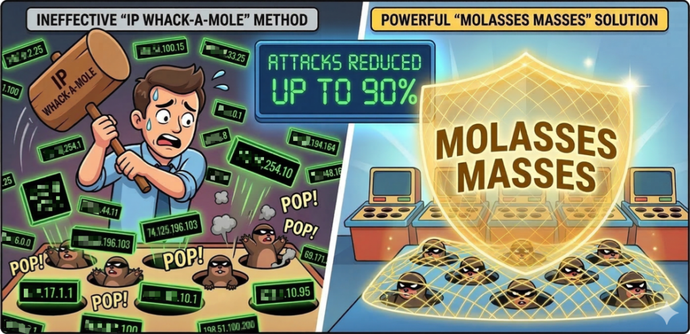
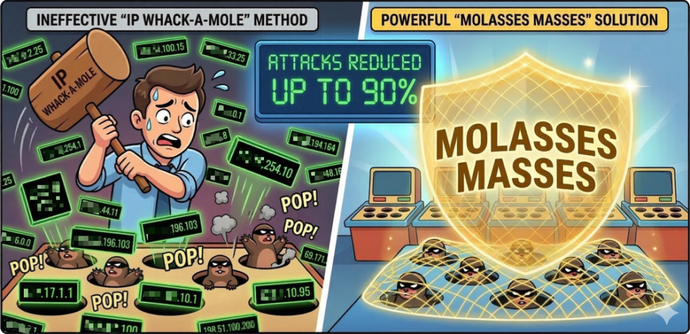
How it began – In my personal time while trying to secure my own personal hosted infrastructure, I was noticing that there wasn’t an efficient or effective way to block bad threat actors (nasty hackers) on the Internet.

The typical (tedious) approach has always been:

  • I see a bad connection from IP1, therefore I must block IP1.
  • I see a bad connection from IP2, therefore I must block IP2.
  • I see a bad connection from IP3, therefore I must block IP3.
  • ….
  • Repeat until you lose all sense of sanity.
  • The problem with this approach is that you end up getting stuck in a game of whack-a-mole. Who do you think wins? Trick question – it’s not you!

    I put a different idea together – what if bad threat actors run their hacking world like a business and focus on cost optimization and automation. Novel idea right?

    How does this apply to what I do? Well if I were to run a business like theirs, I would figure out how to “copy/paste” my attacks in creative ways. To do this, I would choose a (cheap) hosting provider that has resources that I can use for my desired purposes. Once the hosting provider is identified, I’m going to figure out ways to spin up new resources in a quick manner in a different location (i.e. automation).

    New Resource + New Location = New IP Address To Attack From

    Now that I know this, let the hacking begin!

    Do you see how the game of whack-a-mole starts?

    What does my company do?

    I have a few products available now, but the one product that solves the above problem is a product called Molasses Masses.

    How does it work?

    Rather than blocking on a per-IP basis, I get all the subnets for that hosting provider that the hacker is using and then block those. The idea is that remote connections coming to my/your hosted services, should not come from other hosting providers. It should be from people like you reading this article!

    Now it’s possible that you or your business partners get caught up in the block list – no problem! You can exclude your own and/or business partner subnets from the specifically curated list of subnets that you download.

    How effective it this?

    I’ve seen a reduction of attacks of up to 90%* from all my honeypots on the Internet.

    Why would you use this?

    Got remote users that need to VPN into your organization?

    Got hosted services that should be accessed from actual users, and not random bots sitting in hosted environments?

    Then this is the product for you!

    Integrations available?

    Very simply, It’s a flat text file of curated subnets that you can use in your own policies..

    These are the supported platforms available today to consume my product:

    • Linux (shorewall)
    • Cisco – Firepower Threat Defense (FTD)
    • Fortinet – Fortigate Firewalls
    • Palo Alto Networks – PAN-OS and Prisma Access.

    Curious to test it out? 7-day free trials available.

    Use discount code MM2026 to snag a 20% discount on checkout for the first 50 customers 🙂

    * As with all things in life – your mileage may vary. You might have a different environment compared to mine which gives different results. #AntiHacking #BotMitigation #BruteForceProtection #CiscoFTD #CloudSecurity #CyberSecurity #Cybersecurity #DDoSProtection #Fortigate #Honeypot #InfoSec #IPBlocking #MolassesMasses #NetworkSecurity #PaloAltoNetworks #security #Shorewall #SubnetFiltering #SysAdmin #technology #threatIntelligence #VPNTrust #ZeroTrust

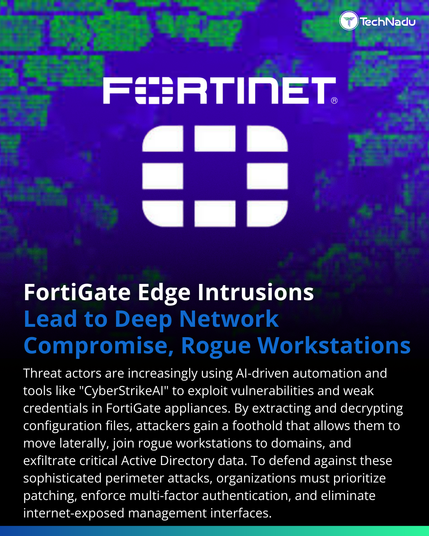
    🚨 FortiGate edge intrusions are enabling deep network compromise.

    Attackers exploit vulnerabilities and weak credentials to extract config files, obtain AD service credentials, deploy RMM tools, and exfiltrate NTDS.dit hashes.

    Full story:
    https://www.technadu.com/fortigate-edge-intrusions-lead-to-deep-network-compromise-rogue-workstations/623060/

    #Cybersecurity #FortiGate #ActiveDirectory #Infosec

    Attackers exploit FortiGate devices to access sensitive network info

    Hackers are exploiting FortiGate devices to breach networks and steal conf data containing service account credentials and network details.

    Security Affairs
    How AI Assistants are Moving the Security Goalposts – Krebs on Security

    CyberStrikeAI used in 600+ FortiGate intrusions across 55 countries.
    AI-driven exploit orchestration + 100+ integrated tools.
    21 IPs tied to China-based infra.
    Patch FortiGate immediately.

    Full report:
    https://www.technadu.com/cyberstrikeai-deployed-in-over-600-fortigate-attacks-targeting-55-countries/622100/

    #InfoSec #AIThreats #FortiGate

    Bleeping Computer: Amazon: AI-assisted hacker breached 600 Fortinet firewalls in 5 weeks. “Amazon is warning that a Russian-speaking hacker used multiple generative AI services as part of a campaign that breached more than 600 FortiGate firewalls across 55 countries in five weeks. A new report by CJ Moses, CISO of Amazon Integrated Security, says that the hacking campaign occurred between […]

    https://rbfirehose.com/2026/02/28/amazon-ai-assisted-hacker-breached-600-fortinet-firewalls-in-5-weeks-bleeping-computer/
    Amazon: AI-assisted hacker breached 600 Fortinet firewalls in 5 weeks (Bleeping Computer)

    Bleeping Computer: Amazon: AI-assisted hacker breached 600 Fortinet firewalls in 5 weeks. “Amazon is warning that a Russian-speaking hacker used multiple generative AI services as part of a c…

    ResearchBuzz: Firehose

    THREAT MODEL: CYBERSECURITY
    for Feb. 24th, 2026
    by independent journalist @violetblue

    - People across the US are destroying #Flock cameras

    - #Discord ’s “new” ID check tool was on a US government server

    - #Arizona and #Colorado want ID scanning for all computer and phone use

    - @wikipedia banned #ArchiveToday for DDoS attacks

    - Some rando used #AI to hack #FortiGate

    - @financialtimes unmasked a Russian oil smuggling ring (from Kremlin-controlled Rosneft) through the ring’s use of a single email server

    - Another major #AotearoaNewZealand health app breach

    - #TimCurry reveals Clue’s secret ending

    - BBC/BAFTA leave N-word intact on tape delay

    ...and much more.

    ✨ THREAT MODEL is free to read -- please help keep it accessible to all by becoming a patron, even $1 a month makes a difference! ✨

    https://www.patreon.com/posts/cybersecurity-24-151516976

    #ThreatModel #ThreatModelCybersecurity #ThreatModelNewsletters #VioletBlue #infosec #cybersec #CovidIsNotOver

    The categorization of the Fortinet web filter is hilarious. I got a report that a certain website is incorrectly blocked by our firewall. After looking into it, the specific website belongs to a large organization.

    Different organizational levels of this large organization are categorized as:

    • Political organization (federal level)
    • General organization (state level)
    • Advocacy organization (local level), giving it an R age rating (18+)

    The “correct” classification should be either general organization or simply “business”.

    This is wrong on many levels. Why are advocacy groups blocked by default? Why do they have an R rating (because politics is only for adults? But then why only advocacy groups and not political organizations?).

    #fortinet #fortigate #fortiguard

    #TIL Fortinet IPsec VPNs: they claim to support IKEv2 2FA (Certificate + EAP password), but they don't strictly enforce RFC 4739 for multiple authentication rounds.

    If a native client (like strongSwan) ignores the cert and just asks for EAP, the FortiGate silently accepts it and falls back to password-only. It literally fails open!

    #fortinet #fortigate #ipsec #vpn #strongswan #infosec