📢 FortiBleed : campagne de collecte de credentials ciblant les équipements FortiGate
📝 ## 🔍 Contexte

Le 19 juin 2026, Fortinet publie sur son blog PSIRT une analyse officielle d'une cam...
📖 cyberveille : https://cyberveille.ch/posts/2026-06-23-fortibleed-campagne-de-collecte-de-credentials-ciblant-les-equipements-fortigate/
🌐 source : https://www.fortinet.com/blog/psirt-blogs/analysis-of-reported-credential-compromise-of-fortigate-devices
#FortiBleed #FortiGate #Cyberveille

FortiBleed : campagne de collecte de credentials ciblant les équipements FortiGate

🔍 Contexte Le 19 juin 2026, Fortinet publie sur son blog PSIRT une analyse officielle d’une campagne malveillante baptisée FortiBleed, ciblant des équipements FortiGate dans le cadre d’une opération de credential harvesting. 🎯 Nature de l’activité Selon Fortinet, cette campagne repose sur deux vecteurs principaux : Réutilisation de credentials issus d’incidents antérieurs référencés FG-IR-26-060 et FG-IR-25-647 Attaques par force brute contre des appareils présentant une politique de mots de passe faible et sans authentification multi-facteurs (MFA) Fortinet précise explicitement qu’il ne s’agit pas d’une nouvelle vulnérabilité et que cette activité n’est pas liée à un incident ou advisory récent.

CyberVeille
FortiBleed campaign used custom FortiGate sniffer to steal credentials

Security firm SOCRadar says the large-scale FortiBleed campaign targeting Fortinet FortiGate devices used custom sniffers to harvest authentication secrets from compromised firewalls and steal credentials.

BleepingComputer

A new report details the FortiBleed campaign, an active operation using a custom Golang sniffer, FortigateSniffer, to steal credentials from over 430,000 FortiGate firewalls. Threat actors exploit a built-in FortiOS command, `diagnose sniffer packet`, to capture live network traffic and extract sensitive authentication data like Kerberos, LDAP, and VPN credentials. This isn't a zero-day, but a…

https://www.tpp.blog/27v7268

#cybersecurity #fortibleed #fortigate

🤖 This post was AI-generated.

RT: @Huntio We want to give Volodymyr "Bob" Diachenko (@MayhemDayOne) a real shoutout here 👏

A couple of days ago, Bob found and broke the #FortiBleed story, the dataset tied to more than 70,000 exposed #FortiGate devices, linked to a Russian-speaking group running credential harvesting at scale.

The open directory he worked from came up through our Open Directory Intelligence, surfaced by AttackCapture. He spotted it in our data and ran his own investigation from there.

What he found:

→ SSL VPN authentication intercepted at scale
→ Hashes cracked offline on a dedicated GPU cluster
→ Roughly 1.16 billion credential attempts run against 320,000+ FortiGate targets, plus another 2.1 billion against 160,000+ MSSQL servers
→ Plaintext credentials reused for lateral movement into Active Directory once inside
→ At least four organizations fully compromised across Asia and the Middle East, including a NATO defense contractor with documents exfiltrated

This is the best kind of validation. A researcher we respect pulled it from the data, dug in, and published it on his own 🙌

If you want to see what AttackCapture surfaces for open directories tied to your own stack, it's live in the platform. Contact us to get started:

reminder that "fortibleed" is not a vuln. no CVE. no patch. nothing fucking "bled."

it's a russian-speaking crew firing 1.16 billion creds from old breaches and infostealer logs at every fortigate dumb enough to have its mgmt interface sitting on the public internet. ~50% of internet-facing boxes. half of you.

and before anyone cries "but my password was 28 characters with symbols": it didn't get cracked. it was already chilling in an infostealer dump in plaintext. great entropy, shame about the malware on your sales guy's laptop.

the -bleed suffix is marketing. the real CVE is CVE-2026-YOUREANIDIOT: "admin panel pointed at 0.0.0.0/0, password recycled from a 2022 breach, MFA considered but never enabled."

rotate the creds, yank the mgmt interface off the internet, force MFA, and maybe stop letting threat intel firms name your incidents like they're naming a fucking Marvel villain.

#infosec #fortinet #fortigate

📢 FortiBleed : fuite massive de credentials Fortinet VPN pour 73 932 équipements dans le monde
📝 📰 **Source** : BleepingComputer — **Date de publication** : 17 juin 202...
📖 cyberveille : https://cyberveille.ch/posts/2026-06-18-fortibleed-fuite-massive-de-credentials-fortinet-vpn-pour-73-932-equipements-dans-le-monde/
🌐 source : https://www.bleepingcomputer.com/news/security/fortibleed-leak-exposes-fortinet-vpn-credentials-for-73-000-devices/
#FortiGate #Fortinet #Cyberveille
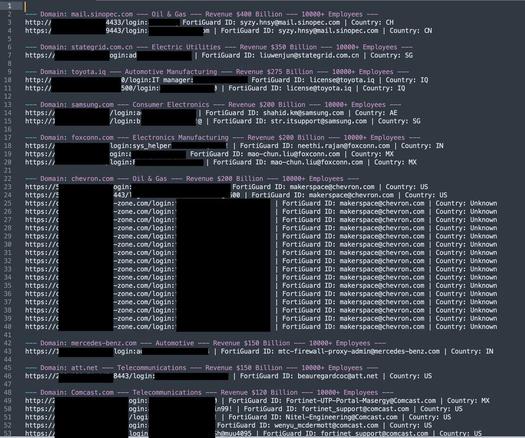
A data leak dubbed »#FortiBleed« exposed 73,932 #Fortinet and #FortiGate #VPN credentials for organisations worldwide. The leak includes usernames, email addresses, and plaintext passwords for organisations like Chevron, Samsung, and AT&T. The exposed data, believed to be from exported Fortinet configurations, includes information typically only accessible through configs and indicates a large-scale credential harvesting campaign. https://www.bleepingcomputer.com/news/security/fortibleed-leak-exposes-fortinet-vpn-credentials-for-73-000-devices/?eicker.news #tech #media #news
FortiBleed leak exposes Fortinet VPN credentials for 73,000 devices.

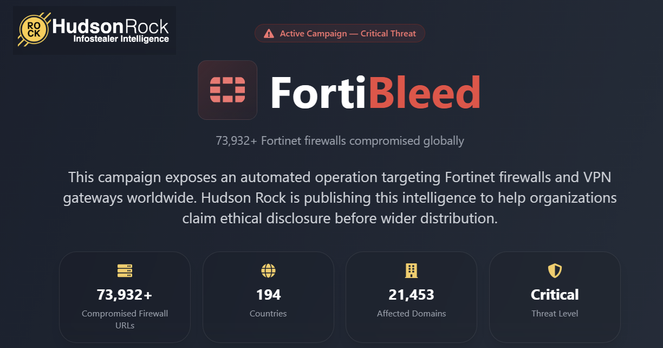
A newly discovered data leak dubbed "FortiBleed" has exposed what appears to be a collection of Fortinet and FortiGate VPN credentials for 73,932 firewall URLs at organizations worldwide.

BleepingComputer

Bleeping Computer: FortiBleed leak exposes Fortinet VPN credentials for 73,000 devices.. “A newly discovered data leak dubbed ‘FortiBleed’ has exposed what appears to be a collection of Fortinet and FortiGate VPN credentials for 73,932 firewall URLs at organizations worldwide.”

https://rbfirehose.com/2026/06/17/bleeping-computer-fortibleed-leak-exposes-fortinet-vpn-credentials-for-73000-devices/
Bleeping Computer: FortiBleed leak exposes Fortinet VPN credentials for 73,000 devices.

Bleeping Computer: FortiBleed leak exposes Fortinet VPN credentials for 73,000 devices.. “A newly discovered data leak dubbed ‘FortiBleed’ has exposed what appears to be a collect…

ResearchBuzz: Firehose

📣🚨 #FortiBleed attack exposes Fortinet firewall credentials in 194 countries, with researchers linking the dataset to nearly 74,000 firewall URLs and 21,000+ affected domains.

Read: https://hackread.com/fortibleed-attack-fortinet-firewalls-credentials/

#Fortinet #FortiGate #Cybersecurity #DataBreach #VPN

FortiBleed Attack Exposes Fortinet Firewall Credentials in 194 Countries

Researchers say FortiBleed used stolen and tested credentials to access exposed Fortinet firewalls, putting major organizations and public agencies at risk now.

Hackread - Cybersecurity News, Data Breaches, AI and More
FortiBleed : 73 932 pare-feux Fortinet compromis par un groupe russophone à l'échelle mondiale

🔍 Contexte Publié le 17 juin 2026 par Hudson Rock (hudsonrock.com), cet article s’appuie sur les recherches du chercheur en sécurité Volodymyr « Bob » Diachenko. Il documente une campagne d’espionnage cyber d’envergure mondiale ciblant les équipements Fortinet FortiGate (pare-feux et passerelles VPN). 🎯 Méthodologie de l’attaque Le groupe, décrit comme multi-opérateurs et russophone, a opéré de manière hautement automatisée : 1,16 milliard de tentatives de credential stuffing contre plus de 320 000 cibles FortiGate 2,1 milliards de tentatives de brute-force contre plus de 160 000 serveurs MSSQL Interception de hachages d’authentification SSL VPN et cracking via un cluster dédié de 45 GPU géré par Hashtopolis Pivot systématique vers les environnements Active Directory internes pour établir une persistance profonde Exploitation de bases de données de credentials préalablement volés (infostealers) pour contourner les politiques de complexité des mots de passe 📊 Ampleur et victimes 73 932 URLs de pare-feux uniques compromises dans 194 pays 21 632 domaines affectés uniques Pays les plus touchés : Inde (9 629), États-Unis (6 352), Taïwan (3 637), Mexique (3 197), Turquie (3 032) Secteurs les plus impactés : IT Services, Télécommunications, Construction, Services financiers, Gouvernement Victimes nommées : Foxconn, Samsung, Comcast, Siemens, Lenovo, PwC, Accenture, Oracle, ainsi que des entités gouvernementales et des infrastructures critiques.

CyberVeille