@futurebird @RationalizedInsanity
I could find the will write
about Abydosaurus
how it lived its life
the tall trees it stripped bare
and how it died
buried in rock
for a hundred million years
while the green river carved a canyon near
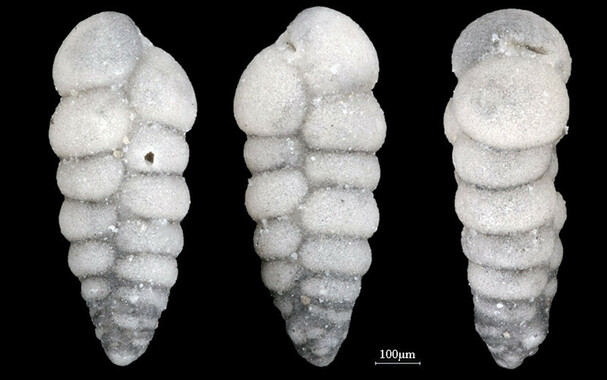
but all the million forams?
that I can't bear
and each annoying conodont?
no
I won't

#poetry
#forams
#fossils
#dinosaurs
#SauropodSaturday

Sedimentary Basins Tell Zealandia’s Ancient Story

New interpretations and mapping of all New Zealand’s offshore sedimentary basins offer clues about the evolution of Earth’s eighth continent.

Eos
To see the world in a grain of sand: Planktonic foraminifera and Evolution.

“To see the world in a grain of sand…”, this is the first line of William Blake´s poem “Auguries of Innocence” which describe a series of paradoxes about innocence, evil and corruption. But in a bi…

Letters from Gondwana.

#Researchers discover a #NewSpecies of larger #benthic #foraminifer from the #Ryukyu islands
https://phys.org/news/2023-09-species-larger-benthic-foraminifer-ryukyu.html paper: https://www.sciencedirect.com/science/article/pii/S0031018223003826 #protists #forams

"#Foraminifera are tiny, single-celled organisms that live in the #oceans. Their hard shells, made of #CalciumCarbonate, can withstand the test of time and their #fossils reveal a lot about Earth's history, including past climates and environments."

Researchers discover a new species of larger benthic foraminifer from the Ryukyu islands

Foraminifera are tiny, single-celled organisms that live in the oceans. Their hard shells, made of calcium carbonate, can withstand the test of time and their fossils reveal a lot about Earth's history, including past climates and environments.

Phys.org
Alcide d’Orbigny and the beginning of foraminiferal studies.

During the eighteenth and nineteenth centuries, Paris was a busy place for science. In 1794 the Reign of Terror ended with the establishment of a new government that was more supportive of the scie…

Letters from Gondwana.

#Plankton evidence reveals a seasonally ice-free ocean during the Last Interglacial https://phys.org/news/2023-08-plankton-evidence-reveals-seasonally-ice-free.html #protists #forams

A seasonally ice-free Arctic Ocean during the Last #Interglacial: Flor Vermassen et al. https://www.nature.com/articles/s41561-023-01227-x

"A subpolar species associated with #Atlantic water expanded far into the #Arctic Ocean during the #LastInterglacial, analysis of #microfossil content of #SedimentCores reveals. This implies that summers in the #Arctic were ice free during this period."

Plankton evidence reveals a seasonally ice-free ocean during the Last Interglacial

A subpolar species associated with Atlantic water expanded far into the Arctic Ocean during the Last Interglacial, analysis of microfossil content of sediment cores reveals. This implies that summers in the Arctic were ice free during this period. The findings are published in Nature Geoscience.

Phys.org

#ClimateCrisis: Acidifying oceans will cause a diversity and survival crisis for microscopic marine organisms https://phys.org/news/2023-07-acidifying-oceans-diversity-survival-crisis.html #protists #microbes #ClimateChange

Biocalcification crisis in the continental shelf under #OceanAcidification https://www.sciencedirect.com/science/article/pii/S1674987123000890

"#SingleCelled organisms known as #foraminifera produce chambered #shells of calcium carbonate, and they are an important part of marine food chains... New research has focused on the impact of #acidification on benthic #forams"

Acidifying oceans will cause a diversity and survival crisis for microscopic marine organisms, finds research

Oceanic responses to climate and human interactions have been studied for decades. In recent years the effects of increasing ocean acidity have been featured, with stark images of coral reefs being decimated by bleaching.

Phys.org

Foraminiferal Christmas cards https://paleonerdish.wordpress.com/2022/12/23/christmas-edition-foraminiferal-christmas-cards/ #protists #forams #sciart by @Ferwen

"During the early decades of the 20th-century, Arthur Earland and Edward Heron-Allen were #volunteers at the #NaturalHistoryMuseum. They both studied #Foraminifera, a group of single celled #protozoa with shells of different composition and granuloreticulose #pseudopodia. Each #Christmas, Earland and Heron-Allen exchanged unusual but beautiful #ChristmasCards made with foraminifera."

Christmas edition: Foraminiferal Christmas cards

During the early decades of the 20th-century, Arthur Earland and Edward Heron-Allen were volunteers at the Natural History Museum. They both studied Foraminifera, a group of single celled protozoa …

Letters from Gondwana.
Foraminifera, Bad Freienwalde

Foraminifera, Bad Freienwalde

Happy birthday Esther Applin (middle)🎉 🥳🎊

—in 1921 Esther suggested that #microfossils could be used in stratigraphy, but was ridiculed: “Gentlemen, here is this chit of a girl... telling us that we can use #Foraminifera to determine the age of formation. You know that it can’t be done”

Oh yes it can! On top of being used to date crucial events in our planet's history, #Forams have revolutionized our understanding of past climates, & has created thousands of jobs globally! #WomenInSTEM