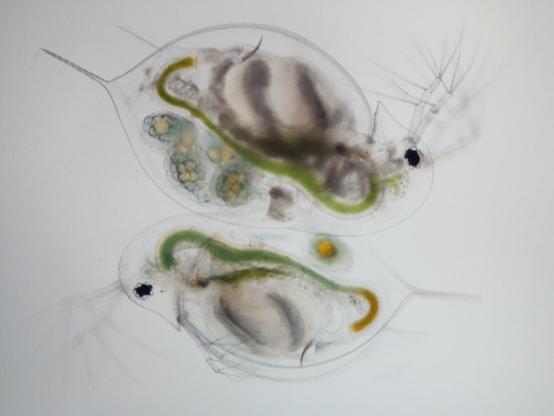
#ICYAMRE2026Bremen #foodwebs #pelagicfoodwebs #climatechange #plankton #earlycareerconference #oceandecade @awi
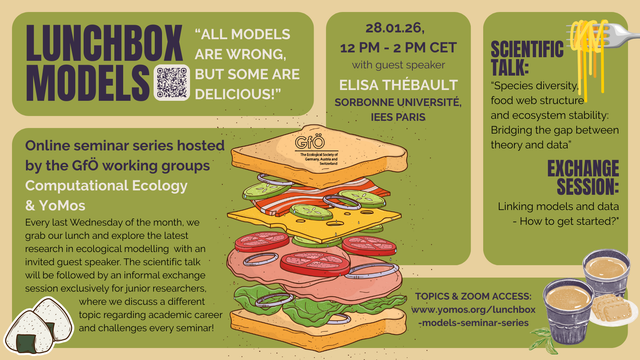
...and another quick reminder that all models are wrong, but some are delicious! 😋
Our next #LunchBoxModels #seminar is scheduled for Wednesday (Jan 28) at 12 CET. Elisa Thebault (Sorbonne Université de Paris) will talk about species diversity, food web structure and ecosystem stability. Don't think twice, join us! 😊
More info here:
https://www.yomos.org/lunchbox-models-seminar-series
#TheoreticalEcology, #ComputationalEcology, #EcologicalModelling, #ecology, #FoodWebs #EcologicalNetworks
How to make sustainable seafood choices this Christmas to ease the pressure on Australia’s oceans
"Last year the market traded about 350 tonnes of seafood over the Christmas period, with 120t of prawns and 70,000 dozen oysters among the top sellers...Australian Marine Conservation Society’s GoodFish guide aims to showcase the most environmentally friendly seafood sources."
>>
https://www.theguardian.com/environment/2025/nov/22/how-to-make-sustainable-seafood-choices-this-christmas-to-ease-the-pressure-on-australias-oceans
'Sustainable Fishing' is a Lie
"Fishing sustainability is based on a pseudoscientific theory that justifies taking the most marine life for maximum profit. Sustainable fishing is a deception, a myth motivated by the ideology that life on Earth belongs to humankind."
>>
https://www.currentaffairs.org/news/sustainable-fishing-is-based-on
#ocean #MarineConservation #biodiversity #wildlife #MarineLife #SustainableSeafood #prawns #BBQ #FishNChips #seafood #salmon #Christmas #OverFishing #stocks #yield #MSY #fishing #regulations #extraction #FoodWebs
Ocean life mural, Mid North Coast, NSW
A new study led by researchers at the University of Hawai‘i (UH) at Mānoa published today in Nature Communications is the first of its kind to show that waste discharged from deep-sea mining operations in the Pacific’s biodiverse Clarion-Clipperton Zone (CCZ) could disrupt marine life in the midwater “twilight zone” — a vital region 200-1,500 meters below sea level that supports vast communities of zooplankton, tiny animals that serve as the ocean’s basic food building blocks. Specifically, it finds that 53% of all zooplankton and 60% of micronekton, which feed on zooplankton, would be impacted by the discharge, which could ultimately impact predators higher up on the food web.
Global oxygen decline in the ocean
Ocean hypoxia: The science of climate change in the sea
"... The field will need to draw on ... advances to meet demands for adaptation solutions to the continued progression of global ocean deoxygenation, particularly in conjunction with ocean acidification and marine heatwaves in a multi-stressor scenario."
Chan, F., Sokolova, I. & Vopel, K. Ocean hypoxia: The science of climate change in the sea. Sci Rep 15, 4260 (2025). https://doi.org/10.1038/s41598-025-86706-4
#climate #ocean #hypoxia #HotOcean #eutrophication #acidification #MarineEcosystems #FoamAndBlooms #FossilFuels #agriculture #MassMortalityEvents #foodwebs #OceanDeoxygenation #DeadZones
Spiders 🕷️ learn to trap glowing fireflies 🪲💡 then use them as bait to catch dinner 🍽️
So, something else that is a key element of ensuring #HumanWelfare remains in the SW range is to make sure folks are fed -- without destroying the environment! That's where #RegenerativeAgriculture , #SustainableAgriculture, #FoodForests, #CommunityGardens, etc., come into play. But #Rewilding and restoring key natural systems are also very important!
7. #Wildlife faces #extinction cascades as #ecosystems collapse.
"Vertebrate populations have declined by an average of 69 percent since 1970, with some regions experiencing losses exceeding 90 percent as habitat destruction, climate change, #pollution, and direct #exploitation combine to trigger ecosystem-wide collapse that eliminates the #biodiversity necessary to maintain stable #FoodWebs. Species extinction rates now exceed background levels by 100 to 1,000 times, representing a mass extinction event comparable to the asteroid impact that eliminated the dinosaurs but compressed into a timeframe measured in decades rather than millennia.
"The collapse of insect populations threatens #pollination services essential for agricultural production, while marine ecosystems face #acidification, warming, and #overfishing that eliminate entire trophic levels and destabilize ocean food chains supporting billions of people. Domestic animals face parallel threats as #IndustrialAgriculture concentrates genetic diversity into vulnerable #monocultures while climate change disrupts feed production and increases disease pressure on livestock populations already stressed by intensive production methods designed to maximize short-term yields rather than long-term #resilience."
#Collapse #Change #TheLimitsToGrowth #PlanetaryBoundaries #WaterIsLife #NatureIsLife #Extinction