Tell Me That You Love Me 1x09 "Episode 9" ★★★★★★★★☆☆

I love how they presented the (1) reaction against deaf people; and (2) a parent's concern for their beloved child.

It was a very good opening for episode 9.

Another thing. They paid attention to the difference between "hard of hearing" and "deaf"; and they did not use the word "mute".

It's close to me because I have a heart for them since I was a little kid. I even studied the #FilipinoSignLanguage or #FSL in 1995/1996, and they told us this:

"We are not mute. We can speak because we have our own language, just like every human being use languages."

#Kdrama #Deaf #HardOfHearing #SignLanguage #TV

https://trakt.tv/comments/628437 #TellMeThatYouLoveMe #trakt

@kdrama @[email protected] @asiandrama

Tell Me That You Love Me 1x09 "Episode 9" shout by ♾ Yuki (유키 雪) :dolphin:

I love how they presented the (1) reaction against deaf people; and (2) a parent's concern for their beloved child. It was a very good opening for episode 9. Another thing. They paid attention to the difference between "hard of hearing" and "deaf"; and they did not use the word "mute".

Trakt

My #language history: en > tl > ja > fil > fsl

Currently learning: he and ko

---

en: #English
tl: #Tagalog
ja: #Nihongo (#Japanese)
fil: #Filipino
fsl: #FilipinoSignLanguage
he: #Hebrew
ko: #Hangugeo (#Korean)

---

For the writing systems:

Of course, Latin writing system is the default for English, Tagalog, and Filipino.

However, we do have a pre-Colonial writing system called #Baybayin (an umbrella term), a.k.a. #Surat and #Suyat.

For Nihongo, I studied #Hiragana and #Katakana but not #kanji

Still learning the writing system for:
* Hebrew
* Korean, which is called #Hangul

The real challenge is using these languages and writing systems. For example, I need a serious refresher for Nihongo, Hiragana, and Katakana. I self learned it when I was six (6) years old. Around mid-20s, I started to forget my Japanese. (And I never learned Kanji, LOL.)

Still, my favourite is (Filipino) #SignLanguage. That I need a refresher too. I think I was Grade 9 when I signed-up for sign language classes (outside school), and that was in the mid-90s.

#Languages, it's fun to learn, be it on your own or formal schooling. The way you analyse and think also shifts with the language you use for communication, so it is important to communicate with the proper language.

Example, in Tagalog and Filipino languages, the English "love" can be translated into "mahal" and "iniibig" (there are others).

"Mahal" is, just, "love". But "iniibig" is deeper and romantic. It can't be directly translated into English (but possible in some Asian languages). The closest we can get in English is "deeply love" but a lot is still lost in translation because "iniibig" is also profound, and forever. You can't just say it to another. We can probably say, "iniibig" can only be used for your soulmate.

So, here in the #Philippines you can say "I love you" in English, but there's no meat to it. It's shallow.

But when you say, "Mahal kita", there's seriousness and meat to it.

However, once you say, "Iniibig kita", it's a whole new level, deep level of love (confession). Anyone who hears it will pause and try to process it.

The way we analyse and think is influenced by the language we use to express it.

My #language learning journey:
1. English
2. Tagalog
3. Japanese (need refresher)
4. Filipino
5. #FilipinoSignLanguage (need refresher) #FSL
6. #Baybayin (Tagalog, Mangyan (Hanunoo, Buhid))
7. Hebrew (learning)
8. Korean (learning)

Also:
1. BASIC
2. COBOL
3. Pascal
4. C
5. HTML (is not a language but)
6. Perl (never again)
7. Lua (I love this)
8. GoLang (I love this too)
9. JavaScript / TypeScript / ECMAscript
10. Python (basic only)
11. PHP (stopped)
12. Assembly Language

#Languages

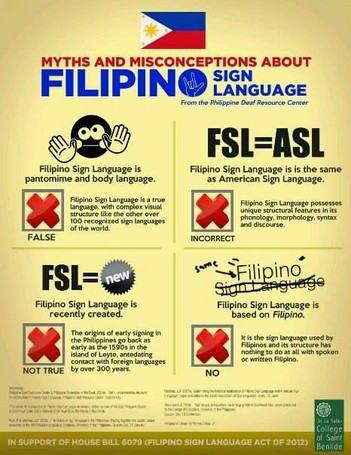
Fact Sheet: Myths and Misconceptions about Filipino Sign Language

Filipino Sign Language (FSL) is pantomime and body language. FALSE.  Filipino Sign Language is a true language, with complex vi...