Studying Acts 20 33-35 & 2 Thessalonians 3 6-12

This week we’re studying two statements by the Apostle Paul, in Acts 20:33-35 (part of a farewell speech by Paul to the elders of Ephesus) and 2 Thessalonians 3:6-12 (almost the conclusion to the 2nd letter to the Thessalonians), along with a cluster of individual verses (Genesis 2:15, Exodus 20:9, John 5:17, and John 9:4) that all mention “work.” That is, we are looking at texts that, taken together, might help us think through the “social teaching of the Christian church” that presents “useful work as a Christian duty.”

A few notes on the isolated verses are here; here are a few notes on the longer texts from Acts and 2 Thessalonians:

Acts 20:33-35 is part of the scene in which Paul says farewell to the elders of Ephesus, for what turns out to be the last time. He’s been traveling, with a set of companions, back and forth through Macedonia and Greece from his more-or-less home base in Antioch, Syria. Now, they are on their way to Jerusalem, which they hope to reach by Passover.

This is all part of the final section of the book of Acts, Part II of Luke-Acts, the “orderly account” of the life and ministry of Jesus, and then the life and ministry of the apostles sent by Jesus to be his witnesses in Judea, Samaria, and to the ends of the earth. The full account will wind up over the next eight chapters, as Paul arrives in Jerusalem, meets with James and other leaders of the church there, agrees to participate in an important Temple ritual to demonstrate his respect for and adherence to Jewish practice, gets arrested, and then tried several times, and then appeals to the emperor and so is eventually sent to Rome, having some hair-raising adventures on the way.

The farewell address to the Ephesians includes a statement of his purpose on this trip, a recap of his ministry there, and instructions to the elders to watch over the spiritual health of the believers, in particular to safeguard them from “savage wolves” – which perhaps means the purveyors of false teaching, or bad practices.

Our verses are his reminder that when he was working there in Ephesus, he didn’t take material advantage of them, but rather supported himself. He’s not in ministry for the money, but rather to serve Christ, and others.

This address to the Ephesians, along with the saying of Jesus it includes, is something we wouldn’t know was in the Bible if all we knew were the lectionary. Bible Content Examinees, take note.

CLOSER READING: In v33, the word translated “coveted” is a general term; in other contexts it could be translated “desired.” [Maybe this could remind us that simply “desiring” things is closer to what we mean by “coveting” than we often think.]

In v34, the Greek grammar emphasizes, first the needs of the apostle and then of his colleagues, and then the serving of those needs done by his hands. This “serving” is an infrequent verb, used only in the book of Acts, which carries with it an image of someone who labors at another’s direction. Later – in Acts 24:23 – Felix will give permission for Paul’s friends serve [“take care of”] his needs in this way.

In v35, the “such work” Paul commends is specifically the kind of laboring we do to the point of exhaustion; in this context it is for the support of the weak. This is a kind of support that reaches out and grabs hold, like of someone about to fall down, actively meeting the need of the situation. The weak might in other contexts be the sick, or the feeble or infirm; that is, people who definitely need help and support.

Then Paul quotes Jesus – fortunately for us, because we don’t have this statement in any of the canonical gospels – as saying “It is more blessed to give than to receive.” This is the kind of blessedness – in Greek, makarios – that shows up in the Beatitudes, too, and that is sometimes translated into English as “happy.”

Paul in these few verses, then, names what he did not do, and what he did, and presents that pattern of activity as a model for the Ephesians. The practical purpose is the support of the weak. The impetus for the practice is the command of Christ. We should note, too, that Paul’s discussion here implies that it’s the Ephesians themselves who were, under the circumstances, the “weak” he was supporting. In this case, perhaps, weak because of their newness to the faith.

2 Thessalonians 3:6-12 is almost the conclusion of this short second letter to the church in Thessaloniki. [A detailed analysis of the letter as a whole is here, from the Bible Project.]

Our verses make up the bulk of the [customary, to be expected] instructive material here at the end of this letter. Paul has just encouraged the Thessalonians to persevere through the persecution they’re experiencing, and not to be anxious about the Day of the Lord – which is yet to come, but hasn’t come yet. Now, he turns to how they ought to go about living their lives in the meantime.

One key term in the text, clearly negative, appears in v6 and v11 as an adverb describing some Thessalonians who are behaving badly, and in v7 as a verb, telling us what Paul was doing properly. It’s translated “irresponsibly” or “was not irresponsible.” Sometimes the word can have the sense of “idle;” it always seems to have the sense of people being disorderly, unruly, or undisciplined. Its etymology is from military life, where it’s used to describe people who fall out of line, out of formation. [But I can’t shake the impression of the Sharks and the Jets and the leather-jacketed hipsters who spend too much time hanging out on street corners instead of sha-na-na-na-na-getting a job.]

Don’t be like that, says Paul. Be like us, like Paul and maybe also his colleagues, who with labor and toil – words that connote extreme exertion, to the point of pain, the way we say at the end of a long, hard shift “I’m beat” – made sure they were not “burdensome” – an infrequent word, used only three times in the New Testament. Rather, they supported themselves, pulled their own weight [to use some of our own linguistic terms that talk about providing for oneself and others by reference to the struggle against gravity].

The irresponsible are not weighty, but flighty. They are meddlesome busybodies, a term that literally means something like “working around” the outer edges of actual work.

The command Paul gives in v10 and also in v12 is the kind that could sound like a “warning” (as in v6, where the same word is used) or “instruction,” and has the force of a message. [It shares a root with words like “news” and “messenger” or angel.] We ourselves might well use the verb “tell” in a context like this, as in “I told you …” or “I’m telling you …” [And by the way … if that language of “I’m telling you …” sounds or feels different to us than the language of “warning” or “command,” we might want to think about that, and ask ourselves why.]

Here’s the message: If anyone is not willing to work, neither should they eat. [Presumably there are some exceptions to this, though … we could think about what the legitimate exceptions might be.] Bread doesn’t just grow on trees. If we won’t help the Little Red Hen plant the seed and cut the wheat and thresh the wheat and carry the grain to the mill and make the bread … then neither should we eat the bread.

Paul is trying to tell people to do their work quietly and [literally] eat their own bread. This quiet way of life, by the way, is the Greek word that names meditative prayer in the Orthodox tradition, hesychasm.

Why we have left off v13 – “do not grow weary in doing what is right” – is anyone’s guess. That seems like a good thing to say about useful work.

Some questions on the texts are here.

Image: “Casa de Convalescència, arrambador ceràmic” Enfo, CC BY-SA 3.0, via Wikimedia Commons

#2Thessalonians3612 #Acts203335 #BibleStudy #commentary #exegesis #meaning #readingTheBible #textsThatArenTInTheLectionary #work

Studying Genesis 2 15, Exodus 20 9, John 5 17, and John 9 14

This week we’re studying a cluster of individual verses, including Genesis 2:15, Exodus 20:9, John 5:17, and John 9:4, along with a couple of almost-whole texts, Acts 20:33-35 (part of a farewell speech by Paul to the elders of Ephesus) and 2 Thessalonians 3:6-12 (almost the conclusion to the 2nd letter to the Thessalonians).

What links these disparate de-contextualized and re-contextualized texts is their mention of work, as something people, and Christian people specifically, ought to be doing. That is, these texts presumably speak to our “social teaching” of the week, “useful work as Christian duty.”

[Although … I myself feel duty-bound to point out that these verses don’t speak to work as a specifically Christian duty. They are more about work as Torah observance, first as taught in the actual Torah, and then as practiced by the we-think-perfectly-Torah-observant Jesus, and then as practiced and encouraged by Paul, the more-Torah-observant-than-not Jewish Christian.]

Anyway, here are a few notes on these isolated verses’ meaning in their [otherwise missing] contexts:

Genesis 2:15 is taken from about the middle of the second Biblical account of God’s creation of the earth and all its inhabitants, Genesis 2:4-25, the one in which God makes an earth-and-breath creature from the dust of the ground first, then causes plants to spring up, including a couple of significant trees, and then, in our verse, takes the earthling (the adam) and sets him in the garden to serve it/her and keep/guard it/her. The Hebrew word translated “to till” is a frequently used one, typically translated “to serve.” The two infinitive verbs “to serve” and “to keep/guard” have a feminine singular object ending, corresponding to the feminine noun “garden”.

So, the original earth-and-breath creature has a God-given agenda: to serve and to keep the creation, which at this point includes plants but no animals. The chapter progresses with God seeing that “it is not good for the adam to be alone,” making animals, and then a woman, whom the adam, now also an ish, a man, poetically receives as “bone of my bone and flesh of my flesh.”

Exodus 20:9 is part of the longer commandment about keeping the Sabbath [same as the way the adam is to keep the garden]. The whole article (one of the well-known “ten words,” #4 by one way of counting those) reads

“Remember the Sabbath day and keep it holy. 9 Six days you shall labor and do all your work. 10 But the seventh day is a Sabbath to the Lord your God; you shall not do any work—you, your son or your daughter, your male or female slave, your livestock, or the alien resident in your towns. 11 For in six days the Lord made heaven and earth, the sea, and all that is in them, but rested the seventh day; therefore the Lord blessed the Sabbath day and consecrated it.

Exodus 20:8-11

This reminds us that, as anyone’s rabbi will affirm, the commandment to keep Shabbat is, reciprocally, a commandment to work the other six days of the week. The word translated “labor” in v9 is the word that names what the earth-and-breath creature is set in the garden to do: to serve. The word translated “work” names a particular kind of activity, and also the result of that activity. Famously, it includes what God accomplishes in the work of creation (see Genesis 2:2), and what the Israelites do in making the Tabernacle in the wilderness, from which the sages derive the 39 general categories of [creative, productive] work that are to be avoided on Shabbat.

John 5:17 is basically the punchline of the story that opens this chapter (John 5:1-18). Jesus heals a lame or paralyzed man at the pool of Bethsaida. About half-way through the story, we find out this healing has happened on the Sabbath, when the man normatively shouldn’t be carrying anything (including his sleeping mat) and when maybe healers ought not to be healing people (although there could be some dispute about that – Jesus obviously seems to think so).

Jesus’ answer to the opposition his action provokes seems to be a reference back to Genesis 2:2-3, and Exodus 20:11, to the effect that, “as a matter of fact, God (“My Father”) isn’t actually resting just yet, and so, neither am I.”

[Presumably, this verse isn’t a prooftext for Jesus’ opposition to people’s taking a regular day of rest, Jesus’ support for repealing fair labor practices legislation, etc.]

In the next verse, Jesus’ opponents interpret Jesus’ calling God his father as overstepping a line. Maybe they are not taking seriously enough the texts that identify Israel – of which Jesus is a member – as God’s son. [See e.g., Hosea 11, Isaiah 63:16, Isaiah 64:8.]

We’d never know Jesus had ever said this, by the way, if all we knew were the lectionary.

John 9:4 is right at the beginning of the much longer narrative of “the man born blind.” “Working the works of him who sent me while it is daymay be yet another reference to God’s ongoing creative activity, including a reference to God’s creative time-keeping. (See Genesis 1, in which “evening and morning” define the “days” of God’s creative work.)

Jesus’ statement also, of course, resonates with the recurrent theme of light and dark, day and night, in the gospel of John. The entire story might even be read as a reference to the creation story, as it includes a “let there be light” moment, the beginning of something new for the sightless man, making this particular Sabbath a new first day. We might start to get the idea that days in the gospel of John are reckoned less by the visibility of the earth’s nearest star than they are by the appearance and activity of the Sun of Righteousness.

Some notes on the almost-whole-texts are here. Some questions on the texts are here.

Image: “Old book – Basking Ridge Historical Society,” William Hoiles from Basking Ridge, NJ, USA, CC BY 2.0, via Wikimedia Commons

#BibleStudy #commentary #exegesis #Exodus209 #Genesis215 #John517 #John94 #meaning #readingTheBible #textsThatArenTInTheLectionary #work

@aardvark179 If you can cope with a long read, this was my response after reading the Exegesis back in 1994.
https://westerngeomancy.org/articles/cosmogony-and-eschatology/

#PhilipKDick #Exegesis #TerenceMcKenna #RobertAntonWilson #Cosmogony

Cosmogony and Eschatology (1994) | Western Geomancy

This is an extract from a book that I was writing at the time, a biography of the American rocket scientist and disciple of Aleister Crowley, Jack Parsons. Parsons famously invoked the Goddess BABALON in a lengthy magickal working, with the assistance of a young L. Ron Hubbard. The book…

Western Geomancy

Studying Jonah 4 6-11

This week we’re studying three excerpts from Jonah: Jonah 1:1-3, Jonah 3:1-5, and Jonah 4:6-11. [Of course, it never hurts to read all four chapters of the entire book of Jonah!]

We have studied the book of Jonah before, and earlier sets of notes can be found here:

While parts of Jonah 3 and all of Jonah 4 are in the lectionary, by the way, Jonah 1 and 2 tell a story we wouldn’t know was IN the Bible if all we knew were the lectionary. Except that, in real life, we would too know it, because who hasn’t heard of “Jonah and the whale?”

Our lesson this week seems to focus a bit on 4:6-11, so it seemed worthwhile to note a couple of additional things about this text:

CLOSER READING

The names of God in this chapter might, possibly, be significant. In vv2-3, Jonah addresses God as YHWH; in v4, YHWH answers back – “Is it right for you to be angry?”; and in v6, YHWH Elohim appoints a bush (or, gourd, or plant) to grow over the sukkah Jonah has constructed in which to keep vigil over the fate of Nineveh. Then, Elohim acts and speaks (vv7, 8, 9). [Maybe, that is, the properly-named God of Israel appears here as the God of all.] Finally, in v10, YHWH returns to insist that the people and animals of Nineveh are YHWH’s proper concern. [Maybe: since the God of Israel is, after all, the maker of heaven and earth and everything, and everyone, in them.]

There is a lot of providential activity, involving a thoroughly compliant natural world, throughout the book of Jonah. Chapter 4 is no exception. God appoints first the aforementioned bush, then a worm (v7), and then an east wind (v8), to provide an object lesson for the prophet.

Nature’s compliance, by the way, is remarkable by its contrast with the resistant human world, and in particular with the resistant human prophet, Jonah.

There are possibly ironic references to Israel’s redemptive history in this chapter. Should we see some irony in Jonah’s building of a sukkah – a shelter that is specially associated with Sukkot, a holiday of rejoicing and harvest – in which to grump about the deliverance of the city of Nineveh? What about in God’s appointment of an east wind to blow on the grumpy Jonah? Should we be reminded of the way another east wind blew across the waters of the Red Sea to open them up for the fleeing Hebrews of the Exodus? Are we meant to see at least a little resemblance between Jonah and the Red Sea here? Maybe not that much of a stretch.

And what does it mean that Jonah would rather die – in v3, v8 (twice), and v9 – than see the mercy of God visited on Nineveh, or experience the loss of God’s consoling bush or gourd vine or castor oil tree? [We seem to be a bit unsure of the precise botanical identity of this plant, which appears only here in scripture.] Does this perhaps raise some hard questions about the nature of consolation? Is Jonah possibly, in both cases, lamenting the loss of God’s consolation – on one hand, the loss of a small but significant physical comfort, and on the other, the loss of the significant consolation of seeing justice done, in the form of the destruction and killing and annihilation of his enemies? (See Esther 3:13.) And is God, just possibly, trying to nudge Jonah to perceive some human commonality with the Ninevites, by way of Jonah’s own ardent desire for consolation and reprieve? An ardent desire that has already moved the Ninevites to repent in a most extravagant way?

The ending of the book of Jonah leaves us with the open question of Jonah’s ultimate repentance. Will, or won’t, Jonah adopt God’s apparent position on what is to be desired for Nineveh and its inhabitants?

For that matter, will we? Or, won’t we? And what difference does it make what position we take? Does it matter, for us, whether what we most want for others is well-deserved destruction, or extravagantly gracious redemption?

Some questions on this week’s texts are here.

Image: photo © Jim Womack and Anne Richardson CC BY-SA 4.0, Public domain, via Wikimedia Commons

#BibleStudy #commentary #exegesis #Jonah4611 #meaning #readingTheBible

Studying Matthew 19 3-9

This week we’re studying two texts that arguably speak to the topic of “the Christian home in a modern world.” The texts are Deuteronomy 6:3-9 – the shema and the ve’ahavta, a text we’ve studied before [with some notes here from that time] – along with Matthew 19:3-9, which is Matthew’s record of Jesus’ response to a question about divorce. We might have to do some thinking about how these texts work together to build up a picture of “the Christian home in a modern world.” But in the meantime, here are a few notes on the Matthew text:

BACKGROUND AND CONTEXT

Since we’re in Matthew’s gospel, we’ll want to remember that the overall context is a presentation of the life of Christ that emphasizes Jesus’ teachings and authoritative interpretation of the law and the prophets, as well as his organization of a community of disciples who will pass on what they themselves have learned and are learning. [Because, “remember, I am with you always …” (Matthew 28:20).] Matthew’s gospel has the reputation for being heavy on references to Jewish customs and practices, which it seems to assume the readers will be thoroughly familiar with – that is, without much translating or explanation. That may be relevant for our reading of this particular text, as it happens.

By the time we get to this particular teaching on divorce, we are nearing the end of the story. The Transfiguration has taken place; Jesus has gathered his group in Galilee, briefed them on the trip to Jerusalem and its upcoming events [not to say they have grasped the import of the project], and now he’s made his way to “Judea beyond the Jordan” (Matthew 19:1) – that is, where John the Baptist was conducting his inaugural ministry and where Jesus began his own public ministry (Matthew 3). The teaching and healing that takes place in Matthew 19 and Matthew 20, then, is immediately preparatory to Jesus’ entry into the city of Jerusalem in Matthew 21. This context may point us toward a deeper meaning in Jesus’ remarks here.

We probably need to be aware of a couple of raging controversies of Jesus’ own day that seem to be embedded in or pointed to by this text. One was the status of divorce, and the grounds for divorce, in rabbinic interpretation. In Jesus’ day, the leading rabbis would have been Shammai and Hillel, the last of the zugot, or “pairs,” who contributed to the rabbinic interpretive tradition. One of their well-known differences of opinion specifically concerned divorce. [Here’s more on this, along with some information on where that difference went, and why, in later rabbinic tradition.] This seems likely to have been the background for the question in v3.

The poster children for wanton divorce – as well as for flouting other laws, like those against marrying one’s close relatives – were Herod Antipas, the current ruler of the territory, and his former sister-in-law but now wife, Herodias. Their sensitivity about the problem had already led to the execution of John the Baptist, who’d railed against their marriage as unlawful. (See Mark 6:17-18.)

This fact presumably makes Jesus’ remarks politically sensitive, as well as religiously meaningful. That’s if we’re thinking of “religion” the way “modern people” do, as something separated – divorced, if you will – from every other aspect of daily life.

The lectionary includes the related synoptic text Mark 10:2-16, but not this one, and not Luke 16:18, which presents a word from Jesus on divorce as an out-of-the-blue commentary on Pharisaic inclination to soften the requirements of the law. That makes Jesus’ limited allowance of grounds for divorce, namely the cause of sexual immorality, something we wouldn’t know was in the Bible if all we knew were the lectionary.

CLOSER READING

When the Pharisees “come” to Jesus “to test him” they are presumably aware of the religious and political controversy surrounding the question of divorce, and have some agenda related to that controversy when they pose their test question.

In v4, the word translated read – “have you not read” – would in many other contexts be translated “recognized.” It might be worth thinking about any difference in meaning we detect between reading and recognizing.

What Jesus is asking the questioners to recognize, or to have read, is the action of God in creation, making humanity “male and female” (Genesis 1:27), and then saying – in what we now think of as a second, slightly different account of creation from the first – “on account of this a man will leave his father and mother and be joined [literally, glued] to his wife and the two will become one flesh.”

That God-made union then becomes the basis for Jesus’ reasoning: what God has joinedpaired together, the Greek word that gave Hebrew the word used to describe the relationship between the schools of Hillel and Shammai, by the way – man should not separate.

The questioners persist, by asking why Moses included a command, to issue a paper of divorce and to send her away.

Jesus responds that this was because of their hardness of heart – using the Greek word that gives us our terms sclerosis and sclerotic. That is, permission to divorce at all is already a concession to a problem people have. Or maybe we should say, a problem men, specifically, have, since the issue in question is men divorcing their wives, and not at all the other way around. [Although for that matter, we probably don’t actually think women never have the problem of hardness of heart themselves. In this legal environment, however, they’re forced to deal with it differently.]

In v9, then, Jesus sums up his teaching: a man who divorces his wife, except because of sexual immorality, commits adultery; a man who marries a divorced woman also commits adultery. That exception to the “no divorce” rule, for sexual immorality, tracks along with the school of Shammai. And the teaching is, in effect, an indictment of the reigning Herod Antipas.

Some extra thoughts …

In the ancient world, we think we know, most women depended on men for the basic necessities of life. Women’s options for securing basic survival independently of a husband or male relative were extremely limited. Reciprocally, most men depended on women, and the specific kinds of work women specifically did, for basic elements of their daily lives. The pressure to marry was enormous, and practical, if nothing else.

The world we live in is different – to a degree, at least. It’s still the case that single women with dependent children are at much higher risk for poverty. The poverty rate for single mother households is approximately 28-30%, compared to around 17% for single father households, and around 5% for married couple households. Single life may not bear the same stigma it once did, nor widowhood the same life-threatening perils. Nevertheless, even in our modern or post-modern world, we recognize people are made for connection and community of life. Pursuing that connection through marriage is still a privileged means to that end; losing it through divorce still feels traumatic.

But among the things we ourselves recognize are the many ways human hardness of heart can manifest itself, and the imperative to make a way of escape for those on the receiving end of that hardness of heart. In particular, we no longer – I hope – insist that faithfulness to God demands that people continue to expose themselves and their children to violence and abuse in their own homes. Surely, the abundant life Jesus Christ came to make possible for people includes not having to be continually on guard against assault and grievous bodily harm, especially from their own intimate partner.

As one author has said,

Divorce is a fire exit. When a house is burning, it doesn’t matter who set the fire. If there is no fire exit, everyone in the house will be burned!

Mehmet Murat-Ildan, quoted in Adrian Warnock, “Christian views on divorce and remarriage – a spectrum,” April, 2024

And as we know in the “modern world,” while we’re not supposed to prop the fire exits open, we’re also not supposed to block them up. Much as we hope no one will ever need to use them.

Some questions on this week’s texts are here.

Image: “Feuchtwangen Pfarrkirche – Vorhalle Fresko Evangelist Matthäus” (cropped), Wolfgang Sauber, CC BY-SA 4.0, via Wikimedia Commons

#BibleStudy #ChristianIdeasAndPractices #commentary #Deuteronomy639 #exegesis #Matthew1939 #meaning #readingTheBible

Studying Mark 9 36-37, 42, Mark 10 13-16

This week we are studying two brief texts that mention children, Mark 9:36-37 and 42, and Mark 10:13-16. This is part of our series exploring “the social teachings of the church,” as an homage to the Uniform Series lessons of the early 1900s in this 150th anniversary year of the lessons.

The bottom line, as we probably know, is that Jesus did not repudiate children, and went so far as to bless them. And told the disciples, who were trying to shoo them away, not to do that. And made a connection between the kingdom of God and children. People have been talking about that connection, and trying to figure out what Jesus really meant, being unwilling to think Jesus is actually saying the kingdom of God belongs to literal children, ever since. [This makes me think of the last 3-year-old’s birthday party we went to, that had a princess theme, with a castle and everything – serious kingdom stuff – and have to laugh, thinking of the banquet of the kingdom of God, complete with cupcakes.]

Anyway, here are a few notes on this week’s verses.

BACKGROUND AND CONTEXT

Both our texts are from Mark’s gospel, the one that is famously short and full of action, with things happening immediately over and over again; and the one in which Jesus bursts on the scene, starts casting out demons and healing sick people, and telling everyone not to tell everyone. Which everyone does anyway. The one in which Jesus is at his wildest and harshest and most uncompromising, and the disciples at their most clueless, and ultimately the [shorter] ending at its most mysterious and provocative.

By the time we get to Mark 9, a little over half-way through Mark’s version of the plot, Peter has just declared Jesus “the Christ;” Jesus has started telling the disciples that the plan is for him to go to Jerusalem, suffer greatly, be rejected, and killed, and then rise again; Peter has tried to shut him up; Jesus has called Peter “Satan.” So, there’s some tension in the group.

Then, a hand-picked trio of disciples gets to witness the Transfiguration, and hear a Voice from Heaven say “Listen to him, already!!” And then, coming down from that mountain-top experience, Jesus runs into a crowd gathered around a father whose son has a seizure disorder that the disciples haven’t been able to do anything about, provoking Jesus to exclaim “You faithless generation, how much longer must I be with you? How much longer must I put up with you?!” (Mark 9:19) More tension.

Then, the disciples start arguing on the road about which one of them is the greatest. [At which point I’m thinking “Sheesh, guys, read the room.”] This is the immediate setting for Jesus’ object lesson in Mark 9:36-37. When the disciples respond to that lesson by explaining that they’ve been policing the group boundaries, though, Jesus follows up with the comments about not doing that, but rather, to police one’s own tendency to sin all the more strictly.

The teaching continues into Mark 10, with Jesus’ statements on divorce, and then with his indignant instructions to the disciples to permit, rather than forbid, children to be brought for blessing. [What are you guys thinking??? What’s your problem with women and children???]

All of our verses are in the lectionary during Year B, and as they are favored preaching texts, we are likely to have heard them read and discussed in church.

CLOSER READING AND MEANINGS

In v36, we are not told where Jesus gets the child or little child – who would likely have been, not an infant, but someone we might identify as an elementary school child – to set in the midst of them. Maybe a child of the house in which they’re spending the night, or from the larger group they’re traveling with. The fact that a little child is ready to hand, however, reminds us that Jesus and the twelve are not alone, but are living into the gospel in the midst of an everyday life that included women and children. [We forget that sometimes.]

Jesus hugs the child – the word here can easily mean “to embrace.” And then talks about welcoming (or receiving, accepting), using the word with that range of meanings four times in his next sentence. Whoever welcomes such a child welcomes Jesus, and whoever welcomes Jesus welcomes not Jesus but rather the one who sent Jesus. Meaning, the stakes are high.

This welcome, perhaps significantly, is on the basis of the name of Jesus. It’s done, somehow, out of devotion to Jesus, or perhaps out of devotion to the Christ.

Maybe it’s the mention of Jesus “name” that reminds John to tell Jesus about the exorcist they told to stop casting out demons in your name, since he wasn’t following us. In response, Jesus famously tells him “whoever isn’t against us is for us.” Whether this does, or should, tell us what Jesus would say about the various doctrinal and denominational quarrels that have arisen down through the centuries of people following Jesus might be something for us to think about.

In any case, Jesus goes on to commend even those who give you-all a cup of water in Christ’s name, suggesting they will have some reward.

And then to talk about the opposite of a reward. Whoever causes one of the little ones, those believing, to stumble, can look forward to something worse than a millstone put around his neck and being cast into the sea. That sounds pretty bad. What brought this particular example to Jesus’ mind is not apparent from the text; whether it was something that ever happened in real life in that place in those days, we might well wonder. The point may simply be that it’s a vivid image of a deadly, doomed predicament that a person couldn’t hope to escape.

In context, this seems to suggest the crime of having done something to make it hard for people – whoever they are – to align themselves with or to serve, in however small a way, the cause of Christ.

The stumbling or “tripping up” Jesus speaks of is a form of a verb that means literally “to ensnare,” to set a trap for. This activity might put us in mind of “the adversary.” We wouldn’t want to be him, or one of his agents, even inadvertently. Maybe this is why Jesus goes on to advocate ridding oneself of anything – even a body part, even one’s right hand – that tempts a person into sin.

Moving on to the next chapter, v13 tells us “they” – an indeterminate 3rd person plural – were bringing to Jesus little children. For the purpose of having Jesus touch them. Probably not because the children were sick, but because they were quite likely to become sick, and then to die, in a time and place in which a child had a 50-50 chance of seeing her or his 1st birthday, and maybe only a 2-in-3 chance of seeing his or her 20th. Which doesn’t seem to have made children any less precious to their parents.

The disciples rebuke the child-bringers, which in turn makes Jesus indignant – the one time this mood is attributed to Jesus, of the only 7 times in the New Testament it’s attributed to anyone. [It’s more often the demeanor of offended temple or synagogue minders.]

How we ought to translate Jesus’ explanation of his instruction to permit, not to prevent the little children coming to him, that “of such is the kingdom of God” is irreducibly open to interpretation. As with any genitive construction, it could mean that the kingdom of God is made up of such little children; or it could mean that the kingdom of God belongs to such little children. In any case, if the history of interpretation has tended to read the “as a child” as indicating Jesus is speaking metaphorically rather than literally, singling out some important quality possessed by children that they share, or could, with adults, it might simply be because the adult readers of scripture would like to think we still have a chance.

Furthermore, we might wonder whether welcoming the kingdom of God as a little child means welcoming the kingdom of God the way someone would welcome a little child – the way Jesus does, by giving them a nice, big hug – or welcoming it the way a little child would. How that would be, once again, is open to more than one meaning. [Humbly? Trustingly? Vulnerably? …] We would clearly like to know, however, because whoever doesn’t do that doesn’t enter it.

In any case, Jesus blesses and lays hands on these little children. No doubt that encouraged whoever brought them in the first place.

Some questions on these texts are here.

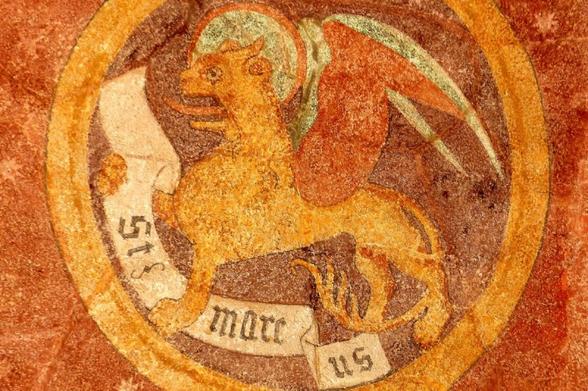
Image: “Feuchtwangen Pfarrkirche – Vorhalle Fresko Evangelist Markus” (cropped), Wolfgang Sauber, CC BY-SA 4.0, via Wikimedia Commons

#BibleStudy #commentary #exegesis #Jesus #Mark101316 #Mark93637 #Mark942 #meaning #readingTheBible
Cᴜʟтoʀ ᴅᴇʟ Pᴇɴsᴀмıᴇɴтo Cʀíтıco.
Sıɢɴos ᴅᴇ Fᴇ | Cultura
#Exégesis Frase atribuida al Bardo, que retrata a hipócritas y fariseos: «Dios os ha dado una cara y vosotros os hacéis otra». William Shakespeare #mdjpm

John 4:44 Exegesis

In John chapter four, verses 43 to 45, there is a seemingly strange sequence of statements… “[43] After the two days he departed for Galilee. [44] (For Jesus himself had testified that a prophet has no honor in his own hometown.) [45] So when he came to Galilee, the Galileans welcomed him, having seen all that he had done in Jerusalem at the feast. For they too had gone to the feast” (John 4:43–45, ESV). What are the issues? Issue 1: How does verse 44 connect to verse 43? Was Jesus […]

https://hobotheology.com/john-4-44-exegesis/

Next week! Two opportunities to learn about important resources for biblical research in the library: Tues., Nov. 4 and Thurs., Nov. 6 at 9:50 AM in F342.

https://library.covenantseminary.edu/workshops

#Seminary #BiblicalStudies #TheologicalEducation #BibleStudy #Exegesis #MinistryPrep