 Matters of Interpretation
Studying Mark 9 36-37, 42, Mark 10 13-16
This week we are studying two brief texts that mention children, Mark 9:36-37 and 42, and Mark 10:13-16. This is part of our series exploring “the social teachings of the church,” as an homage to the Uniform Series lessons of the early 1900s in this 150th anniversary year of the lessons.
The bottom line, as we probably know, is that Jesus did not repudiate children, and went so far as to bless them. And told the disciples, who were trying to shoo them away, not to do that. And made a connection between the kingdom of God and children. People have been talking about that connection, and trying to figure out what Jesus really meant, being unwilling to think Jesus is actually saying the kingdom of God belongs to literal children, ever since. [This makes me think of the last 3-year-old’s birthday party we went to, that had a princess theme, with a castle and everything – serious kingdom stuff – and have to laugh, thinking of the banquet of the kingdom of God, complete with cupcakes.]
Anyway, here are a few notes on this week’s verses.
BACKGROUND AND CONTEXT
Both our texts are from Mark’s gospel, the one that is famously short and full of action, with things happening immediately over and over again; and the one in which Jesus bursts on the scene, starts casting out demons and healing sick people, and telling everyone not to tell everyone. Which everyone does anyway. The one in which Jesus is at his wildest and harshest and most uncompromising, and the disciples at their most clueless, and ultimately the [shorter] ending at its most mysterious and provocative.
By the time we get to Mark 9, a little over half-way through Mark’s version of the plot, Peter has just declared Jesus “the Christ;” Jesus has started telling the disciples that the plan is for him to go to Jerusalem, suffer greatly, be rejected, and killed, and then rise again; Peter has tried to shut him up; Jesus has called Peter “Satan.” So, there’s some tension in the group.
Then, a hand-picked trio of disciples gets to witness the Transfiguration, and hear a Voice from Heaven say “Listen to him, already!!” And then, coming down from that mountain-top experience, Jesus runs into a crowd gathered around a father whose son has a seizure disorder that the disciples haven’t been able to do anything about, provoking Jesus to exclaim “You faithless generation, how much longer must I be with you? How much longer must I put up with you?!” (Mark 9:19) More tension.
Then, the disciples start arguing on the road about which one of them is the greatest. [At which point I’m thinking “Sheesh, guys, read the room.”] This is the immediate setting for Jesus’ object lesson in Mark 9:36-37. When the disciples respond to that lesson by explaining that they’ve been policing the group boundaries, though, Jesus follows up with the comments about not doing that, but rather, to police one’s own tendency to sin all the more strictly.
The teaching continues into Mark 10, with Jesus’ statements on divorce, and then with his indignant instructions to the disciples to permit, rather than forbid, children to be brought for blessing. [What are you guys thinking??? What’s your problem with women and children???]
All of our verses are in the lectionary during Year B, and as they are favored preaching texts, we are likely to have heard them read and discussed in church.
CLOSER READING AND MEANINGS
In v36, we are not told where Jesus gets the child or little child – who would likely have been, not an infant, but someone we might identify as an elementary school child – to set in the midst of them. Maybe a child of the house in which they’re spending the night, or from the larger group they’re traveling with. The fact that a little child is ready to hand, however, reminds us that Jesus and the twelve are not alone, but are living into the gospel in the midst of an everyday life that included women and children. [We forget that sometimes.]
Jesus hugs the child – the word here can easily mean “to embrace.” And then talks about welcoming (or receiving, accepting), using the word with that range of meanings four times in his next sentence. Whoever welcomes such a child welcomes Jesus, and whoever welcomes Jesus welcomes not Jesus but rather the one who sent Jesus. Meaning, the stakes are high.
This welcome, perhaps significantly, is on the basis of the name of Jesus. It’s done, somehow, out of devotion to Jesus, or perhaps out of devotion to the Christ.
Maybe it’s the mention of Jesus “name” that reminds John to tell Jesus about the exorcist they told to stop casting out demons in your name, since he wasn’t following us. In response, Jesus famously tells him “whoever isn’t against us is for us.” Whether this does, or should, tell us what Jesus would say about the various doctrinal and denominational quarrels that have arisen down through the centuries of people following Jesus might be something for us to think about.
In any case, Jesus goes on to commend even those who give you-all a cup of water in Christ’s name, suggesting they will have some reward.
And then to talk about the opposite of a reward. Whoever causes one of the little ones, those believing, to stumble, can look forward to something worse than a millstone put around his neck and being cast into the sea. That sounds pretty bad. What brought this particular example to Jesus’ mind is not apparent from the text; whether it was something that ever happened in real life in that place in those days, we might well wonder. The point may simply be that it’s a vivid image of a deadly, doomed predicament that a person couldn’t hope to escape.
In context, this seems to suggest the crime of having done something to make it hard for people – whoever they are – to align themselves with or to serve, in however small a way, the cause of Christ.
The stumbling or “tripping up” Jesus speaks of is a form of a verb that means literally “to ensnare,” to set a trap for. This activity might put us in mind of “the adversary.” We wouldn’t want to be him, or one of his agents, even inadvertently. Maybe this is why Jesus goes on to advocate ridding oneself of anything – even a body part, even one’s right hand – that tempts a person into sin.
Moving on to the next chapter, v13 tells us “they” – an indeterminate 3rd person plural – were bringing to Jesus little children. For the purpose of having Jesus touch them. Probably not because the children were sick, but because they were quite likely to become sick, and then to die, in a time and place in which a child had a 50-50 chance of seeing her or his 1st birthday, and maybe only a 2-in-3 chance of seeing his or her 20th. Which doesn’t seem to have made children any less precious to their parents.
The disciples rebuke the child-bringers, which in turn makes Jesus indignant – the one time this mood is attributed to Jesus, of the only 7 times in the New Testament it’s attributed to anyone. [It’s more often the demeanor of offended temple or synagogue minders.]
How we ought to translate Jesus’ explanation of his instruction to permit, not to prevent the little children coming to him, that “of such is the kingdom of God” is irreducibly open to interpretation. As with any genitive construction, it could mean that the kingdom of God is made up of such little children; or it could mean that the kingdom of God belongs to such little children. In any case, if the history of interpretation has tended to read the “as a child” as indicating Jesus is speaking metaphorically rather than literally, singling out some important quality possessed by children that they share, or could, with adults, it might simply be because the adult readers of scripture would like to think we still have a chance.
Furthermore, we might wonder whether welcoming the kingdom of God as a little child means welcoming the kingdom of God the way someone would welcome a little child – the way Jesus does, by giving them a nice, big hug – or welcoming it the way a little child would. How that would be, once again, is open to more than one meaning. [Humbly? Trustingly? Vulnerably? …] We would clearly like to know, however, because whoever doesn’t do that doesn’t enter it.
In any case, Jesus blesses and lays hands on these little children. No doubt that encouraged whoever brought them in the first place.
Some questions on these texts are here.
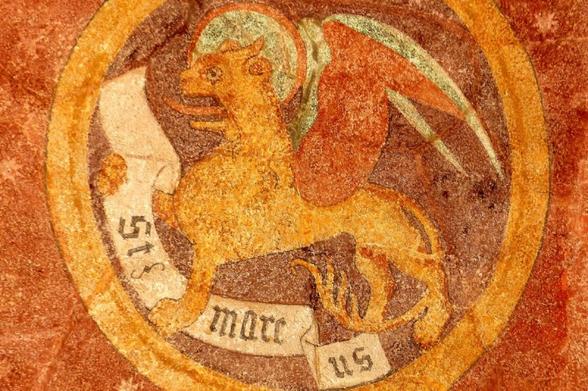
Image: “Feuchtwangen Pfarrkirche – Vorhalle Fresko Evangelist Markus” (cropped), Wolfgang Sauber, CC BY-SA 4.0, via Wikimedia Commons
#BibleStudy #commentary #exegesis #Jesus #Mark101316 #Mark93637 #Mark942 #meaning #readingTheBible