Reflecting on Jonah 4 6-11

This week we’re studying three excerpts from Jonah (Jonah 1:1-3, Jonah 3:1-5, and Jonah 4:6-11) that, taken together, sketch for us the conclusion of this big little story. We skip the drama of Jonah’s futile flight from God, the storm at sea, and his prayer from the belly of the great fish; we’re focusing on Jonah’s half-hearted fulfillment of his prophetic mission to Nineveh, and then his grouchy conversation with God after God spares the city.

Because we’re looking at this text under the rubric of “the higher patriotism,” under the larger rubric of “social teachings of the church,” we are presumably being encouraged to give some thought to the meaning of the story of Jonah, and in particular the meaning of Jonah’s mission to Nineveh on behalf of the God of Israel, and of God’s expression of concern for the Ninevites and their flocks and herds, for ourselves as citizens of some nation. What does all that tell us about our own national loyalties, and how they are likely to look to God, and how compatible they are with our allegiance to God? How compatible are our political loyalties and opinions with our citizenship in “the kingdom of God”? What does all that, in turn, mean for our views on politics, and public policy? If we are meant to have those views informed by what we believe about God, how will our belief in the God revealed in the story of Jonah influence our views, do we think? How should it? Why? What kind of change in our current thinking would that necessitate?

We’ve studied the book of Jonah before, and some notes are on the site from that time, here, here, here, and here, along with some additional notes on Jonah 4:6-11 here. Here are a couple of additional questions we might want to think about, or to discuss in class:

Our published curriculum points out that the central theme of the book of Jonah is repentance. That’s particularly hard to argue with, knowing that Jonah is the afternoon reading on Yom Kippur. Still – what other big themes do we see in the book of Jonah? Where do we see those in the text? And what does the book seem to us to be showing us or saying about those themes?

What does the story of Jonah tell us about the extent and limits of God’s power? Where do we see that? [Hint: I’m particularly fascinated by the way nature – in the form of wind, water, vegetation, animals – seems to be entirely at God’s disposal. Except … for the animals in Nineveh? Because … why?]

So, what does the remarkable compliance of nature tell us about the relationship of humans to God? What do we learn from that?

Where do we find ourselves relating to Jonah? For instance, in his efforts to evade God, or his return, or his begrudging God’s mercy to the Ninevites, or …? What might we like to share about any of that?

Overall, as usual, we probably want to think about what insight into the character of God we gain from this story, and how that either confirms, or challenges, what we already think we know about God. And what influence that has on our own developing relationship with God.

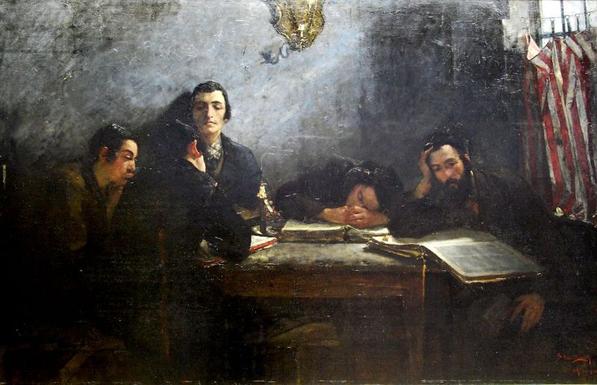
Image: Samuel Hirszenberg ‘Szkoła talmudystów,’ public domain, via Wikimedia Commons

#BibleStudy #God #Jonah131 #Jonah315 #Jonah4611 #meaning #meaningForUs #readingTheBible #thinkingAboutTheBible
Studying Jonah 4 6-11

This week we’re studying three excerpts from Jonah: Jonah 1:1-3, Jonah 3:1-5, and Jonah 4:6-11. [Of course, it never hurts to read all four chapters of the entire book of Jonah!]

We have studied the book of Jonah before, and earlier sets of notes can be found here:

While parts of Jonah 3 and all of Jonah 4 are in the lectionary, by the way, Jonah 1 and 2 tell a story we wouldn’t know was IN the Bible if all we knew were the lectionary. Except that, in real life, we would too know it, because who hasn’t heard of “Jonah and the whale?”

Our lesson this week seems to focus a bit on 4:6-11, so it seemed worthwhile to note a couple of additional things about this text:

CLOSER READING

The names of God in this chapter might, possibly, be significant. In vv2-3, Jonah addresses God as YHWH; in v4, YHWH answers back – “Is it right for you to be angry?”; and in v6, YHWH Elohim appoints a bush (or, gourd, or plant) to grow over the sukkah Jonah has constructed in which to keep vigil over the fate of Nineveh. Then, Elohim acts and speaks (vv7, 8, 9). [Maybe, that is, the properly-named God of Israel appears here as the God of all.] Finally, in v10, YHWH returns to insist that the people and animals of Nineveh are YHWH’s proper concern. [Maybe: since the God of Israel is, after all, the maker of heaven and earth and everything, and everyone, in them.]

There is a lot of providential activity, involving a thoroughly compliant natural world, throughout the book of Jonah. Chapter 4 is no exception. God appoints first the aforementioned bush, then a worm (v7), and then an east wind (v8), to provide an object lesson for the prophet.

Nature’s compliance, by the way, is remarkable by its contrast with the resistant human world, and in particular with the resistant human prophet, Jonah.

There are possibly ironic references to Israel’s redemptive history in this chapter. Should we see some irony in Jonah’s building of a sukkah – a shelter that is specially associated with Sukkot, a holiday of rejoicing and harvest – in which to grump about the deliverance of the city of Nineveh? What about in God’s appointment of an east wind to blow on the grumpy Jonah? Should we be reminded of the way another east wind blew across the waters of the Red Sea to open them up for the fleeing Hebrews of the Exodus? Are we meant to see at least a little resemblance between Jonah and the Red Sea here? Maybe not that much of a stretch.

And what does it mean that Jonah would rather die – in v3, v8 (twice), and v9 – than see the mercy of God visited on Nineveh, or experience the loss of God’s consoling bush or gourd vine or castor oil tree? [We seem to be a bit unsure of the precise botanical identity of this plant, which appears only here in scripture.] Does this perhaps raise some hard questions about the nature of consolation? Is Jonah possibly, in both cases, lamenting the loss of God’s consolation – on one hand, the loss of a small but significant physical comfort, and on the other, the loss of the significant consolation of seeing justice done, in the form of the destruction and killing and annihilation of his enemies? (See Esther 3:13.) And is God, just possibly, trying to nudge Jonah to perceive some human commonality with the Ninevites, by way of Jonah’s own ardent desire for consolation and reprieve? An ardent desire that has already moved the Ninevites to repent in a most extravagant way?

The ending of the book of Jonah leaves us with the open question of Jonah’s ultimate repentance. Will, or won’t, Jonah adopt God’s apparent position on what is to be desired for Nineveh and its inhabitants?

For that matter, will we? Or, won’t we? And what difference does it make what position we take? Does it matter, for us, whether what we most want for others is well-deserved destruction, or extravagantly gracious redemption?

Some questions on this week’s texts are here.

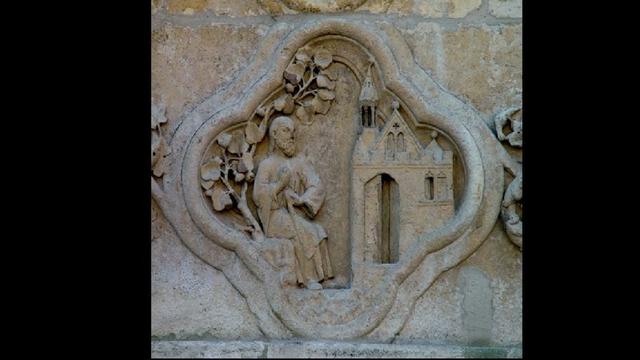
Image: photo © Jim Womack and Anne Richardson CC BY-SA 4.0, Public domain, via Wikimedia Commons

#BibleStudy #commentary #exegesis #Jonah4611 #meaning #readingTheBible