Reflecting on Acts 20 33-35, 2 Thessalonians 3 6-12, and more …

This week we’re studying two statements by the Apostle Paul, in Acts 20:33-35 (part of a farewell speech by Paul to the elders of Ephesus) and 2 Thessalonians 3:6-12 (almost the conclusion to the 2nd letter to the Thessalonians), along with a cluster of individual verses (Genesis 2:15, Exodus 20:9, John 5:17, and John 9:4) that mention “work.”

Our mission seems to be to reflect on “useful work as a Christian duty,” which poses first of all the question: how do these texts address that topic? Especially since a couple of these verses are from the Torah, sacred text which is not exclusive to Christians, although it is part of Christian scripture. Another couple of verses are statements made by Jesus, before there were any Christians. So it might be worth asking ourselves what makes “useful work” a specifically Christian duty, and in what way it is a specifically Christian duty. That is, how do we think Christian commitments influence, or are supposed to influence, Christians’ attitudes towards their work.

From there we might ask ourselves: what aspects of work do Christian commitments seem to influence, or perhaps to influence most, do we think? [For instance, choice of occupation? Diligence in performance of work tasks? Work schedule? Relationships at work? Economic organization more broadly, like pro- or anti-capitalism, or profit-sharing, or support for fair labor practices, or …? Other …?] How is that influence reflected, or encouraged, in the texts we’re reading for this week?

Some notes on those individual verses are here. Some notes on the longer texts are here. Here are a couple of additional questions we might want to reflect on, or discuss in class:

Torah ethics effectively makes all of life a practice of worship – that is, an acknowledgement of God, and of God’s demands on our lives. Christian monastic practice tends in the same direction. Specifically, the Benedictine saying ora et labora, “work and prayer,” makes work and prayer something like two hands of the same purposeful and prayerful gesture. [There is, however, some discussion, or even dispute, about whether the related phrase “work is prayer,” which seems to derive from the Benedictine motto, is more or less authentic, or helpful. See Andrew Penny on that here, and Chris Easley here.]

What do we think – can all of life be worship? And how does work, or some type(s) of work, fit into that? What kind of work might fit that model better, or worse, do we think? Why? Or does saying “work is prayer” have the effect of minimizing the importance of the different kind of prayer that is not work? Or, is that kind prayer a kind of work? …?

What are we even talking about when we say “work,” do we think? How do we think our ideas about work come from, or are supported by, scripture? How are our ideas challenged by scripture? Or perhaps, how do we think our pre-existing ideas about “work” influence the way we’re reading these texts about work?

What makes work “useful”? How do we measure or discern its usefulness? What help are these texts in that regard?

[For instance, 2 Thessalonians 3:8 links working to having money to pay for what the apostle needed. So, how does usefulness relate to a person’s being “self-supporting”? What other considerations might balance the need or desire to be self-supporting?]

More personal: How do we feel our own work “measures up,” or has measured up in the past, to the standard of “useful work” set out in these texts? How would we compare our own work to Adam’s in the garden, for instance, or to Jesus’ work in John, or to the apostle Paul’s work referred to in Acts and 2 Thessalonians? Why do we say that?

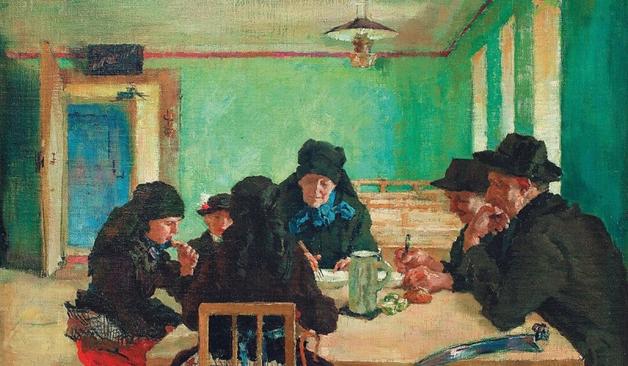
Image: “Bauernfamilie der Brotzeit,” Hermann Groeber, Public domain, via Wikimedia Commons

#2Thessalonians3612 #Acts203335 #BibleStudy #Exodus209 #Genesis215 #John517 #John94 #meaningForUs #readingTheBible #thinkingAboutTheBible #work
Studying Genesis 2 15, Exodus 20 9, John 5 17, and John 9 14

This week we’re studying a cluster of individual verses, including Genesis 2:15, Exodus 20:9, John 5:17, and John 9:4, along with a couple of almost-whole texts, Acts 20:33-35 (part of a farewell speech by Paul to the elders of Ephesus) and 2 Thessalonians 3:6-12 (almost the conclusion to the 2nd letter to the Thessalonians).

What links these disparate de-contextualized and re-contextualized texts is their mention of work, as something people, and Christian people specifically, ought to be doing. That is, these texts presumably speak to our “social teaching” of the week, “useful work as Christian duty.”

[Although … I myself feel duty-bound to point out that these verses don’t speak to work as a specifically Christian duty. They are more about work as Torah observance, first as taught in the actual Torah, and then as practiced by the we-think-perfectly-Torah-observant Jesus, and then as practiced and encouraged by Paul, the more-Torah-observant-than-not Jewish Christian.]

Anyway, here are a few notes on these isolated verses’ meaning in their [otherwise missing] contexts:

Genesis 2:15 is taken from about the middle of the second Biblical account of God’s creation of the earth and all its inhabitants, Genesis 2:4-25, the one in which God makes an earth-and-breath creature from the dust of the ground first, then causes plants to spring up, including a couple of significant trees, and then, in our verse, takes the earthling (the adam) and sets him in the garden to serve it/her and keep/guard it/her. The Hebrew word translated “to till” is a frequently used one, typically translated “to serve.” The two infinitive verbs “to serve” and “to keep/guard” have a feminine singular object ending, corresponding to the feminine noun “garden”.

So, the original earth-and-breath creature has a God-given agenda: to serve and to keep the creation, which at this point includes plants but no animals. The chapter progresses with God seeing that “it is not good for the adam to be alone,” making animals, and then a woman, whom the adam, now also an ish, a man, poetically receives as “bone of my bone and flesh of my flesh.”

Exodus 20:9 is part of the longer commandment about keeping the Sabbath [same as the way the adam is to keep the garden]. The whole article (one of the well-known “ten words,” #4 by one way of counting those) reads

“Remember the Sabbath day and keep it holy. 9 Six days you shall labor and do all your work. 10 But the seventh day is a Sabbath to the Lord your God; you shall not do any work—you, your son or your daughter, your male or female slave, your livestock, or the alien resident in your towns. 11 For in six days the Lord made heaven and earth, the sea, and all that is in them, but rested the seventh day; therefore the Lord blessed the Sabbath day and consecrated it.

Exodus 20:8-11

This reminds us that, as anyone’s rabbi will affirm, the commandment to keep Shabbat is, reciprocally, a commandment to work the other six days of the week. The word translated “labor” in v9 is the word that names what the earth-and-breath creature is set in the garden to do: to serve. The word translated “work” names a particular kind of activity, and also the result of that activity. Famously, it includes what God accomplishes in the work of creation (see Genesis 2:2), and what the Israelites do in making the Tabernacle in the wilderness, from which the sages derive the 39 general categories of [creative, productive] work that are to be avoided on Shabbat.

John 5:17 is basically the punchline of the story that opens this chapter (John 5:1-18). Jesus heals a lame or paralyzed man at the pool of Bethesda. About half-way through the story, we find out this healing has happened on the Sabbath, when the man normatively shouldn’t be carrying anything (including his sleeping mat) and when maybe healers ought not to be healing people (although there could be some dispute about that – Jesus obviously seems to think so).

Jesus’ answer to the opposition his action provokes seems to be a reference back to Genesis 2:2-3, and Exodus 20:11, to the effect that, “as a matter of fact, God (“My Father”) isn’t actually resting just yet, and so, neither am I.”

[Presumably, this verse isn’t a prooftext for Jesus’ opposition to people’s taking a regular day of rest, Jesus’ support for repealing fair labor practices legislation, etc.]

In the next verse, Jesus’ opponents interpret Jesus’ calling God his father as overstepping a line. Maybe they are not taking seriously enough the texts that identify Israel – of which Jesus is a member – as God’s son. [See e.g., Hosea 11, Isaiah 63:16, Isaiah 64:8.]

We’d never know Jesus had ever said this, by the way, if all we knew were the lectionary.

John 9:4 is right at the beginning of the much longer narrative of “the man born blind.” “Working the works of him who sent me while it is daymay be yet another reference to God’s ongoing creative activity, including a reference to God’s creative time-keeping. (See Genesis 1, in which “evening and morning” define the “days” of God’s creative work.)

Jesus’ statement also, of course, resonates with the recurrent theme of light and dark, day and night, in the gospel of John. The entire story might even be read as a reference to the creation story, as it includes a “let there be light” moment, the beginning of something new for the sightless man, making this particular Sabbath a new first day. We might start to get the idea that days in the gospel of John are reckoned less by the visibility of the earth’s nearest star than they are by the appearance and activity of the Sun of Righteousness.

Some notes on the almost-whole-texts are here. Some questions on the texts are here.

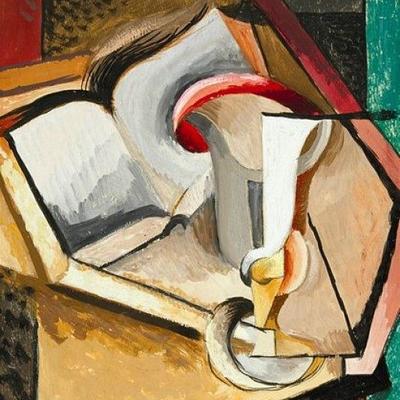
Image: “Old book – Basking Ridge Historical Society,” William Hoiles from Basking Ridge, NJ, USA, CC BY 2.0, via Wikimedia Commons

#BibleStudy #commentary #exegesis #Exodus209 #Genesis215 #John517 #John94 #meaning #readingTheBible #textsThatArenTInTheLectionary #work