Aten

Also known as Aton, Atonu, or Itn.

Aten was the focus of Atenism. The religious system was formally established in ancient Egypt by the late 18th Dynasty pharaoh Akhenaten.

The worship of Aten & the coinciding rule of Akhenaten are major identifying characteristics of a time within the 18th Dynasty referred to as the Amarna Period (circa 1353-1336 BCE).

Atenism, & the worship of Aten as the sole god of the ancient Egyptian state worship, didn’t last past Akhenaten’s passing away. Not long after Akhenaten’s death, 1 of Akhenaten’s 18th Dynasty successors, Tutankhamun, reopened the state temples to other Egyptian gods & re-positioned Amun (not Aten) as the chief solar deity. Aten is pictured as a solar disc emitting rays ending in human hands (think like a kid’s drawing of the sun shining down with its rays).

The word Aten shows up in the Old Kingdom as a noun meaning “disc,” which refers to anything flat & circular. The sun was called the “disc of the day,” where Ra was thought to live. By contrast, the moon was sometimes called the “silver disc.”

The Aten was the disc of the sun & originally an aspect of Ra, the sun god in traditional Egyptian religion. Aten doesn’t have an origin (creation) story/myth or even a family. But is mentioned in the Egyptian Book of the Dead. The 1st known reference to Aten, the sun-disk, as a deity is in The Story of Sinuhe from the 12th century. In which the deceased king is described as rising as a god to the heavens & “uniting with the sun-disk, the divine body merging with its maker.”

Aten was extensively worshipped as a solar deity under Amenhotep III, where it was depicted as a falcon-headed god like Ra. While Aten was the preeminent creator deity of a pantheon of ancient Egyptian gods under Amenhotep III, it wasn’t until his successor that Aten would be the only god acknowledged via state worship.

During the reign of Amenhotep III’s successor, Amenhotep IV, the Aten became the sole God of the Egyptian state religion. Amenhotep IV changed his name to Akhenaten to reflect his close link with the supreme deity. The sole worship of Aten can be referred to as Atenism.

In Atenism, night is a time to fear. Work is done best when the sun, or Aten, is present. The Aten created all countries & people, & cares for every creature. According to inscriptions, the Aten created a Nile River in the sky (rain) for the Syrians.

The rays of the sun disk only hold out life to the royal family. Because of this, non-royals receive life from Akhenaten & Nefertiti (later renamed Neferneferuaten) in exchange for loyalty to the Aten. In inscriptions (like the Hymn to the Aten & the King), the Aten is depicted as caring for the people through Akhenaten, putting the royal family as intermediaries for the worship of the Aten. There’s only 1 known example of the Aten talking.

Akhenaten represented himself as the son of Aten, mirroring many of his predecessors’ claims of divine birth & their positions as the embodiment of Horus. Akhenaten positioned himself as the only intermediary who could speak to Aten, emphasizing the dominance of Aten as the preeminent deity.

Aten is both a unique deity & a continuation of the traditional idea of a sun-god in Egyptian religion. Aten carried absolute power in the universe, representing the life-giving force of light to the world. The cult center of the Aten was the capital city, Amarna, founded by Akhenaten.

Though other cult sites have been found in Thebes & Heliopolis. The use of Amarna as a capital city & religious center was relatively short-lived as it was abandoned after Akhenaten’s death. Major principles of Aten’s cult worship were recorded via inscriptions on temples and tombs from the period.

The temples of Aten were open & don’t have roofs so that the sun’s full power/rays could go inside. This was significantly straying from the traditional ancient Egyptian temples. No statues of Aten were allowed; it was seen as idolatry.

On the other hand, these Aten idols were replaced by functionally equivalent representations for Akhenaten & his family, venerating the Aten & receiving the ankh (the breath of life) from him. As a pharaoh, Akhenaten was considered the “high priest” or even a prophet of the Aten. During his reign, he was 1 of the main propagators of Atenism in Egypt.

After his dad’s death, Tutankhamun reinstated the cult of Amun (probably under pressure from the priests & other religious officials because Tutankhamun was a kid when he took over). It didn’t last more than 10 years or so after Akhenaten’s death.

When Tutankhamun came to power, his religious reign was marked by tolerance. He made efforts to rebuild the state temples that were destroyed during Akhenaten’s reign & reinstated the traditional pantheon of gods.

One-Time Monthly Yearly

Make a one-time donation

Make a monthly donation

Make a yearly donation

Choose an amount

$5.00 $10.00 $15.00 $1.00 $5.00 $10.00 $5.00 $10.00 $15.00

Or enter a custom amount.

$

Your contribution is appreciated.

Your contribution is appreciated.

Your contribution is appreciated.

DonateDonate monthlyDonate yearly #12thDynasty #1336BC #18thDynasty #Akhenaten #Amarna #AmarnaPeriod #AmenhotepIII #AmenhotepIV #Amun #AncientEgypt #Ankh #Aten #Atenism #Aton #Circa1353BCE #EgyptianBookOfTheDead #Heliopolis #HighPriest #HymnToTheAtenTheKing #Neferneferuaten #Nefertiti #NileRiver #OldKingdomOfEgypt #Pharaoh #Ra #StateReligionS #StateWorship #SunDisk #Syrians #temples #TheStoryOfSInuhe #Thebes #Tutankhamun
Ma’at

She comprised the ancient Egyptian concepts of truth, balance, order, harmony, law, morality, & justice. Ma’at was also the goddess who personified these concepts, & regulated the stars, seasons, & the actions of mortals & the deities who had brought order from chaos at the moment of creation. Her ideological opposite is Isfet (Egyptian: jzft), meaning injustice, chaos, violence, or to do evil.

The earliest surviving records indicating that Ma’at is the norm for nature & society in this world & the next, were recorded during the Old Kingdom of Egypt. The earliest significant surviving examples being found in the Pyramid Texts of Unas (circa 2375 BCE-2345 BCE).

Most Egyptian goddesses were paired with a male counterpart. Her masculine equivalent was Thoth. This is because their traits are similar. In other accounts, Thoth was paired off with Seshat, the goddess of writing & measure, who’s a lesser-known deity.

After her role in creation & continuously preventing the universe from returning from & returning to chaos, her primary role in ancient Egyptian religion dealt with the Weighing of the Heart that took place in the Duat.

Her feather was the measure that determined whether the souls (considered to reside in the heart) of the departed would reach the paradise other afterlife successfully. In other versions, Ma’at was the feather as the personifications of truth, justice, & harmony.

Pharaohs are often shown with the emblems of Ma’at to emphasize their roles in upholding the laws & righteousness. From the 18th Dynasty (circa 1550-1295 BC), Ma’at was shown as the daughter of Ra, suggesting that Pharaohs were believed to rule through her authority.

As the goddess of harmony, justice, & truth, Ma’at was shown as a young woman. She’s sometimes shown with wings on each arm or as a woman with an ostrich feather on her head.

The sun-god Ra came from the primaeval mound of creation only after he set his daughter Ma’at in place of isfet (chaos). Kings inherited the duty to ensure Ma’at remained in place. They with Ra are said to “live on Ma’at,” with Akhenaten in particular emphasizing the concept to a degree that the king’s contemporaries are seen as intolerance & fanaticism. Some kings combined Ma’at into their names, being referred to as Lords of Ma’at or Meri-Ma’at (Beloved of Ma’at). Ma’at had a central role in the ceremony of the Weighing of the Heart.

Ma’at represented the ethical & moral principle that all Egyptian citizens were expected to follow throughout their daily lives. They were to act with honor & truth in matters that involve family, the community, the nation, the environment, & the gods.

Ma’at was the spirit in which justice was applied rather than the detailed legalistic account of rules. She represented the normal & basic values that formed the setting for the application of justice that had to be carried out in the spirit & fairness.

From the 5th Dynasty (circa 2510-2370 BC) onward, the vizier (Jafar’s job in Disney’s Aladdin, the 1st one.) was responsible for justice and was called the Priest of Ma’at. In later periods, judges wore images of Ma’at.

The goddess Ma’at was the daughter of the Egyptian sun-god Ra. She was/is the wife of Thoth, who’s the god of wisdom who invented writing. She’s associated with the judgment of the dead & whether a person has done what’s right in their life. To do Ma’at was to act in a manner unreproachable or innocent.

So revered was the concept of Ma’at that Egyptian kings would often pay tribute to gods, offering small statues of Ma’at. This indicated that they were successfully upholding the universal order.

The earliest evidence for a dedicated temple is in the New Kingdom (circa 1569-1081 BC) era. Amenhotep III commissioned a temple in the Karnek complex. While textual evidence indicates that other temples of Ma’at were located in Memphis & at Deir el-Medina. The Ma’at temple at Karnak was also used by courts to meet regarding the robberies of the royal tombs during the rule of Ramesses IX.

In the Duat, the Egyptian underworld, the hearts of the dead were said to be weighed against Ma’at’s single “Feather of Ma’at.” This symbolically represented the concept of Ma’at in the Hall of 2 Truths.

This is why hearts were left in the Egyptian mummies while other organs were removed, as the heart (called “ib”) was seen as part of the Egyptian soul. If the heart was found to be lighter or equal to the feather of Ma’at, the deceased had led a virtuous life & would go to Aaru. A heart that’s unworthy was devoured by the goddess Ammit & its owner condemned to remain to the Duat.

The Weighing of the Heart, as usually shown on papyrus in the Book of the Dead (or in tomb scenes) shows Anubis overseeing the weighing & Ammit seated awaiting the results to eat those who failed. The image contains a balancing scale with an upright heart standing on 1 side & the Shu-feather standing on the other.

Other traditions God that Anubis brought the soul before the posthumous Osiris who performed weighing while the heart was weighed the deceased recited the 42 Negative Confessions as the Assessors of Ma’at looked on.

The Assessors of Ma’at are the 42 deities listed in the Papyrus of Nebseni, to whom the deceased make the Negative Confession in the Papyrus of Ani. They represent the 42 united nomes of Egypt. They’re called “the hidden Ma’ati gods, who feed upon Ma’at during the years of their lives.”

One-Time Monthly Yearly

Make a one-time donation

Make a monthly donation

Make a yearly donation

Choose an amount

$1.00 $5.00 $10.00 $1.00 $5.00 $10.00 $5.00 $10.00 $15.00

Or enter a custom amount

$

Your contribution is appreciated.

Your contribution is appreciated.

Your contribution is appreciated.

DonateDonate monthlyDonate yearly

#1081BC #1550BC #1569BC #18thDynasty #2345BCE #2370BC #2375BCE #2510BC #42NegativeConfessions #5thDynasty #Akhenaten #Aladdin #AmenhotepIII #Ammit #Anubis #AssessorsOfMaAt #BelovedOfMaAt #BookOfTheDead #Chaos #DeirElMedina #Disney #Duat #Egypt #EgyptianBookOfTheDead #Feather #FeatherOfMaAt #Goddess #HallOfTwoTruths #Ib #Isfet #Jzft #Karnek #LordsOfMaAt #MaAt #Memphis #MeriMaAt #Mummies #NewKingdom #OldKingdomOfEgypt #Osiris #OstrichFeather #PapyrusOfAni #PapyrusOfNebseni #Pharaoh #PriestOfMaAt #PyramidTextsOfUnas #Ra #RamesesIX #Seshat #ShuFeather #SunGod #Thoth #Vizier #WeighingOfTheHeart

Duat

This is a concept in Ancient Egyptian mythology involving death. It’s most commonly seen as a domain where people go after they pass away.

What we know about the Duat comes mainly from funerary texts such as: the Book of Gates, the Book of Caverns, the Coffin Texts, the Amduat, the (Egyptian) Book of the Dead.

It’s typically known best as a dark subsurface realm that not only houses the deceased, but an assortment of deities. The deities shown in these texts are: Osiris, Anubis, Thoth, Horus, & Ma’at in various forms. While all of those documents/books involve the Duat. Each of them fulfilled a different purpose & showed the Duat in a variety of unique ways.

The Duat is divided into sections by 12 guarded gates that represented each hour of the night & are closely connected with the journey of Ra & conspicuously feature Osiris, the god of the Duat & the personification of rebirth.

The west bank of the Nile was affiliated with the dead. Funeral barges would mimic the sun god Ra’s journey through the sky during the day. The Duat also is often described as having many realistic features like rivers, islands, fields, paths, & lakes.

Texts also depict fantastic lakes of fire, walls of iron, & trees of turquoise. These lands are described as being dark & were partitioned with a series of gates. They’re mostly identified as Shetit, a dangerous land translated as ‘The Beyond.’

There were important locations relating to the deceased would be ‘The Hall of Truth.’ It is often shown alongside the ‘Weighing of the Heart’ ritual in the Book(s) of the Dead & mentioned in the 6th hour of Ra’s journey.

If the dead are found to be virtuous, they’ll be allowed to live in A’aru. This is also known as ‘The Field of Reeds.’ It’s shown as a paradise where the dead could live their former life with their loved ones without pain or suffering.

There’s hundreds of different divinities of shifting importance related to the Duat throughout time with the most referenced being:

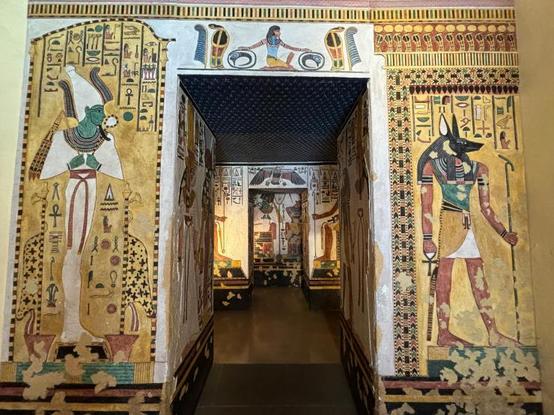
  • Osiris: He’s believed to be the lord of the realm & personifies rebirth & the afterlife. In his own mythology, he himself is reborn after his brother, Set, kills him & Osiris’ wife partially revives him. He’s shown as a man with green skin, partially wrapped in bandages.
  • Anubis: The son of Osiris & Nephthys. He weighs the heart of the deceased. His domains also cover the embalming & mummification process. As well as guiding souls to the Duat upon death. He’s shown with the black head of a canine. But most often assumed to be a jackal. Nephthys is a goddess of the night, mourning, & death.
  • Thoth: He records the verdict of the ‘Weighing of the Heart.’ He’s most often shown as an ibis-headed with a stylus & tablet.
  • Horus: The son of Osiris & Isis. He protects Ra during his journey through the Duet. He’s also the heir to Osiris.
  • Ma’at: She’s both the goddess of order & the conception of order, balance, & truth itself. She’s the feather that’s weighed against the heart in the ‘Weighing of the Heart’ ritual.
  • Ammit: She eats the hearts & souls of those who cannot pass the ‘Weighing of the Heart’ ritual. She’s often shown near the Scales in the Book(s) of the Dead with the face of a crocodile, the mane & front half of a lion, & the hindquarters of a hippopotamus.
  • Ra: He’s the God of the sun who must journey through the Duat every night to be reborn every morning.
  • Apep: The personification of darkness & true chaos who tries to devour Ra & bring about eternal chaos.

In order to receive judgment, the dead journeyed through the different parts of the Duat to be judged. If the deceased was successfully able to pass different challenges, then they would reach the Judgment of the Dead.

In this ritual, the deceased’s 1st task was to correctly address each of the 42 Assessors of Ma’at by name. While reciting the sins they didn’t commit during their lifetime.

After confirming that they were sinless, the heart of the deceased was weighed by Anubis against the feather of Ma’at which represents truth & justice. Any heart that’s heavier than the feather failed the test, & was rejected & eaten by Ammit, the devourer of souls.

As these people were denied existence after death in the Duat. The souls that were lighter than the feather would pass this most important test, & would be allowed to travel to Aaru.

The Duat isn’t equal to the notions of Hell in Abrahamic religions. This is where the souls are condemned with fiery torment. The absolute punishment for the wicked in ancient Egyptian though, was the denial of an afterlife to the deceased, ceasing to exist in the intellectual form seen through the devouring of the heart by Ammit.

Each night, Ra journeyed through the Duat. Bringing revival to the dead as their main benefit. When in the underworld, he was in his ram-headed form, Af. Ra travelled under the world on his Atet barge from West to East. On the course of the underground journey, he was transformed from his aged Atum form into his young Khepri form – the new dawning sun.

The role of the dead king, worshipped as a god, was also central to the mythology surrounding the concept of Duat, often shown as being identical with Ra.

Along with the sun god, the dead king travelled through the Duat, the Kingdom of Osiris, using the special knowledge he was supposed to possess, which was recorded in the Coffin Texts. This served as a guide to the Hereafter. Not just for the king but for all the deceased.

According to the Amduat, the underworld consists of 12 areas signifying the 12 hours of the sun God’s journey through it. Battling Apep in order to bring order back to the earth in the morning. As his rays illuminated the Duat during the journey, the revived the dead who lived in the underworld & let them enjoy life after death during that hour of the night when they were in the presence of the sun god. After which they resumed their sleep, waiting for the god’s return the next night.

One-Time Monthly Yearly

Make a one-time donation

Make a monthly donation

Make a yearly donation

Choose an amount

$1.00 $5.00 $10.00 $1.00 $5.00 $10.00 $5.00 $10.00 $15.00

Or enter a custom amount

$

Your contribution is appreciated.

Your contribution is appreciated.

Your contribution is appreciated.

DonateDonate monthlyDonate yearly

#42AssessorsOfMaAt #AAru #AbrahamicFaiths #Af #Amduat #Ammit #AncientEgypt #Anubis #Apep #AtetBarge #Atum #BookOfCaverns #BookOfGates #CoffinTexts #Crocodile #Duat #EgyptianBookOfTheDead #EgyptianMythology #EgyptianPantheon #Egyptians #Embalming #FuneralBarges #Hippopotamus #IbisHeaded #Jackal #JudgmentOfTheDead #Khepri #Lion #MaAt #Mummification #Nephthys #Nile #Osiris #Paradise #Ra #RamHeaded #Reincarnation #Scales #Set #Shetit #TheFieldOfReeds #TheHallOfTruth #Thoth #WeighingOfTheHeart

The Coffin Texts

The Coffin Texts (c. 2134-2040 BCE) are 1,185 spells, incantations, and other forms of religious writing inscribed on coffins to help the deceased navigate the afterlife. They include the text known...

World History Encyclopedia

I have a note in my notebook that says only:

Chapter 17 of the Egyptian Book of the Dead is the most philosophical-
Mandrake

Does anyone know who Mandrake is?

#EgyptianBookOfTheDead

The Lamentations of Isis and Nephthys is an ancient Egyptian text in which the two goddess-sisters call the soul of the god Osiris to rejoin the living. https://www.worldhistory.org/article/878/the-lamentations-of-isis-and-nephthys/ #History #EgyptianBookoftheDead #EgyptianPapyrus #EgyptianReligion
The Lamentations of Isis and Nephthys

The Lamentations of Isis and Nephthys is an ancient Egyptian text in which the two goddess-sisters call the soul of the god Osiris to rejoin the living. The poem takes the form of a call-and-response...

World History Encyclopedia
A Brief History of Egyptian Art

Art is an essential aspect of any civilization. Once the basic human needs have been taken care of such as food, shelter, some form of community law, and a religious belief, cultures begin producing...

World History Encyclopedia
The Lamentations of Isis and Nephthys is an ancient Egyptian text in which the two goddess-sisters call the soul of the god Osiris to rejoin the living. https://www.worldhistory.org/article/878/the-lamentations-of-isis-and-nephthys/ #History #EgyptianBookoftheDead #EgyptianPapyrus #EgyptianReligion
The Lamentations of Isis and Nephthys

The Lamentations of Isis and Nephthys is an ancient Egyptian text in which the two goddess-sisters call the soul of the god Osiris to rejoin the living. The poem takes the form of a call-and-response...

World History Encyclopedia
The Egyptian Book of the Dead is a collection of spells which enable the soul of the deceased to navigate the afterlife. https://www.worldhistory.org/Egyptian_Book_of_the_Dead/ #History #Ankh #Anubis #EgyptianBookoftheDead
Egyptian Book of the Dead

The Egyptian Book of the Dead is a collection of spells which enable the soul of the deceased to navigate the afterlife. The famous title was given the work by western scholars; the actual title would...

World History Encyclopedia
Ghosts in Ancient Egypt

A text known as The Lay of the Harper, dating from the Middle Kingdom (2040-1782 BCE) encourages its audience to make the most of the time because death is a certainty: Make a holiday! And do not...

World History Encyclopedia