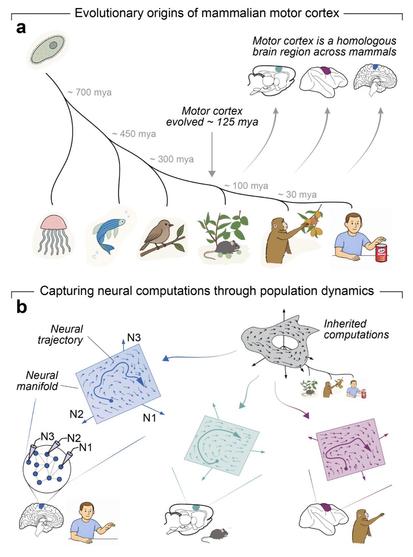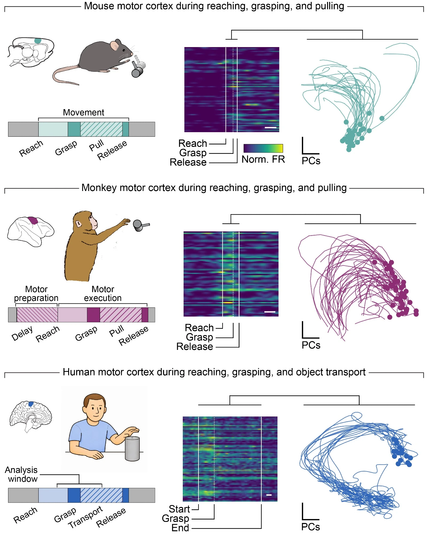
🧠 New by Codol et al. who show that #MotorCortex dynamics are remarkably conserved across #mice, #monkeys, and #humans. Despite very different #behaviors, #NeuralPopulation activity follows similar dynamical rules on low-dimensional #manifolds. Species differences arise mainly from the geometry of trajectories within this shared #DynamicalSystem.

📄 https://doi.org/10.64898/2026.03.06.709637

#Neuroscience #CompNeuro #NeuralDynamics

Congratulations to Dr. @jayeshdhadphale on successfully defending his PhD thesis on Data-driven modelling and prediction of onset of instability in thermoacoustic system. Wishing him continued success!

#PhD #MachineLearning #IITMadras #DynamicalSystem #PhasespaceReconstruction

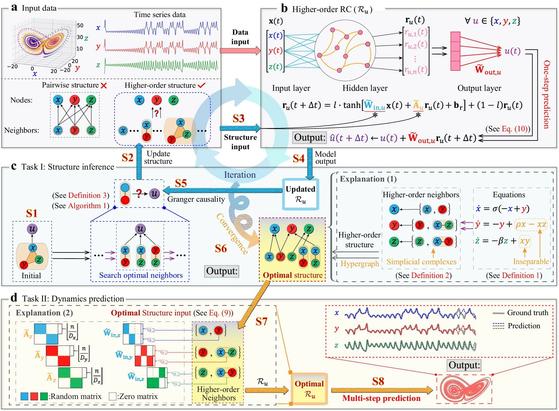
#simplicialcomplex + #Causality +#Reservoircomputing:
"Higher-order Granger reservoir computing: simultaneously achieving scalable complex structures inference and accurate dynamics prediction" https://www.nature.com/articles/s41467-024-46852-1

#dynamicalsystem #ML #AI

Higher-order Granger reservoir computing: simultaneously achieving scalable complex structures inference and accurate dynamics prediction - Nature Communications

For reservoir computing, improving prediction accuracy while maintaining low computing complexity remains a challenge. Inspired by the Granger causality, Li et al. design a data-driven and model-free framework by integrating the inference process and the inferred results on high-order structures.

Nature

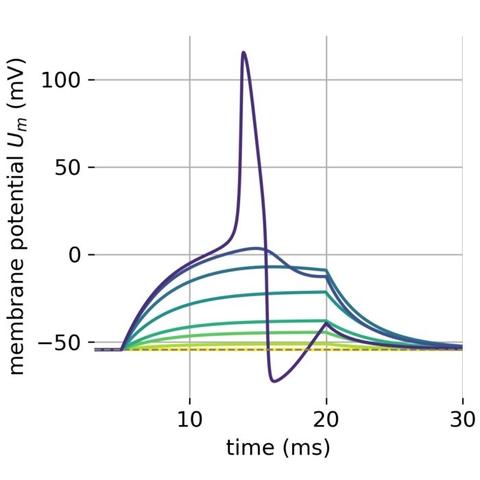
An important step in #ComputationalNeuroscience 🧠💻 was the development of the #HodgkinHuxley model, for which Hodgkin and Huxley received the #NobelPrize in 1963. The model describes the dynamics of the #MembranePotential of a #neuron 🔬 by incorporating biophysiological properties. See here how it is derived, along with a simple implementation in #Python:

🌍 https://www.fabriziomusacchio.com/blog/2024-04-21-hodgkin_huxley_model/

Feel free to share and to experiment with the code.

#CompNeuro #PythonTutorial #NeuralDynamics #DynamicalSystem

Hodgkin-Huxley model

An important step beyond simplified neuronal models is the Hodgkin-Huxley model. This model is based on the experimental data of Hodgkin and Huxley, who received the Nobel Prize in 1963 for their groundbreaking work. The model describes the dynamics of the membrane potential of a neuron by incorporating biophysiological properties instead of phenomenological descriptions. It is a cornerstone of computational neuroscience and has been used to study the dynamics of action potentials in neurons and the behavior of neural networks. In this post, we derive the Hodgkin-Huxley model step by step and provide a simple Python implementation.

Fabrizio Musacchio
The Van der Pol oscillator

In this post, we will apply phase plane analysis to the Van der Pol oscillator. The Van der Pol oscillator is a non-conservative oscillator with nonlinear damping, which was first described by the Dutch electrical engineer Balthasar van der Pol in 1920. We will explore how phase plane analysis can be used to gain insights into the behavior of this system and how it can be used to predict its long-term behavior.

Fabrizio Musacchio

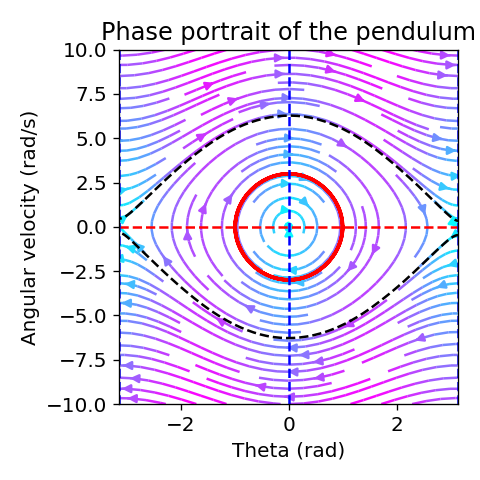
Exploring the behavior of #DynamicalSystems directly through their differential equations can be complex. #PhasePlaneAnalysis offers a clearer and intuitive view by visualizing dynamics with #PhasePortraits, simplifying understanding. Here is a #tutorial along with some #Python code, exploring this method and exemplarily applying it to the simple pendulum.

🌍 https://www.fabriziomusacchio.com/blog/2024-03-17-phase_plane_analysis/

#ChaoticSystems #DynamicalSystem #ComputationalScience

Using phase plane analysis to understand dynamical systems

When it comes to understanding the behavior of dynamical systems, it can often get too complex to analyze the system’s behavior directly from its differential equations. In such cases, phase plane analysis can be a powerful tool to gain insights into the system’s behavior. This method allows us to visualize the system’s dynamics in phase portraits, providing a clear and intuitive representation of the system’s behavior. Here, we explore how we can use phase plane analysis by applying it to the simple pendulum.

Fabrizio Musacchio

Genuary Prompt Nr. 5 is "In the style of Vera Molnàr". When I looked at her works I liked the framing squares with things going on in them. They reminded me at what I saw when investigating Dynamical Systems. This is 8 iterations of the function f(x,y)=( x-(1+y/4)tan(y)-t*y , x )

Full-Res full-length full-size version: https://youtu.be/q8V0KPQRjRM

#genuary #genuary5 #genuary2024 #dynamicalsystem

Squary Dynamical System

YouTube
visual_server/media/frag/cmplx/cmplx-03.frag · master · Thomas Jourdan / aNa · GitLab

analog Not analog aNa is a live coding system for visuals. The aNa display server can mix generative code fragments with different inputs channels in real-time:...

GitLab

@noneuclideandreamer Again, this iterative mapping in the complex plane. This time with adjustable color spectrum and denoised.

for(int l=0; l<9; ++l) {
_xy = vec2(_xy.y + sin(t * _xy.x),
_xy.x);
}

#dynamicalsystem

Soapy Function:

(x,y)=(y+tlog|x|,x)

(better resolution on youtube)

#mastoart #codeart #dynamicalsystem