Exploring the behavior of #DynamicalSystems directly through their differential equations can be complex. #PhasePlaneAnalysis offers a clearer and intuitive view by visualizing dynamics with #PhasePortraits, simplifying understanding. Here is a #tutorial along with some #Python code, exploring this method and exemplarily applying it to the simple pendulum.
🌍 https://www.fabriziomusacchio.com/blog/2024-03-17-phase_plane_analysis/
#ChaoticSystems #DynamicalSystem #ComputationalScience
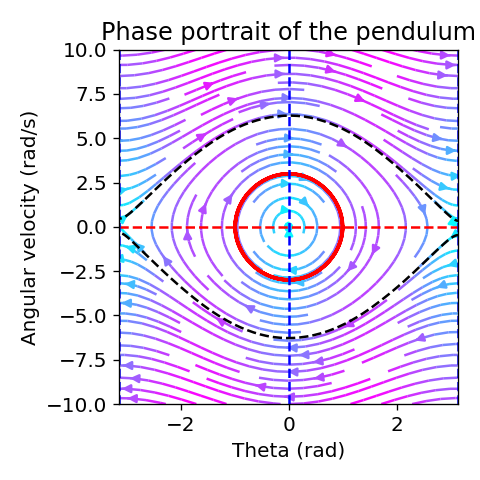

Using phase plane analysis to understand dynamical systems
When it comes to understanding the behavior of dynamical systems, it can often get too complex to analyze the system’s behavior directly from its differential equations. In such cases, phase plane analysis can be a powerful tool to gain insights into the system’s behavior. This method allows us to visualize the system’s dynamics in phase portraits, providing a clear and intuitive representation of the system’s behavior. Here, we explore how we can use phase plane analysis by applying it to the simple pendulum.
The #RösslerAttractor, introduced by Otto Rössler in 1976, does not describe a real physical system. Instead, it is a mathematical construction designed to illustrate and study the behavior of #ChaoticSystems in a simpler, more accessible manner. Here's some #Python code that simulates the #attractor and to play around with:
🌍 https://www.fabriziomusacchio.com/blog/2024-03-10-roessler_attractor/
#Chaos #ChaosTheory #DynamicalSystems

The Rössler attractor
Unlike the Lorenz attractor which emerges from the dynamics of convection rolls, the Rössler attractor does not describe a physical system found in nature. Instead, it is a mathematical construction designed to illustrate and study the behavior of chaotic systems in a simpler, more accessible manner. In this post, we explore how we can quickly simulate this strange attractor using simple Python code.
Emergence of a stochastic resonance in machine learning
Can noise be beneficial to machine-learning prediction of chaotic systems?
Utilizing reservoir computers as a paradigm, we find that injecting noise to
the training data can induce a stochastic resonance with significant benefits
to both short-term prediction of the state variables and long-term prediction
of the attractor of the system. A key to inducing the stochastic resonance is
to include the amplitude of the noise in the set of hyperparameters for
optimization. By so doing, the prediction accuracy, stability and horizon can
be dramatically improved. The stochastic resonance phenomenon is demonstrated
using two prototypical high-dimensional chaotic systems.
On states of disorder and irregularities in chaos theory. Self-similarity itself is a typical property of those mathematical objects.
#Fractals #StrangeAttractors #chaoticsystems are used to create an immersive light and sound performance @WolfgangSpahn
#amro20mainstage Fabrizio Musacchio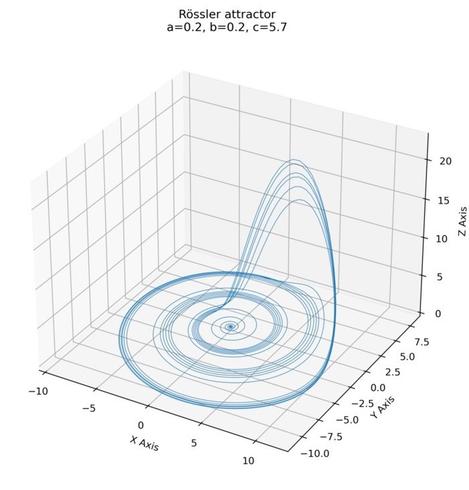
 Dominic Boutet
 servus.at