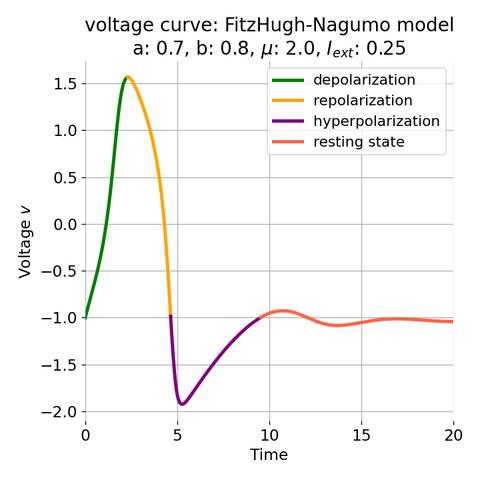
FitzHugh-Nagumo model
In the previous post, we analyzed the dynamics of Van der Pol oscillator by using phase plane analysis. In this post, we will see, that this oscillator can be considered as a special case of another dynamical system, the FitzHugh-Nagumo model. The FitzHugh-Nagumo model is a simplified model used to describe the dynamics of the action potential in neurons. With a few modifications of the Van der Pol equations we can obtain the model’s ODE system. By again using phase plane analysis, we can then investigate how the dynamics of the system changes under these modifications.

The Van der Pol oscillator
In this post, we will apply phase plane analysis to the Van der Pol oscillator. The Van der Pol oscillator is a non-conservative oscillator with nonlinear damping, which was first described by the Dutch electrical engineer Balthasar van der Pol in 1920. We will explore how phase plane analysis can be used to gain insights into the behavior of this system and how it can be used to predict its long-term behavior.

Nullclines and fixed points of the Rössler attractor
After introducing phase plane analysis in the previous post, we will now apply this method to the Rössler attractor presented earlier. We will investigate the system’s nullclines and fixed points, and analyze the attractor’s dynamics in the phase space.
Exploring the behavior of #DynamicalSystems directly through their differential equations can be complex. #PhasePlaneAnalysis offers a clearer and intuitive view by visualizing dynamics with #PhasePortraits, simplifying understanding. Here is a #tutorial along with some #Python code, exploring this method and exemplarily applying it to the simple pendulum.
🌍 https://www.fabriziomusacchio.com/blog/2024-03-17-phase_plane_analysis/
#ChaoticSystems #DynamicalSystem #ComputationalScience
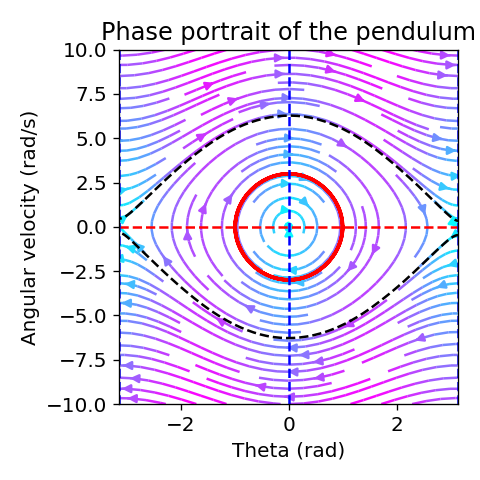

Using phase plane analysis to understand dynamical systems
When it comes to understanding the behavior of dynamical systems, it can often get too complex to analyze the system’s behavior directly from its differential equations. In such cases, phase plane analysis can be a powerful tool to gain insights into the system’s behavior. This method allows us to visualize the system’s dynamics in phase portraits, providing a clear and intuitive representation of the system’s behavior. Here, we explore how we can use phase plane analysis by applying it to the simple pendulum.
 Fabrizio Musacchio