Welchen Beitrag leisten digitale Editionen zur Profilierung von Epochen?
Heute erscheint "Editionen an der Herzog August Bibliothek Wolfenbüttel. Ein explorativer Rückblick" von @delaiglesia und @pmgoerma
Der Beitrag ist Teil des Sonderbands "Digitales Edieren gestern, heute und morgen" und geht der Frage mittels Distant Reading, quantitativer Analysen ausgewählter Metadaten und Volltexte nach: https://doi.org/10.17175/sb007_006
#digitalHumanities #distantreading #digitaledition
@MWWForschung @hab_wf
Der Beitrag unternimmt einen explorativen Rückblick auf die Editionen in der Wolfenbütteler Digitalen Bibliothek. Ausgehend von einem korpusbasierten Distant Reading, mittels quantitativer Analysen von ausgewählten Metadaten und Volltexten, wird die Frage nach dem Beitrag digitaler Editionen zur Profilierung der Epochen diskutiert.
Heute Abend bei #DH im Fokus: Anastasia Glawion (@FAU), die online über "Netzwerkbasierte Zugänge zu postpandemischen #HarryPotter -Interpretationen auf Fanfiktion.de". sprechen wird. Start um 17:15 Uhr. Zoom-Link & Abstract:
#RosDH #UniRostock #DigitalHumanities #HybridLecture #NetworkAnalysis #PlatformLiterature #DistantReading #Fanfiktion
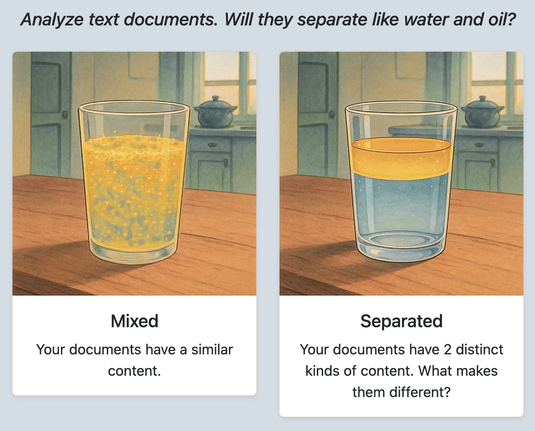
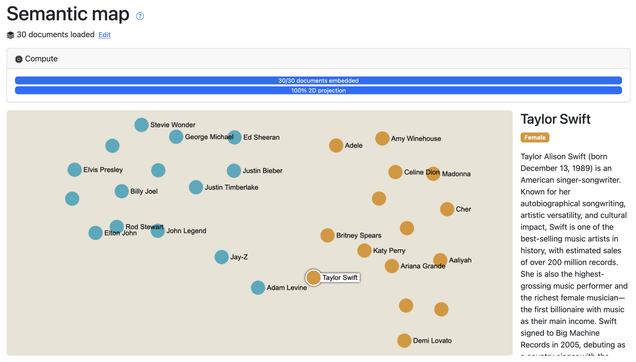
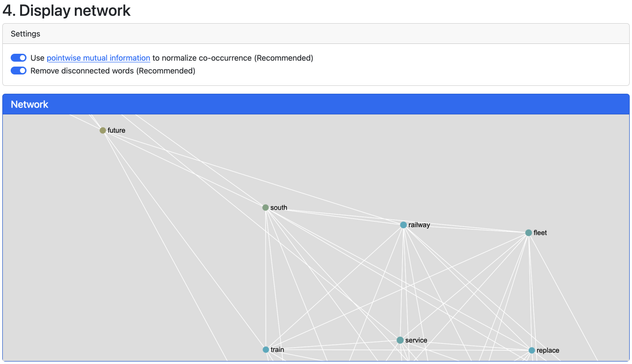
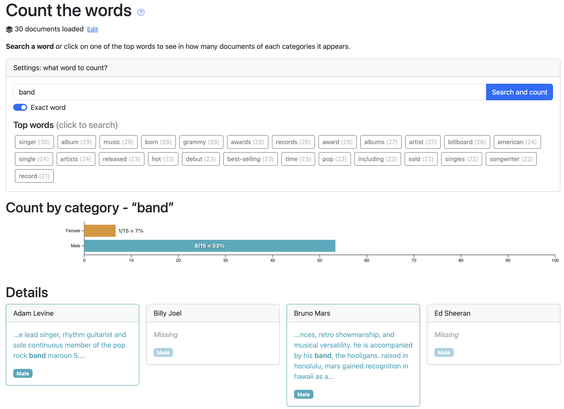
Ah, my latest tool, just out of the oven! Just in time for my Summer break... It's called *Vandolie*. It's for high school students, but it may work for you as well. I will let you discover it by yourself.
👉 https://jacomyma.github.io/vandolie/en/
It's like a mini CorTexT for teenagers, if you know that tool. But it runs entirely in the browser.
Entirely localized in Danish.
Consider it a beta version. Usable, but feel free to file GitHub issues for feedback & bugs.
This paper presents BookNLP-fr: the adaptation to French of BookNLP, an existing NLP pipeline tailored for literary texts in English. We provide an overview of the challenges involved in the adaptation of such a pipeline to a new language: from the challenges related to data annotation up to the development of specialized modules of entity recognition and coreference. Moving beyond the technical aspects, we explore practical applications of BookNLP-fr with a canonical task for computational literary studies: subgenre classification. We show that BookNLP-fr provides more relevant and – even more importantly – more interpretable features to perform automatic subgenre classification than the traditional bag-of-words approach. BookNLP-fr makes NLP techniques available to a larger public and constitutes a new toolkit to process large numbers of digitized books in French. This allows the field to gain a deeper literary understanding through the practice of distant reading.
📢 Im heutigen Beitrag zur #DigHis23 diskutiert @ChristianWachter die methodologischen Herausforderungen seines neuen Projekts zur Untersuchung der heterogenen Konzepte von #Demokratie in historischen Zeitungen der #WeimarerRepublik. Dazu bedient er sich mit dem #ScalableReading einer Kombination aus Close und #DistantReading.
📰 Zum Paper: https://doi.org/10.5281/zenodo.8322406
Ein Beitrag zur Digital History 2023: Digitale Methoden in der geschichtswissenschaftlichen Praxis: Fachliche Transformationen und ihre epistemologischen Konsequenzen, Berlin, 23.-26.5.2023. Abstract: In this paper, I will discuss methodological challenges and considerations in the early stages of a research project on political discourse in the Weimar Republic. The project focuses on heterogeneous perceptions and definitions of democracy as visible in Weimar's newspapers. I will problematize that text mining might seem particularly helpful for coping with the textual masses of this serial primary source. However, primarily quantitative approaches tend to neglect essential political and social contexts, thus omitting what stands behind the concrete formulations on the text surface. On the other hand, purely qualitative examination tends to be too selective to scrutinize discourse at scale. Therefore, I will outline a framework of scalable reading: The alternating movement of zooming into the close reading perspective and zooming out to the large-scale level. My strategy is, at its core, qualitative, but it introduces quantitative explorations in an overall framework of methodological triangulation. This is inspired by other studies of scalable reading in contemporary history, whose approaches must be adapted to do justice to the specific conditions of Weimar’s complex political culture. I will outline my considerations and a proposal for scalable reading, which enters largely uncharted terrain in historical research on Germany’s first democracy. While this paper focuses on methodological considerations during the project's onset, I have reported on the project more extensively and with special regard to pro-democratic discourse here: Christian Wachter [in press], Capturing Discourse through the Digital Lens: Towards a Framework for the Analysis of Pro-Democratic Discourse in the Weimar Republic, in: Florentina Armaselu/Andreas Fickers (eds.), Zoomland: Exploring Scale in Digital History and Humanities, Berlin 2023 (Studies in Digital History and Hermeneutics, 7).