🚀 Great kickoff to the workshop *"Scaling from Digital and Computational Perspectives"* at @CAS_LMU. Today's talks highlighted how different scales - of data structuring, analysis, and even of our reading and writing - can align productively. In many cases, however, aligning different scales remains difficult.
I am delighted to have contributed with my paper *"Augmented Vision: Scalable Heuristics for Historical Research."*

🔗 https://www.cas.lmu.de/en/events/event/scaling-from-digital-and-computational-perspectives.html
#DH #DigitalHumanities #ScalableReading


Scaling from Digital and Computational Perspectives

Workshop organized by Prof. Dr. Julian Schröter (LMU).

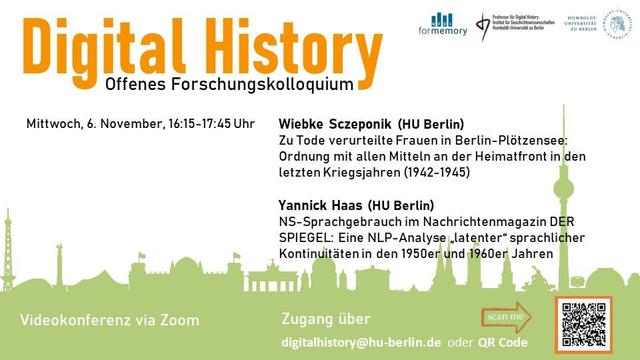
📢 Morgen startet unser #DigitalHistoryOFK.
Die 1. Sitzung ist wieder ausgewählten Abschlussarbeiten gewidmet:

Wiebke Sczeponik untersucht mit #ScalableReading Schicksale von Frauen in der Strafanstalt Berlin-Plötzensee (1942-45), Yannick Haas analysiert mit #NLP-Methoden Kontinuitäten von NS-Sprachgebrauch beim #Spiegel in den 1950-60ern.

🔜 Wann? 6.11., 16-18 Uhr (c.t.), via Zoom

ℹ️ Abstracts:
https://dhistory.hypotheses.org/8802
https://dhistory.hypotheses.org/8793

@historikerinnen #NFDI4Memory

Wiebke Sczeponik: Zum Tode verurteilte Frauen in Berlin-Plötzensee: Ordnung mit allen Mitteln an der Heimatfront in den letzten Kriegsjahren (1942 – 1945)

Die Strafanstalt Plötzensee im Nordwesten Berlins war während der nationalsozialistischen Diktatur einer der zentralen Orte für die Vollstreckung von Todesurteilen. Obwohl Plötzensee bereits vor 1933 existierte, erhielt es in der Zeit des NS-Regimes eine besondere Bedeutung im Rahmen des staatlichen Justizterrors. Die Forschung hat sich intensiv mit der Rolle von Frauen im NS-Staat sowie mit … „Wiebke Sczeponik: Zum Tode verurteilte Frauen in Berlin-Plötzensee: Ordnung mit allen Mitteln an der Heimatfront in den letzten Kriegsjahren (1942 – 1945)“ weiterlesen

Digital History Berlin

🏝️ 📘 today i learned from Kirill Mitsurov about #ZOOMLAND: a book about scalable digital history and humanities with a table of contents in the form of a 3d game in your browser – very impressive!

https://www.c2dh.uni.lu/zoomland/

#DigitalHumanities #DigitalHistory #WebGames #OpenAccess #ScalableReading #C2DH

Zoomland

Exploring scale in digital history and humanities

Come to #Zoomland! So excited to see this brilliant volume published (#OA) @c2dh_lu / @degruyter_pub ! Delighted to have contributed a piece on #ScalableReading of #newspaper|s. Focused on discourses on democracy in the #WeimarRepublic. #DigitalHistory #DH

https://www.degruyter.com/document/doi/10.1515/9783111317779/html

Zoomland

Despite a variety of theoretical and practical undertakings, there is no coherent understanding of the concept of scale in digital history and humanities, and its potential is largely unexplored. A clearer picture of the whole spectrum is needed, from large to small, distant to close, global to local, general to specific, macro to micro, and the in-between levels. The book addresses these issues and sketches out the territory of Zoomland , at scale. Four regions and sixteen chapters are conceptually and symbolically depicted through three perspectives: bird’s eye , overhead, and ground view. The variable-scale representation allows for exploratory paths covering areas such as: theoretical and applicative reflections on scale combining a digital dimension with research in history, media studies, cultural heritage, literature, text analysis, and map modelling; creative use of scale in new digital forms of analysis, data organisation, interfaces, and argumentative or artistic expressions. Zoomland provides a systematic discussion on the epistemological dimensions, hermeneutic methods, empirical tools, and aesthetic logic pertaining to scale and its innovative possibilities residing in humanities-based approaches and digital technologies.

De Gruyter

📢 Im heutigen Beitrag zur #DigHis23 diskutiert @ChristianWachter die methodologischen Herausforderungen seines neuen Projekts zur Untersuchung der heterogenen Konzepte von #Demokratie in historischen Zeitungen der #WeimarerRepublik. Dazu bedient er sich mit dem #ScalableReading einer Kombination aus Close und #DistantReading.

📰 Zum Paper: https://doi.org/10.5281/zenodo.8322406

#DigitalHistory #histodons

Democracy and Uncertainty. Approaching a Heuristic Framework for Studying Political Discourse in the Weimar Republic

Ein Beitrag zur Digital History 2023: Digitale Methoden in der geschichtswissenschaftlichen Praxis: Fachliche Transformationen und ihre epistemologischen Konsequenzen, Berlin, 23.-26.5.2023. Abstract: In this paper, I will discuss methodological challenges and considerations in the early stages of a research project on political discourse in the Weimar Republic. The project focuses on heterogeneous perceptions and definitions of democracy as visible in Weimar's newspapers. I will problematize that text mining might seem particularly helpful for coping with the textual masses of this serial primary source. However, primarily quantitative approaches tend to neglect essential political and social contexts, thus omitting what stands behind the concrete formulations on the text surface. On the other hand, purely qualitative examination tends to be too selective to scrutinize discourse at scale. Therefore, I will outline a framework of scalable reading: The alternating movement of zooming into the close reading perspective and zooming out to the large-scale level. My strategy is, at its core, qualitative, but it introduces quantitative explorations in an overall framework of methodological triangulation. This is inspired by other studies of scalable reading in contemporary history, whose approaches must be adapted to do justice to the specific conditions of Weimar’s complex political culture. I will outline my considerations and a proposal for scalable reading, which enters largely uncharted terrain in historical research on Germany’s first democracy. While this paper focuses on methodological considerations during the project's onset, I have reported on the project more extensively and with special regard to pro-democratic discourse here: Christian Wachter [in press], Capturing Discourse through the Digital Lens: Towards a Framework for the Analysis of Pro-Democratic Discourse in the Weimar Republic, in: Florentina Armaselu/Andreas Fickers (eds.), Zoomland: Exploring Scale in Digital History and Humanities, Berlin 2023 (Studies in Digital History and Hermeneutics, 7).

Zenodo
Looking for #dh projects that allow for actual #ScalableReading. Any pointers would be very much appreciated.