 Hackaday [Unofficial]
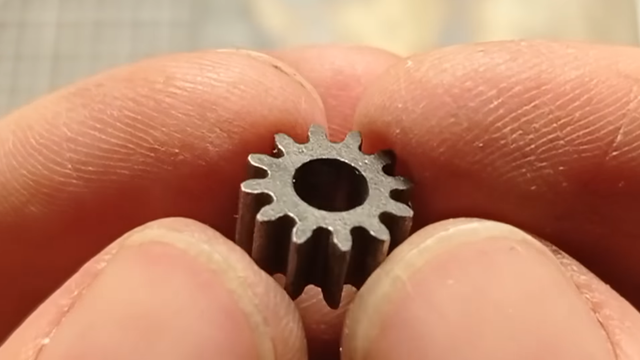
Cutting Steel Gears with Homemade EDM
https://fed.brid.gy/r/https://hackaday.com/2026/05/05/cutting-steel-gears-with-homemade-edm/
Cutting Steel Gears with Homemade EDM
https://fed.brid.gy/r/https://hackaday.com/2026/05/05/cutting-steel-gears-with-homemade-edm/
Newer #dielectric fluids and #powerelectronics now allow #electrostaticmotors to be better at some applications than their electromagnetic peers.
> The main advantage of electrostatic motors is their reduced critical materials use. In particular, electrostatic motors don’t require copper windings or any rare earth magnets which are getting more expensive as demand grows for electrically-powered machines.
Electrostatic Motors Are Making A Comeback
https://hackaday.com/2024/10/29/electrostatic-motors-are-making-a-comeback/
If you recognize the name Ajinomoto, you’re probably surprised to hear it plays a critical role in the chip sector:
the company is better known as the world’s leading supplier of #MSG seasoning powder.
In the 1990s, Ajinomoto discovered that a by-product of MSG made a great insulator, and it has enjoyed a near monopoly in the niche material ever since.
But Ajinomoto doesn’t make any of the other parts that go into chips.
In fact, the insulating materials in chips rely on dispersed supply chains: one layer uses materials from Ajinomoto, another uses material from another company, and so on, with none of the layers optimized to work in tandem.
The resulting system works okay when data is being transmitted over short paths, but over longer distances, like between chips, weak insulators act as a bottleneck, wasting energy and slowing down computing speeds.
That’s recently become a growing concern, especially as the scale of AI training gets more expensive and consumes eye-popping amounts of energy.
#Ajinomoto #dielectric #film #laptops #data #centers #Thintronics #CHIPS #Science #Act
For 30 years, a single Japanese company called #Ajinomoto has made billions producing #dielectric #film.
Competitors have struggled to outdo them, and today Ajinomoto has more than 90% of the market in the product, which is used in everything from #laptops to #data #centers.
But now, a startup based in Berkeley, California, is embarking on a herculean effort to dethrone Ajinomoto and bring this small slice of the chipmaking supply chain back to the US.
#Thintronics is promising a product purpose-built for the computing demands of the AI era
—a suite of new materials that the company claims have higher insulating properties and, if adopted, could mean data centers with faster computing speeds and lower energy costs.
The company is at the forefront of a coming wave of new US-based companies, spurred by the $280 billion #CHIPS and #Science #Act, that is seeking to carve out a portion of the semiconductor sector, which has become dominated by just a handful of international players.
But to succeed, Thintronics and its peers will have to overcome a web of challenges—solving technical problems, disrupting long-standing industry relationships, and persuading global semiconductor titans to accommodate new suppliers.
`Here we report a theoretical and experimental framework for the force behaviour in generic solid/liquid-dielectric #multilayer stacks independent of #actuator design and solely based on their #dielectric properties. We use this model to develop #materials-based solutions, which rely on matching the bulk charge relaxation rates of the constituent dielectrics, for a variety of soft actuator systems: tunable #lenses, artificial #muscles and #haptic #devices.`

A model that predicts the force behaviour for solid/liquid-dielectric multilayer stacks independent of actuator design, and solely based on the material properties, can be used to develop actuators that provide a steady force output under constant-voltage operation.
Learning About Capacitors by Rolling Your Own Electrolytics
#parts #aluminum #anode #capacitor #cathode #dielectric #electrolyte #electrolytic #oxide #hackaday
-- Delivered by RssEverything service
 Hacker News
 mc ☕
mc ☕
 Chuck Darwin
 katch wreck
 Andro Abhi