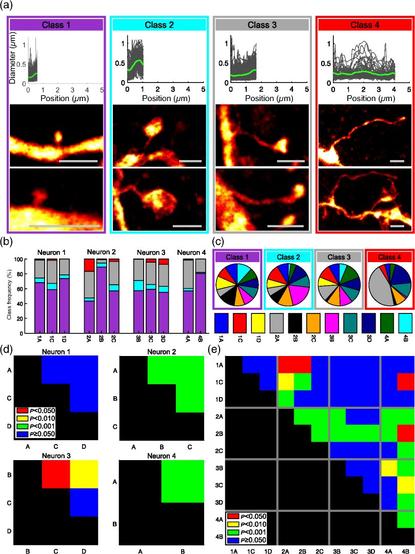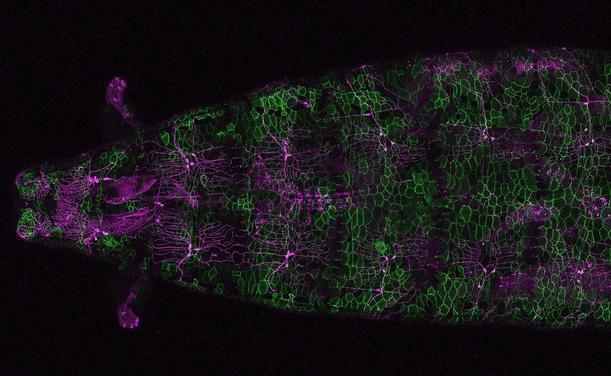
Axons and dendrites are fundamentally different. An example from #Drosophila:
"axons and dendrites can accumulate different microtubule-binding proteins; protein synthesis machinery is concentrated in the cell body; pre- and post-synaptic sites localize to distinct regions of the neuron; and specializations similar to the initial segment are present. In addition, we track EB1-GFP dynamics and determine microtubules in axons and dendrites have opposite polarity."
"Polarity and intracellular compartmentalization of Drosophila neurons", Rolls et al. 2007
https://link.springer.com/article/10.1186/1749-8104-2-7
To collapse axons and dendrites into point neurons in a simulation of neural circuits is, at this point, malpractice.
Background Proper neuronal function depends on forming three primary subcellular compartments: axons, dendrites, and soma. Each compartment has a specialized function (the axon to send information, dendrites to receive information, and the soma is where most cellular components are produced). In mammalian neurons, each primary compartment has distinctive molecular and morphological features, as well as smaller domains, such as the axon initial segment, that have more specialized functions. How neuronal subcellular compartments are established and maintained is not well understood. Genetic studies in Drosophila have provided insight into other areas of neurobiology, but it is not known whether flies are a good system in which to study neuronal polarity as a comprehensive analysis of Drosophila neuronal subcellular organization has not been performed. Results Here we use new and previously characterized markers to examine Drosophila neuronal compartments. We find that: axons and dendrites can accumulate different microtubule-binding proteins; protein synthesis machinery is concentrated in the cell body; pre- and post-synaptic sites localize to distinct regions of the neuron; and specializations similar to the initial segment are present. In addition, we track EB1-GFP dynamics and determine microtubules in axons and dendrites have opposite polarity. Conclusion We conclude that Drosophila will be a powerful system to study the establishment and maintenance of neuronal compartments.
Stanford University published a study recently finding that #EV #batteries may see 40% more lifespan than thought.
In a nutshell, the growth of #dendrites on the electrodes is the nail in the coffin for #lithium batteries. Historic testing was to do constant discharge/recharge cycles. But that's not how cars work. Acceleration and regen braking cause huge surges. Turns out, these surges are good and fry the dendrites, making the #battery healthier.
So EV owners, punch it and slam the brakes time to time! (but not with traffic around!!).
`In this work, we investigated the #dendrites of layer 2 and 3 (L2/3) pyramidal #neurons of the human cerebral cortex ex vivo. In these neurons, we discovered a class of #calcium-mediated dendritic action potentials (dCaAPs) whose waveform and effects on #neuronal output have not been previously described. In contrast to typical all-or-none action potentials, dCaAPs were graded; their amplitudes were maximal for threshold-level stimuli but dampened for stronger stimuli`
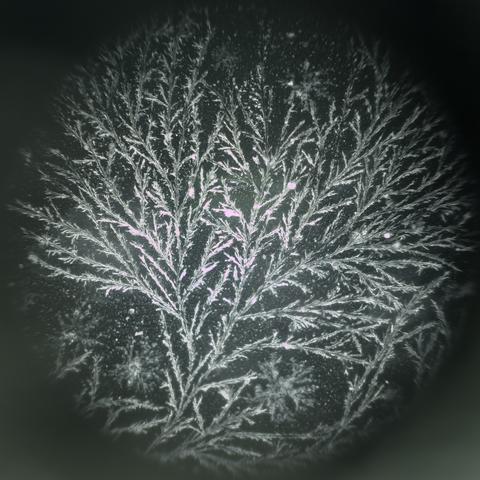
Summer vibes! Here researchers have captured dendrite generated on a zinc surface, and added their own seaside-themed flourish.
Photograph: Yutong Zhu