https://democracyparadox.com/2025/11/26/adam-przeworski-asks-who-decides-what-is-democratic/
#DemocraticTheory #PoliticalScience
Call for Applications: PhD position in political theory at the Department of Political Science, University of Copenhagen
https://employment.ku.dk/all-vacancies/?show=164147
🤓 3-year doctoral scholarship
📝 part of @anewq 's project “Citizens’ Agenda-Setting in Democratic Systems”
⏰ Deadline to apply: 03.08.2025
@democraticinnovations @politicalscience @politicaltheory #Democracy #DemocraticTheory #AgendaSetting #Job #Copenhagen #PoliticalTheory #DFF #DemoInno #Academia
A book I want to reread is C.B. Macpherson's "The Political Theory of Possessive Individualism".
#PoliticalThought #PoliticalTheory #PoliticalPhilosophy #CBMacpherson ##DemocraticTheory #PossessiveIndividualism #Canada #Liberalism #Socialism #CanadianIntellectuals #CanadianThought
"A Systemic Theory of Democracy": @DemocracyNet member Victor Sanchez-Mazas' first book is out!
AND it is downloadable for free here ⤵️
https://www.epflpress.org/auteur/2270/victor-sanchez-mazas
#democracy #democratictheory #openaccess @democraticinnovations @politicalscience @politicaltheory
I have: an article published (open access in Res Publica).
We (hopefully) have: one fewer objection to binding referendums and initiatives.
"Referendums, Initiatives, and Voters’ Accountability"
https://doi.org/10.1007/s11158-023-09647-7
It is part of a special issue edited by Suzanne Bloks and Dorota Mokrosinska on democratic decision-making methods.
Some of the other pieces are already out, and they're great:
@politicalscience @politicaltheory @democraticinnovations @DemocracyNet #voting #DemocraticTheory
Do democratic systems that include binding referendum and initiative processes violate a core principle of democracy, namely that legislators should be accountable? Some have argued that they do: these popular vote processes would grant the right to legislate to ordinary voters even though they cannot be held accountable—i.e., face possible consequences imposed by others for their actions and decisions. As a result, we should favor conventional representative systems over systems with popular vote processes. In this article, I analyze this ‘accountability objection’ to referendums and initiatives and the conception of voters as ‘legislators’ on which it relies and argue that it does not withstand scrutiny. I first demonstrate that there is no sound basis to characterize only voters in popular votes, and not voters in elections, as ‘legislators’. Therefore, the scope of the objection is broader than anticipated by its proponents: it cannot be consistently used to dismiss popular votes without also being fatal to elections. I then argue that voters’ lack of accountability is not fatal to either mass voting process. The institutional role of ordinary voters provides them with co-lawmaking powers; but these are not the kind of special powers that justify holding certain actors accountable in democratic systems. This does not exclude that voters have responsibilities. I close by highlighting that, compared to conventional representative systems, democratic systems including well-designed popular vote processes could offer voters more supportive conditions to meet such possible responsibilities.
Big congratulations to our member Hans Asenbaum for being awarded the ECPR 2022 Rising Star Award 🤩 ✨
https://ecpr.eu/News/News/Details/663
The award highlights his
🌟 outstanding academic performance
🌟 extensive publications
🌟 generous service to the profession
So well deserved!
@Hans_Asenbaum @ECPR_PolCom #ECPRPrizes @democraticinnovations @politicalscience #DemocraticTheory #Democracy #DemocracyStudies #DemocraticInnovations #DemocraticAssemblage
Excited to read The Boundaries of Democracy: A Theory of Inclusion By Ludvig Beckman. Open Access here:
@politicaltheory @politicalscience @philosophy #democratictheory
Hello👋! This is my #introduction post.
I am a political scientist at Altınbaş University and the head of political science and public administration department. My academic interests are at the intersection of #politicaltheory and #ComparativePolitics. I got my PhD from Boğaziçi University in 2019 with a thesis on a conceptual analysis of secularism as a constitutional principle. Recently, I’ve been working on #democratictheory, #democratization, #autocratization, and political participation.
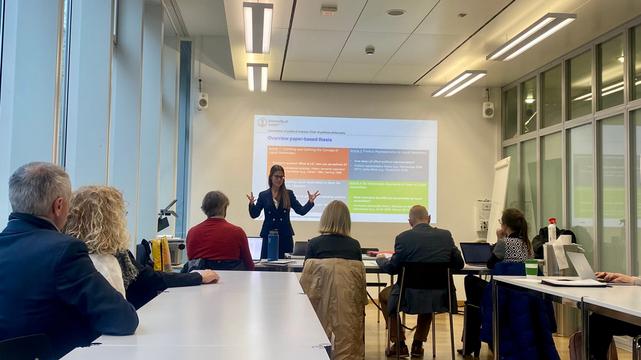
Congratulations to Chiara Valsangiacomo, Vice President of @DemocracyNet, on her successful PhD defence and her 'groundbreaking’ dissertation on liquid democracy! 👏
#LiquidDemocracy #Democracy #DemocraticTheory #DemInno #DemocraticInnovations #summacumlaude #UZH #UniversityOfZurich @politicaltheory @democraticinnovations @IPZ_ch