Repubblica.it: Conan, il batterio immortale venuto (forse) da Marte: “Può aver preso un passaggio da un asteroide”

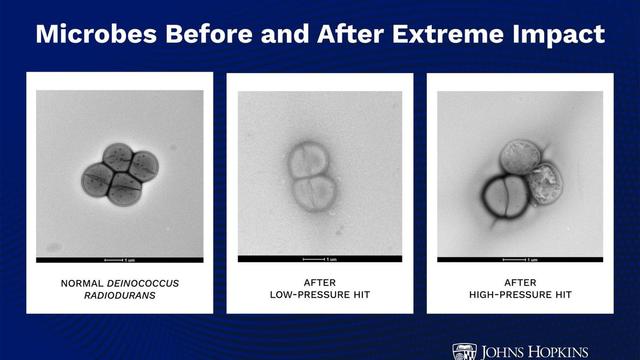
Gli scienziati hanno sottoposto “Deinococcus radiodurans” alla simulazione di un impatto con un meteorite. E lui è sopravvissuto. Si pensa che possa essere stato scagliato così verso la Terra

Conan, the immortal bacterium from (perhaps) Mars: “It may have taken a ride from an asteroid.”

Scientists subjected “Deinococcus radiodurans” to a simulation of a meteorite impact. And it survived. It is thought that it may have been hurled in this way towards Earth.

#Conan #Deinococcus #Earth

https://www.repubblica.it/cronaca/2026/03/11/news/batterio_conan_marte_asteroide-425213697/
Conan, il batterio immortale venuto (forse) da Marte: “Può aver preso un passaggio da un asteroide”

Gli scienziati hanno sottoposto “Deinococcus radiodurans” alla simulazione di un impatto con un meteorite. E lui è sopravvissuto. Si pensa che possa essere sta…

la Repubblica
Reisten Mikroben von Planet zu Planet? Einige Bakterien könnten durch Einschläge und Meteoriten durchs All gelangen. #Panspermie #Mikroben #Meteoriten #Marsmikroben #Deinococcus #Einschlag
https://www.scinexx.de/news/biowissen/reisen-mikroben-von-planet-zu-planet/
Reisen Mikroben von Planet zu Planet?

Mikrobielles Planeten-Hopping: Mikroben könnten auf Einschlagstrümmern von Planet zu Planet gelangen – und so das Leben im All ausgebreitet haben.

scinexx | Das Wissensmagazin
Bakterielle Superkraft: Wie „Conan das Bakterium“ extremer Strahlung standhält. Struktur von bakteriellem Antioxidans enthüllt. #Deinococcus #Conan #Bakterien #Extremophile #Antioxidans
https://www.scinexx.de/news/biowissen/wie-conan-das-bakterium-extremer-strahlung-standhaelt/
Wie „Conan das Bakterium“ extremer Strahlung standhält

Bakterielle Superkraft: Die winzige Mikrobe Deinococcus radiodurans kann extreme Strahlendosen überleben. Nun haben Biochemiker das Geheimnis hinter

scinexx | Das Wissensmagazin

Lab made magnetic bead genome extraction method.

https://journals.plos.org/plosone/article?id=10.1371/journal.pone.0296847

When I was working with Deinococcus I got fantastic long-read results just using handmade lysozyme cocktail and magnet beads - just precipitated out the DNA once they were bound. Leagues better than any commercial kit we've used, that's for sure.

#microbiology #deinococcus

Crop DNA extraction with lab-made magnetic nanoparticles

Molecular breeding methods, such as marker-assisted selection and genomic selection, require high-throughput and cost-effective methods for isolating genomic DNA from plants, specifically from crop tissue or seed with high polysaccharides, lipids, and proteins. A quick and inexpensive high-throughput method for isolating genomic DNA from seed and leaf tissue from multiple crops was tested with a DNA isolation method that combines CTAB extraction buffer and lab-made SA-coated magnetic nanoparticles. This method is capable of isolating quality genomic DNA from leaf tissue and seeds in less than 2 hours with fewer steps than a standard CTAB extraction method. The yield of the genomic DNA was 582–729 ng per 5 leaf discs or 216–1869 ng per seed in soybean, 2.92–62.6 ng per 5 leaf discs or 78.9–219 ng per seed in wheat, and 30.9–35.4 ng per 5 leaf discs in maize. The isolated DNA was tested with multiple molecular breeding methods and was found to be of sufficient quality and quantity for PCR and targeted genotyping by sequencing methods such as molecular inversion probes (MIPs). The combination of SA-coated magnetic nanoparticles and CTAB extraction buffer is a fast, simple, and environmentally friendly, high-throughput method for both leaf tissues and seed(s) DNA preparation at low cost per sample. The DNA obtained from this method can be deployed in applied breeding programs for marker-assisted selection or genomic selection.

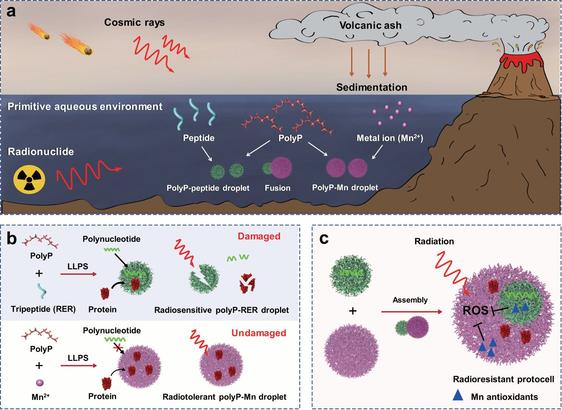
A possible way for early life on Earth to survive cosmic radiation https://phys.org/news/2023-12-early-life-earth-survive-cosmic.html

An inorganic mineral-based #protocell with #prebiotic radiation fitness https://www.nature.com/articles/s41467-023-43272-5

"#Deinococcus radiodurans is capable of surviving levels of #radiation that would kill most other living creatures. Study of this #bacteria reveals that it is able to do so because of the amount of #manganese ions in its cell."

A possible way for early life on Earth to survive cosmic radiation

A team of biophysicists affiliated with several institutions in China has uncovered via experimentation the means by which early life might have been able to survive cosmic radiation. In their study, reported in the journal Nature Communications, the group conducted experiments with radiation-resistant manganese antioxidants.

Phys.org

Hiding in plain sight: new insights into one of the world’s oldest and smallest #bacteria

https://tinyurl.com/29p4rfw8

#Deinococcus #radiodurans #astrobiology #extraterrestrial #life #space

Hiding in plain sight: new insights into one of the world’s oldest and smallest bacteria

Researchers produce the first large-scale analysis of Omnitrophota, one of the world’s oldest and smallest bacteria.

BioTechniques
Novel genetic manipulation technique can help scientists make the most of radiation-resistant bacterium

Deinococcus radiodurans can survive a range of harsh environments and is resistant to very high levels of ionizing and UV radiation, dehydration, cold, vacuum, and even acid. Therefore, the bacterium has unmatched potential to act as a bacterial chassis (i.e., a bacterium that carries and supports the genetic components necessary for a particular experiment or application) in synthetic biology. For instance, it can excel as a biological factory in the industrial production of valuable compounds, help in nuclear waste or soil treatment, and assist in the remediation of oil spills. However, genetic engineering tools specific to D. radiodurans are required to realize the bacterium's potential in human applications.

Phys.org
For Nanopore Community Meeting #ncm2022 - my onsite poster number is #7, and online number is #16. I'll be around the poster from 4 to 5:15 or so, please do stop by and provide some feedback! Especially interested in feedback for #Deinococcus #phages #plasmids #phylogeny
Things had been hectic with me taking an extra job recently - but I'm just glad I have some extra income to finish shelved experiments. There's an #ONT flowcell waiting for another #Deinococcus #genome probably with a commercial #longread genome extraction kit. Does anyone have a recommendation?