Kostas Kormas

167 Followers
239 Following
388 Posts

Awed by tiny creatures,
With a slight preference towards those without a #nucleus,
Living below any #water surface on Planet #Earth (but open to extraterrestrial collaborations, as well).

#Aquatic #microbial #ecology. Host-microbe interactions. #University of #Thessaly, Greece

#gutmicrobes #hostmicrobiota #hostmicrobe #microbialecology #microbeinteractions #symbiosis
tootfinder

https://linktr.ee/kkormas

🌡️🧪💉🔬💻✈️🦈🦞🦐🦑🐙🦀🐟🐋

Lab webpagehttps://sites.google.com/site/kkormas/?pli=1
Google Scholarhttps://scholar.google.com/citations?hl=en&user=6MJC8sMAAAAJ&view_op=list_works&sortby=pubdate
ORCIDhttps://orcid.org/0000-0002-8214-0175
English MSc Program "Host-Microbe Interactions"http://hosmic.uth.gr/
Cross-species gut microbiota transplantation predictably affects host heat tolerance

Highlighted Article: Cross-species microbiome transplants in ectothermic vertebrates can increase the heat tolerance of the recipient in a predictive manner.

The Company of Biologists

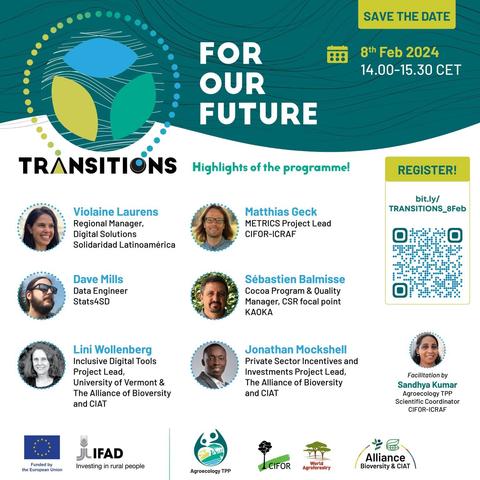
Join the Agroecological TRANSITIONS Program next Thursday, ⏰ Feb 8, for a discussion with our implementing partners. TRANSITIONS aims to scale up agroecology through better metrics, digital tools, and public-private incentives & investment.

✍️ Register today: https://us02web.zoom.us/webinar/register/WN_BgpNXtGgR1WyRud3boFRKw#/registration

Welcome! You are invited to join a webinar: TRANSITIONS For Our Future. After registering, you will receive a confirmation email about joining the webinar.

The Agroecological TRANSITIONS programme asks the question of how to scale up agroecology through improved metrics, digital tools and public and private incentives and investment. Our programme takes a very broad approach to transforming food systems, with a plurality of outcome-based methods. By considering both strengths and trade-offs of different viable options in particular contexts, TRANSITIONS aims to take the best of all of them to scale up innovations, principles and approaches that break existing barriers and lock-ins. Implementing partners will present the most important highlights of the program to date, all the while creating a space for discussion with key partners working on transforming food systems on the ground. A panel will openly discuss perspectives for the future with the objective of agreeing on a set of recommendations for action for the TRANSITIONS programme. Ample time will be given for a thorough Q&A and interaction with the audience. The draft agenda is as follows: 14h00: Welcome remarks | IFAD representative TBD 14h05: Introduction and framing of the event | Matthias Geck, METRICS Project Lead, CIFOR-ICRAF 14h10: METRICS Implementation partner | Dave Mills, Data Engineer, Stats4SD 14h20: Inclusive Digital Tools Implementation partner | Violaine Lauren, Regional Manager - Digital Solutions · Solidaridad Latinoamérica 14h30: Private Sector Incentives and Investments Implementation partner | Sébastien Balmisse, Cocoa Program & Quality Manager - CSR focal point, KAOKA 14h40: Panel discussion | Facilitation by Sandhya Kumar 15h00: Q&A Session with Audience 15h15: Perspectives from the donor | Marion Michaud, European Commission 15h20: Wrap-up, recommendations and way forward | Lini Wollenberg, University of Vermont & The Alliance of Bioversity and CIAT and Jonathan Mockshell, The Alliance of Bioversity and CIAT

Zoom

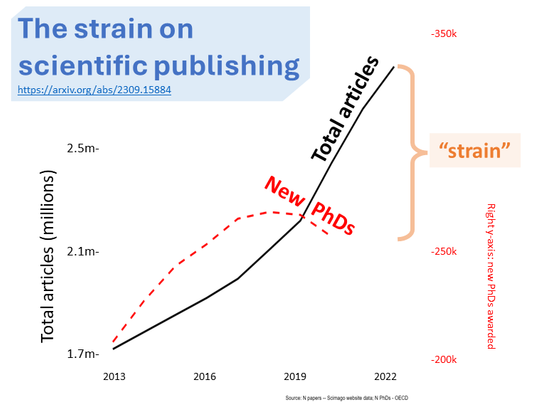
The strain on scientific publishing 📄:

The publishing sector has a problem. Scientists are overwhelmed, editors are overworked, special issue invitations are constant, research paper mills, article retractions, journal delistings… JUST WHAT IS GOING ON!?

Myself, pablo, @paolocrosetto and Dan have spent the last few months investigating just that.
https://arxiv.org/abs/2309.15884

A thread🧵1/n

#AcademicChatter #PublishOrPerish #Elsevier #Springer #MDPI #Wiley #Frontiers #PhDAdvice #PhDChat #SciComm

The strain on scientific publishing

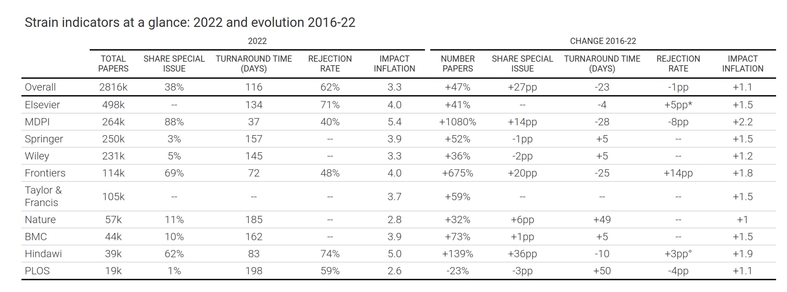
Scientists are increasingly overwhelmed by the volume of articles being published. Total articles indexed in Scopus and Web of Science have grown exponentially in recent years; in 2022 the article total was approximately ~47% higher than in 2016, which has outpaced the limited growth - if any - in the number of practising scientists. Thus, publication workload per scientist (writing, reviewing, editing) has increased dramatically. We define this problem as the strain on scientific publishing. To analyse this strain, we present five data-driven metrics showing publisher growth, processing times, and citation behaviours. We draw these data from web scrapes, requests for data from publishers, and material that is freely available through publisher websites. Our findings are based on millions of papers produced by leading academic publishers. We find specific groups have disproportionately grown in their articles published per year, contributing to this strain. Some publishers enabled this growth by adopting a strategy of hosting special issues, which publish articles with reduced turnaround times. Given pressures on researchers to publish or perish to be competitive for funding applications, this strain was likely amplified by these offers to publish more articles. We also observed widespread year-over-year inflation of journal impact factors coinciding with this strain, which risks confusing quality signals. Such exponential growth cannot be sustained. The metrics we define here should enable this evolving conversation to reach actionable solutions to address the strain on scientific publishing.

arXiv.org

You know how we'll know if this #COP28 or any "plan" will be a success or failure?

When the #climate stabilizes.

Until then it's all blah, blah, blah.

🇬🇧 As part of a scientific community committed to #openness, we have decided to discontinue our engagement on the social media platform X (formerly Twitter) by the end of this year. The account will remain, but we will no longer post or interact there. We are happy to exchange ideas with you here on Mastodon and on LinkedIn: https://www.linkedin.com/company/helmholtz-open-science-office/

#leavingtwitter #openscience (as)

Helmholtz Open Science Office | LinkedIn

Helmholtz Open Science Office | 561 followers on LinkedIn. Enabling Open Science practices in Helmholtz! | Das Helmholtz Open Science Office unterstützt die Helmholtz-Gemeinschaft als Dienstleister bei der Gestaltung des Kulturwandels hin zu Open Science. Es fördert den Dialog zu Open Science innerhalb der Helmholtz-Gemeinschaft. Das Helmholtz Open Science Office vertritt Helmholtz in verschiedenen Open-Science-Initiativen, engagiert sich in Drittmittelprojekten und vermittelt auf diese Weise die Helmholtz-Positionen zu Open Science auf nationaler und internationaler Ebene.

We have now opened the call for nominees for the 2024 GBIF Graduate Researchers Awards!

This programme will recognize the work of two early-career researchers, awarding each €5,000 for their innovative research and discovery in biodiversity informatics.

The global deadline is 24 June 2024

Full call with details of national deadlines (as they become available):
https://www.gbif.org/news/0YedTUAf3Nk14JKZqBn0a/call-opens-for-nominations-to-2024-gbif-graduate-researchers-award

#GradResearchers

Call opens for nominations to 2024 GBIF Graduate Researchers Award

Deadline for receiving nominations from GBIF member countries for graduate students whose innovative research relies on biodiversity data: **24 June 2024**

Nitrogen fixation in mangroves

Mangroves have to cope with a large variety of challenges. Low nutrient levels in the soil is one of them. A recent publication now documents one mechanism used by the plants thrive inspite of low nitrogen levels in the substrate: nitrogen fixing bacteria. (Citation: Inoue et al., (2023) Diazotrophic nitrogen fixation through aerial roots occurs in Avicennia marina: implications for adaptation of mangrove ..., New Phytologist, doi: 10.1111/nph.19442).
https://www.youtube.com/watch?v=aXkAdgL1OAw

Nitrogen fixation in mangroves

YouTube

These #microbes have been thriving without #mitochondria since the age of #dinosaurs!

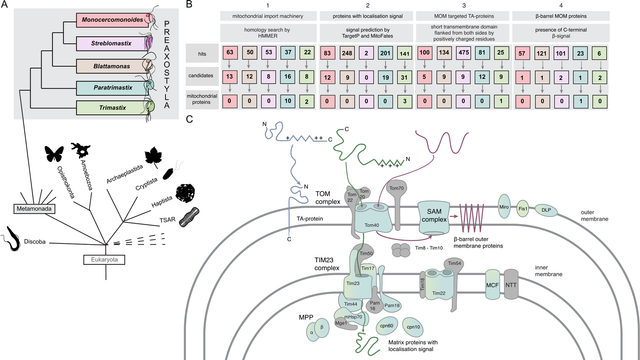
7 years ago, we identified the first known #eukaryote that has completely lost its mitochondria in a humble inhabitant of #chinchilla's gut - #Monocercomonoides exilis.

Today, we can say with confidence, that this intriguing simplification of the cell is not unique to M. exilis, but shared with many of its relatives. This means that it happened at least 100 million years ago!

https://journals.plos.org/plosgenetics/article?id=10.1371/journal.pgen.1011050

Genomics of Preaxostyla Flagellates Illuminates the Path Towards the Loss of Mitochondria

Author summary Mitochondria are nearly ubiquitous components of eukaryotic cells that constitute bodies of animals, fungi, plants, algae, and a broad diversity of single-celled eukaryotes, a.k.a. protists. Many groups of protists have substantially reduced the complexity of their mitochondria because they live in oxygen-poor environments, so they are unable to utilize the most salient feature of mitochondria–their ATP-producing oxidative phosphorylation metabolism. However, for a long time, scientists thought that it is impossible to completely lose a mitochondrion because this organelle provides other essential services to the cell, e.g. synthesis of protein cofactors called iron-sulfur clusters. Detailed investigation of the chinchilla symbiont M. exilis documented the first case of an organism without mitochondrion, and it also provided a scenario explaining how this unique evolutionary experiment might have happened. In this work, we expand on this discovery by exploring genomes of multiple relatives of M. exilis. We show that the loss of the mitochondrion is not limited to a single species but possibly extends to its entire group, the oxymonads. We also compare the predicted metabolic capabilities of oxymonads to their closest known mitochondrion-containing relatives and map out various changes that occurred during the transition to amitochondriality.