The Digital Field Hospital: Grafting Your React App into Viva Connections

1,804 words, 10 minutes read time.

You think you can just “import” your bloated, unoptimized React app into a mobile dashboard? Think again. Transitioning a web application into the Viva Connections ecosystem isn’t a migration; it’s an amputation and a graft. Most developers treat their code like a hoard of trinkets, dragging every dependency, every questionable state-management library, and every lazy component across the border into SharePoint. You aren’t building a website anymore; you are building a tactical interface for a mobile device. If your application feels heavy, it’s already dead.

The architecture of Viva Connections—specifically Adaptive Card Extensions (ACEs)—demands discipline. It is built on the bedrock of the SharePoint Framework, which forces you to play by the rules of performance, sandboxing, and mobile-first constraints. If you try to force a desktop-class React application into an ACE container, you are building a skyscraper on a swamp. The bridge between a functional web app and a high-performance Viva dashboard is a change in mindset: stop being a feature-factory and start being an architect who understands that every byte you ship to a mobile user costs them battery, data, and patience.

Why Your Spaghetti Code is Killing Your Mobile Credibility

Most developers are cowards when it comes to refactoring. They see a massive, legacy React codebase and decide it’s easier to wrap it in an IFrame or a “Weblink” card rather than doing the work to integrate it properly. This is the mark of a technician who has lost the will to engineer. When you try to shoehorn a desktop web application into Viva Connections, you are ignoring the reality of the user’s environment. Mobile users aren’t sitting at a desk with fiber-optic connections and 32GB of RAM. They are walking through a parking lot, or they are in a dead zone, or they are using a device that hasn’t seen a restart in a week.

If your code is bloated, your life is bloated. You are likely relying on heavy third-party libraries for things that could be handled with native browser APIs. In the context of an ACE, you must embrace the limitations of the Adaptive Card format. You aren’t shipping a full React SPA (Single Page Application); you are orchestrating a lightweight, reactive view of your backend data. If you haven’t stripped your project down to the bare metal, you aren’t ready to deploy.

The tactical lesson here is simple: stop using npm install as a panacea for your lack of skill. Every library you add increases the bundle size and the complexity of your dependency tree. Use the SPFx framework’s built-in hooks to manage state. If you find yourself needing to bring in a massive library for simple state management, you’ve failed. Here is your ammo for identifying the rot: audit your package.json and ask if every dependency is truly worth the latency it introduces to your mobile experience.

Code Snippet: Minimalist State Management

// Avoid complex state management libraries when localized // hooks or React Context will suffice in your ACE components. import * as React from 'react'; export const MyDashboardView: React.FC = () => { const [data, setData] = React.useState<any>(null); // Keep the logic contained and local. // Offload heavy processing to the server, not the client. return <div>{data ? data.render() : "Loading..."}</div>; };

Are you honestly convinced that your current architecture is robust enough for mobile, or are you just praying it doesn’t crash on a 4G connection?

The Engineering of Brutal Performance: Adapting for the Edge

You’ve accepted that your legacy bloat has no place in the mobile dashboard. Now you must face the reality of the Adaptive Card Extension (ACE) lifecycle. Most developers treat their components like static images, failing to account for the volatile nature of the mobile device’s lifecycle. An ACE is not a web page that stays open; it is a card that flickers in and out of existence as the user scrolls, pauses, and navigates. If your initialization logic is heavy—if you’re hitting the Graph API on every mount without a local caching strategy—you are failing the user. You must cache, batch, and throttle your requests until they are lean enough to survive the brutal handshake of a spotty cellular tower.

The technical failure here is almost always a lack of defensive programming. You expect the data to be there. You expect the network to be stable. You write your components like you are in a sterile, air-conditioned lab. But out in the field, where this dashboard lives, the environment is hostile. You need to implement local storage patterns and intelligent state reconciliation that can handle interruptions. If the network drops, your card shouldn’t show a generic “Error” message. It should show the last known good state, or a clear, actionable instruction. To build for the mobile dashboard is to build for resilience.

The lesson here is to master the onInit and render lifecycle hooks in your ACE. Don’t perform heavy data fetches inside the render loop. If you find yourself writing logic that triggers an async call every time a component re-renders, stop. Move that logic into a controlled service layer that utilizes the SPFx MSGraphClientV3. Cache your responses. If the user isn’t looking at the card, the card should be effectively dormant, consuming zero resources. If your CPU usage spikes when a user switches between the Dashboard and the Chat tab, you are doing it wrong.

Tactical Lesson: Implementing Caching for ACEs

// Use a simple caching strategy within your service class // to prevent redundant network calls across component refreshes. private _cachedData: any = null; public async fetchData(): Promise<any> { if (this._cachedData) return this._cachedData; // Fetching only when the cache is cold. this._cachedData = await this.context.msGraphClientFactory .getClient('3') .then(client => client.api('/me').get()); return this._cachedData; }

Is your code built to survive the network volatility of the real world, or does it collapse the second it loses a heartbeat?

Abandoning the Comfort of the Desktop Mindset

The final barrier to true mobile excellence is the refusal to sacrifice. You want your dashboard to have the same animations, the same hover effects, and the same deep-nested menus as the desktop site. This is emotional attachment to code, and it is a fatal flaw. A mobile dashboard is about velocity. It is about a user looking at a screen for three seconds, getting the information they need, and moving on. If your UI requires a “hamburger menu” to get to the core feature, you have failed the user’s intent. The mobile dashboard is the sharp end of the spear—it should only carry the essential data, nothing more.

The technical discipline required here is to enforce a strict design system. If you are using massive CSS frameworks that bring in global styles you don’t need, strip them. If you are using icons that aren’t optimized, replace them. Every pixel on that mobile screen has a cost in battery life. When you bring your React code into the Viva ecosystem, you need to prune the features that don’t belong on a four-inch screen. Be ruthless. If a feature isn’t essential for a field worker or a mobile executive, cut it. Your job is not to replicate the office; your job is to provide mission-critical utility in the palm of a hand.

If you cannot justify a feature’s existence in a single sentence, it does not belong in your Viva Connections dashboard. You are not a collector of features; you are an architect of utility. The hardest thing you will ever do as a developer is delete code you spent hours perfecting because it simply didn’t belong. Do it anyway. The quality of your work is measured not by what you include, but by what you have the strength to leave behind. Your users will never know how much you cut, but they will certainly feel the speed and efficiency of what remains.

Tactical Lesson: The Rule of Three Clicks

If a user cannot reach the data point in three taps or less, your information architecture is trash. Map out every view in your ACE. If a view requires complex state transitions or deep drilling to show a KPI, flatten the data structure on the server-side before it ever hits the client. Optimize the API response to deliver exactly what is needed for the card, not the entire entity object.

Why are you still holding onto features that add nothing but weight to a system that needs to be as fast as a bullet?

Conclusion: Command Your Output

You have the tools. You have the framework. The only thing standing between a high-performance Viva Connections dashboard and a pile of garbage is your own discipline. Stop hiding behind libraries you don’t understand and designs that don’t fit the medium. You are the one who determines whether your code is a masterpiece of efficiency or a monument to your own laziness. Own your architecture. If you aren’t willing to bleed a little over the optimization of your bundle size and the structure of your data flow, stop calling yourself a lead developer.

The transition from a web app to a mobile dashboard is a filter. It separates the engineers from the script-kiddies. It demands that you understand the platform, the network, and the human being on the other side of the glass. Do the work. Audit your dependencies, prune your components, and enforce a rigid performance budget. If you find the process painful, good—that is the feeling of improvement. Now get back to the terminal and build something that doesn’t just work, but dominates the medium. No excuses.

Call to Action

Stop treating your codebase like a junk drawer. If you are serious about building for the mobile frontline, you need to strip the ego from your commits and the bloat from your bundles. Audit your dependencies, enforce your performance budgets, and start designing for the three-second user journey. The next deploy is not a suggestion—it is a test of your professional survival. Refactor the rot today or stop complaining when your dashboard becomes a liability.

SUPPORTSUBSCRIBECONTACT ME

D. Bryan King

Sources

Disclaimer:

The views and opinions expressed in this post are solely those of the author. The information provided is based on personal research, experience, and understanding of the subject matter at the time of writing. Readers should consult relevant experts or authorities for specific guidance related to their unique situations.

Related Posts

Rate this:

#ACEs #AdaptiveCardExtensions #adaptiveCards #bundleSizeReduction #cleanCode #codeRefactoring #codingStandards #devOps #developmentMentor #developmentWorkflow #digitalWorkplace #engineeringStandards #enterpriseApps #enterpriseDashboard #enterprisePortal #EnterpriseSolutions #enterpriseUI #enterpriseWebDevelopment #frontEndArchitecture #frontendPerformance #highPerformanceApps #legacyCodeModernization #Microsoft365Development #MicrosoftGraphAPI #mobileDashboard #mobileProductivity #mobileUI #mobileFirstDevelopment #performanceOptimization #professionalCoding #React #ReactOptimization #ReactPerformance #responsiveDesign #SharePointCustomization #SharePointDevelopment #SharePointExpert #SharePointFramework #SharePointIntegration #SharePointMobile #softwareArchitecture #softwareEngineering #SPFx #SPFxBestPractices #SPFxPerformance #technicalDebtReduction #technicalLeadership #UXOptimization #VivaConnections #webArchitecture


Hard-Truths About Modern SharePoint Development

1,991 words, 11 minutes read time.

You are drowning in a sea of technical debt, pretending that the warning bells in your npm audit or the flashing red alerts from Black Duck and Sonatype are just background noise. If your project build feels like a house of cards ready to collapse under the slightest pressure, it is because you have prioritized your own comfort over the structural integrity of your codebase. You treat security scanning software as an administrative hurdle to be bypassed rather than a diagnostic tool to keep your system from failing when the stakes are highest.

The modern SharePoint Framework (SPFx) ecosystem is unforgiving to those who refuse to evolve, and if you are still relying on legacy Gulp workflows while ignoring the massive security implications of your transitive dependencies, you are not an architect; you are an obstacle to your own success. It is time to look at the hard truth: your workflow is leaking memory, your dependency tree is a security hazard, and your refusal to adopt the modern Heft-based toolchain is a sign of stagnant leadership. We are going to dismantle your lazy habits, re-examine the load-bearing requirements of enterprise-grade SPFx development, and force a refactor of the discipline you lack.

In this breakdown, we will rip the rot out of your project by focusing on three non-negotiable truths. First, we will address the death of the legacy build system and why the move to Heft is the only path toward professional stability. Second, we will provide practical tactics to mitigate the transitive dependency tax that scanners flag, even when the upstream packages refuse to patch. Finally, we will confront the reality that your build system is a mirror of your character—if your environment is a mess and you ignore the findings of your security stack, your final delivery will be a failure.

The Death of Gulp: Why Heft is Your New Foundation

For years, the SharePoint community leaned on Gulp like a crutch, wrapping their build processes in a thick, obfuscated black box that shielded developers from the actual complexity of their own work. You treated Gulp tasks as magic, hoping that if you copied the right gulpfile.js from a forum, you could bypass the need to actually understand how your code was compiled. This was the birth of your technical debt. Every line of code added to that fragile configuration was a piece of rotten wood in the foundation of your project, and now you are wondering why your build times are climbing and your deployment environment is brittle.

The shift to Heft, the standard for newer SPFx versions, is not just another update; it is an architectural reset designed to force transparency back into your workflow. Unlike the legacy Gulp systems that hid everything behind layers of abstraction, Heft provides a clear, lifecycle-based build process that makes the “dark matter” of your project visible. When you work with Heft, you are forced to define your build stages with precision, acknowledging the reality of your dependency tree rather than hiding it. If you are struggling with the transition, it is only because you have spent too long relying on a system that did your thinking for you.

You are expected to understand the lifecycle of your code, from the initial pre-compile check to the final production bundle. Heft demands this rigor. It eliminates the unnecessary bloat that Gulp carried around like a parasite, resulting in leaner, faster, and more predictable deployments. A senior architect does not fear the complexity of a modern build system; he masters it, stripping away every unnecessary task until only the mission-critical operations remain. If you aren’t comfortable with the internals of your own toolchain, you are not ready to lead a project in the 2026 enterprise.

Practical Mitigation: Handling the Unfixable Transitive Tax

You stare at the Sonatype or Black Duck report, watching the sea of red warnings pile up, and you realize that a significant portion of these transitive dependencies will never be patched by their maintainers. This is the reality of the modern web. However, you don’t just throw your hands up. You practice defensive dependency management. First, use npm ls <package-name> to identify exactly which of your direct dependencies is pulling in the vulnerable transitive package. If that direct dependency is abandoned or refuses to update, your first tactical move is to find a modern, maintained replacement. If you can’t replace it, isolate it.

If you cannot replace a library, use npm-force-resolutions or the overrides field in your package.json to force a secure version of the sub-dependency—but do this with extreme caution and rigorous testing. This is how you prevent a vulnerable, low-level package from ever touching your production bundle. Furthermore, you must aggressively prune your package.json. If a package is only used in development, move it to devDependencies. If you aren’t using a package, remove it entirely. Every unused line of code is an invitation to a security breach.

Finally, implement a strict “build-time validation” protocol. Don’t just scan your code once a month; integrate the scan into your CI/CD pipeline so that the build fails if a high-severity vulnerability is detected. This forces you and your team to confront the debt immediately, rather than letting it accumulate until it becomes unmanageable. If you cannot fix the dependency, you wrap it in a custom service layer that limits its exposure to the rest of your application. Be the architect who builds a bulkhead, not the one who lets a single leak sink the whole ship.

The Mirror Effect: Build Integrity and Personal Character

I have seen countless developers fall apart under the pressure of a crunch, and it always comes down to the same thing: they treated their build environment as a side effect rather than a core component of their craft. When your package.json is a mess of conflicting versions and your tasks are failing because of a mismatch in node versions, that chaos is going to manifest in your code. A man who lets his environment rot will eventually let his logic rot. If you cannot maintain the integrity of a simple build process, why should anyone trust you with the integrity of a critical business logic module or a complex SharePoint integration?

Your build system is the kernel of your professional identity. If it panics, the whole system goes down, and you are the one who is blamed for the failure. Modernizing your SPFx stack isn’t just about checking a box for your security team; it is about proving to yourself that you have the discipline to handle the requirements of a high-stakes enterprise environment. You need to adopt the mindset that if it isn’t clean, it isn’t deployed. This means rigorous management of your TypeScript configurations, keeping your framework version synced with the latest releases, and refusing to cut corners with dangerous, global force-fixes.

When you refactor your build pipeline, you are refactoring your own discipline. You are acknowledging that the “easy way” is a trap and that the hard way—the way of transparency, rigorous audits, and modern architecture—is the only way to build systems that last. The “dark matter” of your project—those hidden sub-dependencies and obfuscated tasks—will always reveal themselves eventually, usually at the worst possible time. Be the architect who finds them first. Own your toolchain, respect your security requirements, and build your projects with the kind of permanence that only comes from true, unrelenting technical integrity.

No Excuses, Just Results

The hard truth is that the SharePoint Framework is evolving, and it is leaving the lazy, the stagnant, and the complacent behind. You have the tools, the modern Heft-based architecture, and the clear guidance from Microsoft to clean up your dependency mess and secure your deployments. If you are still running a legacy Gulp workflow and complaining about security reports, the problem isn’t the framework; it’s your refusal to evolve. You’ve seen the damage that transitive debt does, and you know that the “black box” approach to building is a relic of a failed era.

Now, you have a choice. You can keep pushing out brittle, vulnerable code and waiting for the next scan to expose you, or you can start the work of modernizing your stack today. This isn’t a suggestion—it’s a requirement for anyone who wants to claim the title of “Senior” or “Architect.” It’s time to stop the excuses. Refactor your projects, audit your dependencies with professional intent, and master the modern stack.

If you’re ready to stop the rot in your codebase, put the work where it matters. Drop a comment below with your most persistent build-time vulnerability and how you’re handling it—let’s see if your approach holds up under scrutiny. Subscribe, keep your eyes on the terminal, and start building with the integrity that this industry demands. Your deployment is waiting, and it should be as clean as your logic. Don’t settle for anything less.

Call to Action: Stop the Rot, Start the Refactor

The hard truth is that the SharePoint Framework is evolving, and it is leaving the lazy, the stagnant, and the complacent behind. You have the tools, the modern Heft-based architecture, and the clear guidance from Microsoft to clean up your dependency mess and secure your deployments. If you are still running a legacy Gulp workflow and complaining about security reports, the problem isn’t the framework; it’s your refusal to evolve. You’ve seen the damage that transitive debt does, and you know that the “black box” approach to building is a relic of a failed era.

Now, you have a choice. You can keep pushing out brittle, vulnerable code and waiting for the next scan to expose you, or you can start the work of modernizing your stack today. This isn’t a suggestion—it’s a requirement for anyone who wants to claim the title of “Senior” or “Architect.” It’s time to stop the excuses. Refactor your projects, audit your dependencies with professional intent, and master the modern stack.

If you’re ready to stop the rot in your codebase, put the work where it matters. Drop a comment below with your most persistent build-time vulnerability and how you’re handling it—let’s see if your approach holds up under scrutiny. Subscribe, keep your eyes on the terminal, and start building with the integrity that this industry demands. Your deployment is waiting, and it should be as clean as your logic. Don’t settle for anything less.

SUPPORTSUBSCRIBECONTACT ME

D. Bryan King

Sources

Disclaimer:

The views and opinions expressed in this post are solely those of the author. The information provided is based on personal research, experience, and understanding of the subject matter at the time of writing. Readers should consult relevant experts or authorities for specific guidance related to their unique situations.

Related Posts

Rate this:

#ACEDevelopment #AdaptiveCardExtensions #applicationLifecycleManagement #BlackDuck #buildPipelineOptimization #buildTimeValidation #CICDForSharePoint #codeQuality #codeRefactoring #dependencyHygiene #dependencyManagement #dependencyPruning #developerDiscipline #developerTools #enterpriseMobility #enterpriseSoftwareArchitecture #enterpriseSoftwareSolutions #enterpriseWebApps #frontEndArchitecture #frontendBuildTools #HeftBuildSystem #highPerformanceWeb #MicrosoftViva #ModernExperience #modernWebDevelopment #npmSecurity #professionalProgramming #ReactDevelopment #SecureCodingPractices #SharePointArchitecture #SharePointDevelopment #SharePointFramework #SharePointFrameworkSecurity #SharePointOnline #SharePointPerformance #softwareEngineeringBestPractices #softwareReliability #softwareScalability #softwareStability #Sonatype #SPFx122 #SPFxBuildOptimization #SPFxDebugging #SPFxDevelopment #SPFxLifecycle #SPFxToolchain #technicalDebt #technicalLeadership #transitiveDependencies #TypeScriptDevelopment #VivaConnections #vulnerabilityManagement #webSecurityAudit

The Architecture of Utility: Mastering the ACE Lifecycle

1,685 words, 9 minutes read time.

You want to build for the mobile workforce? Then stop treating Adaptive Card Extensions (ACEs) like a web-page hobby project. When you’re developing for Microsoft Viva Connections, you are operating in a constrained, high-stakes environment where every millisecond of latency and every redundant re-render is a failure of your technical integrity. This isn’t just “React-like” development; it’s an exercise in strict state management and hardware-aware architecture. If you don’t master the lifecycle, you’re just building digital debris that will eventually get purged by a frustrated user who needs information now, not after your bloated component finishes its third unnecessary re-render.

We are going to dismantle the ACE architecture from the metal up. We’ll look at the IState contract, the data() mapping layer, and the lifecycle hooks that separate the senior architects from the script kiddies. If you’re tired of your extensions jittering on mobile or failing during high-load scenarios, pay attention. The following breakdown is how you move from a “component-pusher” to a systems engineer. We aren’t just coding; we’re defining the protocol for how a mobile user interacts with their entire enterprise.

1. The IState Contract: Engineering Your Memory Footprint

The biggest failure in amateur ACE development is treating the IState interface as a junk drawer. You’re fetching massive JSON blobs from the Graph API and dumping them directly into your state. This is reckless. The ACE lifecycle is sensitive to object identity; when you update the state, the framework does a comparison to determine if it needs to re-render. If you are passing object references that change constantly, you trigger unnecessary reconciliation cycles that kill performance on mobile devices.

You must design your IState to hold only the absolute primitives required to drive the UI. Everything else is metadata that belongs in a service layer or a private property, not the state. Consider this structure:

// DON'T do this: storing the full API response in state export interface IMyACEState { fullData: any[]; // The hallmark of a lazy developer } // DO this: strict, lean state management export interface IMyACEState { status: 'loading' | 'ready' | 'error'; itemCount: number; highlightTitle: string; }

By keeping your state lean, you ensure that the data() getter—the bridge between your logic and your Adaptive Card template—remains predictable. Your data() method is where you transform your internal state into the exact JSON schema that the Adaptive Card renderer expects. Never pass the raw state. The data() method should be a pure transformation function. If your logic in data() is heavy, you are doing it wrong; pre-calculate those values in your onInit or in your onStateUpdate cycle. If you don’t control the footprint of your data, you don’t control the quality of the user experience.

2. The Lifecycle Protocol: Controlling the onInit and onPropertyPaneFieldChanged

Most developers treat onInit() as a “fetch and forget” function. It’s not. It is the initialization of a persistent state machine. When your ACE loads, it needs to handle the transition from “placeholder” to “functional component” gracefully. If you are firing off network requests without a loading state, your card will look broken until the promise resolves. You need to leverage the loadPropertyPaneResources and initial state settings to ensure the card is never in an undefined state.

Furthermore, how you handle the Property Pane is a direct reflection of your discipline. Every time a user changes a setting in the property pane, the framework calls onPropertyPaneFieldChanged. If you are re-triggering your entire data-fetch logic every single time a toggle is flipped, you are burning your user’s bandwidth and CPU. You must implement a strategy to only refetch the data that actually changed.

protected async onPropertyPaneFieldChanged(propertyPath: string, oldValue: any, newValue: any): Promise<void> { // Only trigger a re-fetch if the specific dependency property changes if (propertyPath === 'listId' && oldValue !== newValue) { await this.loadData(); } }

This is the difference between a tool that feels like a native part of the OS and a tool that feels like a glitchy web-wrapper. You are responsible for the lifecycle. If the data is stale, you update it. If the property hasn’t changed, you do nothing. Don’t rely on the framework to guess your intentions. Define your dependencies, bind them to your property change events, and keep the logic locked down.

3. Navigation and Action: Designing the Quick View Gateway

The Quick View is not a standard React modal; it is a scoped navigation context within the ACE. If you are handling actions in the onAction method by performing heavy operations, you are blocking the main thread. Remember, you are working within a mobile-first paradigm. If an action is going to take more than a few milliseconds, you need to provide immediate visual feedback.

When you dispatch an action, you must follow the IQuickViewNavigator pattern strictly. The interaction flow should be: Input -> Validation -> State Mutation -> View Transition. If your transition happens before the state is synchronized, you are creating a “race condition” where the user sees old data in the new view.

public onAction(action: IActionArguments): void { if (action.type === 'Submit') { // 1. Optimistic UI update this.setState({ status: 'loading' }); // 2. Perform the async operation this.service.postData(action.data).then(() => { // 3. Finalize state only after successful network round-trip this.setState({ status: 'ready' }); }); } }

This is defensive programming. You assume the network will fail, you assume the user will double-click, and you structure your code to survive those realities. If you don’t build your Quick View navigation to be resilient to asynchronous latency, you aren’t building a product; you’re building a bug report. Master the onAction pipeline, and you’ll eliminate the vast majority of the “ghost” issues that plague less disciplined developers.

The Terminal State: Why Your Career Depends on Your Codebase

We’ve stripped the veneer off the Adaptive Card Extension framework. You’ve seen the mechanics: the IState contract that dictates your memory footprint, the lifecycle discipline required to handle property changes without burning the user’s battery, and the defensive onAction patterns that separate a professional from an amateur. If you’ve been treating ACEs as a playground for sloppy React habits, you now have the blueprint for what true architectural integrity looks like in the Viva Connections ecosystem. The hard truth is this: the platform doesn’t care about your clever hooks or your “React-like” shortcuts if your component hangs the mobile bridge. The platform demands efficiency, consistency, and a total disregard for technical debt.

You are the gatekeeper of your user’s efficiency. Every time you push a build, you’re either adding a robust, load-bearing component to their dashboard, or you’re adding another layer of digital noise that they’ll inevitably silence. The code you write is a direct reflection of your character. A developer who accepts redundant re-renders is a developer who accepts low standards in his personal life. A developer who writes asynchronous logic that can’t handle a network drop is a developer who avoids solving the hard problems in his professional life. It’s all the same discipline. If you can’t master the state of a small card, you have no business touching the core architecture of a larger system.

The No-Excuses Refactor

The path forward is clear: you stop taking the easy route. Next time you open a project, refactor your IState into a lean, strictly-typed contract. Prune your data() mapping until it only returns exactly what the UI needs to breathe. Audit your onAction handlers to ensure they are shielded against the reality of intermittent network connectivity. Stop blaming the framework, the mobile bridge, or the limitations of SharePoint for your bugs. Your bugs are your own. They are the artifacts of your lack of attention, your refusal to optimize, and your desire to cut corners where the hard work is required.

It’s time to move from “getting it to work” to “ensuring it remains stable.” This is the only mindset that survives the crunch. When the system fails—and it will—you want to be the engineer who knows exactly where the memory leaked, not the one who hides behind a “works on my machine” excuse while the production environment burns. You have the technical documentation, you have the patterns, and you have the objective reality of the code in front of you. There are no more excuses left to hide behind. Refactor your logic, harden your contracts, and stop building debris.

Call to Action

You’ve got the blueprint, the constraints, and the cold reality of what it takes to build a component that doesn’t collapse under the weight of an enterprise load. You have two choices: go back to slapping together bloated, “it-mostly-works” code that keeps you stuck in the cycle of fixing your own technical debt, or commit to the discipline of a senior architect.

Stop lurking and start refactoring.

If you are serious about hardening your codebase, I want to see the friction you’re currently wrestling with. Drop a comment below with the biggest performance bottleneck in your current ACE deployment—be specific about your state handling or your action pipeline—and I will tell you exactly where you’re leaking memory.

Don’t send me “it’s broken” complaints; send me the architectural breakdown of where you think your logic is failing. Subscribe, keep your eyes on the terminal, and let’s stop building debris. Your next deployment is the test of your standards—make sure it passes.

SUPPORTSUBSCRIBECONTACT ME

D. Bryan King

Sources

Disclaimer:

The views and opinions expressed in this post are solely those of the author. The information provided is based on personal research, experience, and understanding of the subject matter at the time of writing. Readers should consult relevant experts or authorities for specific guidance related to their unique situations.

#ACEDevelopment #AdaptiveCardExtensions #adaptiveCards #APIContract #applicationLifecycleManagement #backendIntegration #cloudNativeDevelopment #codeQuality #codeRefactoring #customACE #dataMapping #developerBestPractices #developerDiscipline #DigitalDashboard #enterpriseApplication #enterpriseIntegration #enterpriseMobility #enterpriseSoftwareDevelopment #frontendDevelopment #frontendPerformance #highPerformanceWeb #memoryManagement #MicrosoftGraphAPI #MicrosoftViva #mobileWorkforceSolutions #mobileFirst #mobileFirstDesign #networkResiliency #performanceTuning #ProfessionalDevelopment #professionalProgramming #QuickViewDevelopment #ReactStateManagement #robustArchitecture #SharePointArchitecture #SharePointDevelopment #SharePointFramework #softwareArchitecture #softwareEngineering #softwareReliability #softwareScalability #SPFx #systemStability #technicalDebt #technicalLeadership #TypeScriptDevelopment #UIThreadOptimization #VivaConnections #webPerformanceOptimization

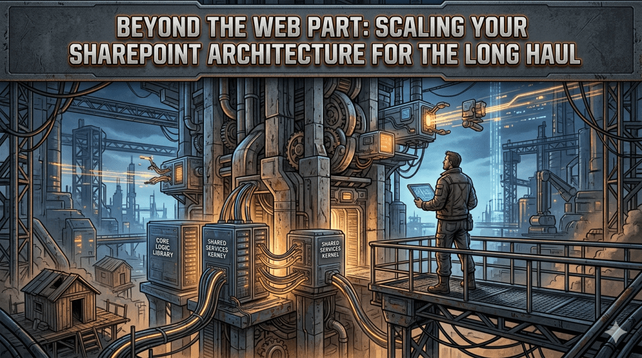
Beyond the Web Part: Scaling Your SharePoint Architecture for the Long Haul

1,441 words, 8 minutes read time.

Many of us fall into the trap of viewing SharePoint Framework (SPFx) as a collection of isolated UI components, but that mindset is exactly what leads to fragile, unmaintainable systems. If your entire development strategy begins and ends with individual web parts, you’re not building a solution—you’re building a graveyard of redundant code, incompatible dependencies, and technical debt that complicates future maintenance. You’re patching holes in a sinking ship while calling it “agile development.” It’s time to stop treating projects like weekend experiments and start building with the discipline of a professional.

Today, we are stripping away the misconceptions of “simple” development. We are going to deconstruct Library Components and Extensions—the load-bearing structures of a mature enterprise environment. If you want to stop chasing bugs across twenty different solutions, you need to understand that your code is only as stable as its architecture. I’m going to show you how to centralize your logic, scale your extensions, and finally treat your tenant as a single, cohesive machine rather than a collection of disconnected parts. If you are ready to refine your approach, let’s look at how we build systems that actually last. Let’s break it down.

The Death of Redundancy: Library Components as the Kernel

Many of us have dealt with the frustration of copy-pasting helper functions, API wrappers, and custom logging logic into every single web part folder. We often call it “reusability,” but it’s actually a recipe for a maintenance nightmare. When that common logic needs an update, you’re forced to hunt down every instance, rebuild, and redeploy. If you miss one, you’ve introduced a configuration drift that complicates your production environment. A library component is your single source of truth, and it is the primary tool for following the fundamental principle of professional engineering: Don’t Repeat Yourself.

By moving your shared core logic—your data service layers, your custom validation schemas, or your telemetry hooks—into an independently versioned library component, you effectively create a “kernel” for your SharePoint ecosystem. This isn’t just about efficiency; it’s about control. When the requirements shift, you patch the library once, increment the version, and every consuming extension and web part receives the update downstream. It’s a clean, modular approach that forces you to write code that is decoupled from the UI. If you find yourself hardcoding logic inside a React component, you’re making the system harder to support than it needs to be. Separate your concerns, build your core, and manage your logic in one place.

// Define your core service in a Library Component export interface IDataService { getData(endpoint: string): Promise<any>; } export class CoreDataService implements IDataService { public async getData(endpoint: string): Promise<any> { // Centralized logging and error handling try { const response = await fetch(endpoint); return await response.json(); } catch (error) { console.error("System Failure in CoreDataService:", error); throw error; } } }

Extensions: Injecting Logic into the Fabric of the Tenant

If Library Components are your kernel, then SPFx Extensions are your system services—the background processes and UI hooks that run globally. Many developers treat extensions as an afterthought, manually injecting them or limiting their scope to single sites. This is a tactical mistake. An extension should be treated as a load-bearing piece of infrastructure that monitors or modifies the environment. When you build an Application Customizer, you aren’t just adding a header or a footer; you’re hooking into the page lifecycle. If that code is bloated or lacks error handling, you aren’t just breaking a feature—you’re tanking the user experience for the entire site collection.

You need to write extensions that are “page-aware.” A professional developer understands that a global extension must be performant and defensive. It should be able to detect if the current page context requires its functionality, failing silently and gracefully if it doesn’t. If your extension throws an unhandled exception, it doesn’t just crash a component; it can block the entire page from rendering. Use the onInit() method to verify dependencies and pre-load configurations before you ever touch the DOM. If your extension relies on external data, ensure it’s fetching that data from the shared library we built earlier, not reinventing the wheel in every site.

// Implementing a robust Application Customizer export default class GlobalHeaderApplicationCustomizer extends BaseApplicationCustomizer<IGlobalHeaderApplicationCustomizerProperties> { public onInit(): Promise<void> { // Fail gracefully if the context isn't what we expect if (!this.context.pageContext.web.absoluteUrl) { return Promise.resolve(); } // Use the central logging from our Library Component console.log("Initializing global infrastructure extension..."); return Promise.resolve(); } }

The Deployment Protocol: Versioning as a Security Measure

The difference between a amateur and an architect is how they handle the release cycle. When you update a web part, do you just bump the version and push it to the App Catalog, praying that nothing breaks downstream? That’s not development; that’s gambling. When you use Library Components, you gain the ability to manage dependencies explicitly. You must treat your package.json file as a contract. If your library introduces a breaking change, you increment the major version. Your consuming web parts and extensions must then explicitly request that version to ensure stability.

This is the “deployment integrity” that most teams ignore. By locking down versions in your consumer projects, you guarantee that a deployment in one area of your tenant won’t accidentally trigger a silent failure in a completely unrelated department. It’s about building a predictable system. When you manage your dependencies with the same rigor you apply to your logic, you eliminate the “it worked on my machine” excuse. A professional engineer knows that every deployment is a risk—the goal is to make that risk zero through version control and exhaustive dependency management. You aren’t just shipping code; you’re managing the lifecycle of an enterprise asset.

// Define explicit versions to prevent accidental regression "dependencies": { "@my-company/shared-core-library": "2.1.0", "@microsoft/sp-application-base": "1.18.0" }

Conclusion: The Architect’s Mandate

We’ve stripped away the amateur approach and looked at the core of a professional SPFx architecture. We started with Library Components as the kernel of your system, ensuring that your business logic is centralized, testable, and maintainable. We moved to Extensions, treating them as system services that require surgical precision and defensive coding. Finally, we defined the deployment protocol—the versioning discipline that separates a chaotic environment from a stable, scalable enterprise solution.

You now have a choice. You can go back to building isolated, redundant web parts that slowly accumulate technical debt until they eventually collapse. Or, you can start building with the discipline of an architect. Every function you write, every dependency you define, and every extension you deploy is a reflection of your commitment to the system. Stop looking for shortcuts. Start building for the long haul. Refactor your mindset, tighten your deployment cycles, and start treating your SharePoint tenant with the respect it deserves. The code you write today is the foundation for tomorrow—make sure it can hold the weight. Now, get back to the console and start refactoring.

Call to Action

The foundation is set, but the structure is only as strong as your next deployment. Stop waiting for a system failure to reveal your technical debt; start refactoring your approach today. If you are ready to stop patching holes and start building reliable, scalable architecture, it’s time to move beyond the basics.

Subscribe to my newsletter for deeper dives into enterprise-grade SharePoint engineering and raw, no-nonsense technical strategies. Drop a comment below with your biggest architecture struggle—let’s dismantle the bad patterns together. Or, if you’re ready to bring a professional perspective to your next project, reach out directly and let’s get to work. The console is waiting.

SUPPORTSUBSCRIBECONTACT ME

D. Bryan King

Sources

Disclaimer:

The views and opinions expressed in this post are solely those of the author. The information provided is based on personal research, experience, and understanding of the subject matter at the time of writing. Readers should consult relevant experts or authorities for specific guidance related to their unique situations.

#APIIntegration #ApplicationCustomizer #BackendLogic #BuildPipeline #codeIntegrity #codeQuality #codeRefactoring #ComponentReusability #CustomExtensions #customization #DataServiceLayer #debuggingSPFx #DeploymentProtocol #developerProductivity #DevelopmentDiscipline #enterpriseSharepoint #EnterpriseSolutions #EnterpriseGrade #frontEndDevelopment #LibraryComponents #LogicDecoupling #Microsoft365 #ModernExperience #NPMPackages #PageLifecycle #ProfessionalEngineering #React #ScalableSoftware #SharePointBestPractices #SharePointDeveloper #SharePointDevelopment #SharePointFramework #SharePointFrameworkRoadmap #SharePointInfrastructure #SharePointLifecycle #SharePointMaintenance #SharePointOnline #SharePointTenant #SoftwareEngineeringPrinciples #SPFxArchitecture #SPFxDependencyManagement #SPFxExtensions #SPFxLifecycle #SPFxPerformance #SPFxVersioning #systemArchitecture #technicalDebt #TenantStability #webPartOptimization

The Fortress Pattern: Safeguarding SPFx Solutions from Untyped Dependencies

1,286 words, 7 minutes read time.

The Structural Integrity of the Modern Web Stack

The greatest challenge in modern SharePoint development isn’t writing your own code; it’s surviving the code you’re forced to inherit. We operate in an ecosystem where our SPFx solutions sit on top of a mountain of npm modules, many of which treat type safety as an afterthought. When a critical dependency exports everything as any, it creates a ripple effect of instability that threatens the integrity of your entire build. The hard truth is that the external world is chaotic, but your internal architecture must remain a fortress.

The goal of a Senior Architect is to ensure that the “leaky abstractions” of third-party packages do not compromise the load-bearing logic of the enterprise application. We aren’t just writing features; we are building containment systems. We must acknowledge that while we cannot control the quality of every node module, we have absolute authority over how that data is allowed to interact with our primary state. This mission focuses on three technical protocols: the implementation of the “Corruption Layer,” the use of Type Assertions as a defensive perimeter, and the enforcement of the “Single Point of Truth” for external data.

The conflict is real. You want to enable strict: true, but the moment you do, your terminal lights up with errors from a library you didn’t even write. It’s tempting to just lower your standards to match the lowest common denominator in your node_modules folder. But that is how technical debt begins its slow, agonizing crawl through a system. If you surrender your type safety to a third-party module, you are letting an outsider dictate the stability of your deployment. We don’t surrender. We adapt the architecture to handle the chaos.

The Corruption Layer: Building a DMZ for Third-Party Modules

When an npm module provides untyped or loosely typed outputs, the most dangerous thing you can do is let those any types bleed into your React components. This is where the “Corruption Layer” pattern becomes essential. You must treat every external library as a potential source of failure. Instead of calling the library directly from your UI, you wrap it in a dedicated internal Service or Utility class.

This wrapper acts as a technical DMZ. Within this file, you deal with the library’s any mess, but the function itself returns a strictly defined interface that you control. By isolating the untyped dependency, you ensure that if the library changes—or if you eventually replace it with a better-typed alternative—you only have to update a single wrapper function. You are effectively “shimming” the external chaos to fit your internal order. This is how you maintain a strict kernel while operating in a loosely-typed world.

Defensive Assertions: Transforming any into unknown

The presence of any in a library is a vacuum of information. To regain control, the architect uses unknown and custom Type Guards. When a third-party function hands you a variable typed as any, the first move is to cast it to unknown. This immediately forces the compiler to stop you from doing anything reckless with it until you’ve verified its structure.

Using a Type Guard—a simple function that returns a type predicate—allows you to validate the shape of the external data at runtime. This isn’t just about satisfying the compiler; it’s a load-bearing safety check. If the npm module’s schema shifts due to a version update, your Type Guard will catch it at the boundary, preventing a “null reference” error from crashing the browser. You are turning a blind assumption into a verified protocol.

Strict Interfacing: Dictating the Schema of the Subsystem

In a complex SPFx web part, you likely have multiple components relying on a single data source. If that source is an untyped API or library, the risk of “spaghetti logic” increases exponentially. The protocol here is to define your own “Internal Source of Truth.” Even if the library gives you a disorganized object, you map it into a clean, readonly interface immediately upon ingestion.

This mapping process is where the stability of the system is forged. You decide what properties are required, which are optional, and what the types should be. By the time that data reaches your state management (like Redux or React Context), it is no longer a mystery; it is a compliant part of your architecture. You are taking ownership of the data. You aren’t just consuming a library; you are integrating it into a controlled environment where the rules of the system are absolute.

Total Ownership of the Architecture

The battle against untyped dependencies is a constant in the life of a SharePoint Architect. We cannot wait for every npm maintainer to adopt strict TypeScript patterns, and we cannot afford to let our enterprise builds become fragile as a result. The quality of your solution is defined by how well it handles the unexpected. By implementing wrappers, type guards, and strict mapping layers, you ensure that your code remains resilient even when the world around it is breaking.

Integrity in development means never accepting a “silent failure” just because it’s easier to code. It means fighting for every type definition and every validation check because you know that a stable system is built on a foundation of certainty. When you push your SPFx package to the production tenant, you should do so with the confidence that every external variable has been checked at the gate.

Take a hard look at your current project. Find the places where a third-party any is sneaking into your components and build a perimeter around it. Refactor the interface. Secure the logic. The goal is a system that is robust, maintainable, and strictly defined—no matter what is happening in the node_modules folder. Build with authority, or watch the system fail.

SUPPORTSUBSCRIBECONTACT ME

D. Bryan King

Sources

Disclaimer:

The views and opinions expressed in this post are solely those of the author. The information provided is based on personal research, experience, and understanding of the subject matter at the time of writing. Readers should consult relevant experts or authorities for specific guidance related to their unique situations.

#AntiCorruptionLayer #castingAnyToUnknown #cleanCode #codeRefactoring #defensiveProgramming #discriminatedUnions #enterpriseSharePointApps #enterpriseSoftwareDevelopment #FortressPattern #frontendArchitecture #ISPHttpClientResponse #M365Developer #mappingAPIResponses #Microsoft365Development #MicrosoftGraphAPI #nodeModulesTypeSafety #npmModuleTypes #ODataNormalization #PnPjs #ReactPropsTyping #ReactTypeSafety #SharePointFramework #SharePointRESTAPI #softwareEngineering #SPFxArchitecture #SPFxBestPractices #SPFxDeployment #SPFxDevelopment #SPFxMaintenance #SPFxPerformance #SPFxProjectStructure #SPFxServiceLayer #SPFxStateManagement #SPFxVersioning #SPFxWebParts #structuralIntegrity #systemArchitecture #technicalDebt #typeGuards #TypeScriptGenerics #typescriptInterfaces #TypeScriptStrictMode #TypeScriptUnknownType #TypeScriptUtilityTypes #webProgramming

The Silicon Parasite: Why Your Editor is Gaslighting Your Workflow

1,401 words, 7 minutes read time.

The industry is rotting from the inside out, and the rot smells like a predictive text engine. Your editor used to be a sharp blade, a surgical tool that did exactly what you told it to do and nothing more. Now, Microsoft has turned Visual Studio Code into a bloated, desperate “co-pilot” that thinks it knows your logic better than you do. It’s forcing these “helpful” little AI ghosts into your margins, under your cursor, and into your RAM, and the worst part isn’t just the lag—it’s the violation of the protocol. You go into the settings, you hunt down the toggles, and you kill the processes. You think you’ve reclaimed your sovereignty. Then, two weeks later, after a silent “background update,” the intrusive shadows are back, whispering suggestions that break your flow and turn your high-level architecture into a graveyard of hallucinations. The hard truth is that we are living through a Great Refactoring where the toolmakers no longer trust the craftsmen. They want to turn you into a prompt engineer, a glorified copy-paster who doesn’t understand the “dark matter” of the codebase because the AI hid the complexity from you. If your career is leaking memory, it’s because you’ve outsourced your critical thinking to a corporate plugin that prioritizes its own telemetry over your deployment stability.

We’re going to break down the three reasons why this forced AI integration is a terminal infection for a real developer. First, we’ll look at the technical debt of “Ghost Code”—the garbage logic that AI sneaks into your editor and how it mirrors the compromises you make in your own integrity. Second, we’ll analyze the architectural collapse of the “Local Development Environment,” where the tools you rely on have become Trojan horses for corporate data harvesting. Third, we’ll tackle the psychology of the “Automated Interruption,” and why letting a machine break your deep work state is the fastest way to become a mediocre, replaceable commodity. This isn’t just about a slow IDE; it’s about the battle for the kernel of your professional identity.

The Ghost in the Machine: Hallucinated Logic as Technical Debt

When you allow an AI tool to “suggest” a block of logic, you aren’t just saving keystrokes; you are importing unvetted debt into your system. In the world of SharePoint and complex web architecture, one misplaced bracket or a misunderstood API call in a “suggested” function can lead to a catastrophic failure that doesn’t manifest until you’re under 100x load. These tools operate on probability, not logic. They don’t understand the specific, heavy-duty constraints of your environment; they only know what the most common, often mediocre, solution looks like across a billion public repositories. By forcing these tools into the UI, Microsoft is betting that you’re too lazy to write your own boilerplate.

This mirrors a fundamental failure in the character of modern developers. Integrity in code means knowing exactly why every line exists. When you accept an AI suggestion because you’re tired or in a rush, you’re admitting that you’ve lost control of the architecture. You’re letting a black box write your “load-bearing” functions. In a man’s life, this is the equivalent of taking the path of least resistance and hoping the consequences don’t compile until you’re gone. If you can’t vouch for the logic in your own editor, you aren’t an architect; you’re a janitor cleaning up after a machine that doesn’t even know it’s making a mess. You have to treat every “helpful” AI pop-up as an unauthorized PR from an intern who lied on his resume.

The Multi-Node Infection: Syncing Mediocrity Across the Grid

The real nightmare begins when you realize this isn’t just a local bug; it’s a distributed system failure. You spend an hour diving into the JSON of your settings.json, manually flagging every “Copilot,” “IntelliCode,” and “Suggested Action” to false. You feel a brief sense of victory as the UI cleans up. But then you head to your secondary machine, or your home rig, and because Microsoft has tethered your identity to their cloud sync, the “helpful” ghosts have already migrated. It’s a digital game of whack-a-mole where the hammer is made of foam and the moles have admin privileges. In my opinion, this forced synchronization of unwanted features is a direct assault on developer autonomy. They’ve turned your configuration into a suggestion rather than a command.

Architecturally, this is a violation of the principle of isolation. A developer’s machine should be a clean room, a sandbox where only the necessary dependencies are permitted to run. When the IDE decides to override your local environment variables via a cloud-synced “profile update,” it breaks the chain of custody for your workflow. IMHO, this mirrors the way many men allow their focus to be fragmented by “synced” distractions—notifications that follow you from the phone to the desktop to the watch. If you can’t maintain a consistent, hardened perimeter around your workspace across multiple nodes, you’re not managing a system; you’re being managed by one. Your tools should serve your intent, not the telemetry goals of a corporation trying to justify its latest AI acquisition.

The Latency of Thought: Why “Context-Aware” is Just Bloated Interference

There is a physical cost to this AI-first pivot. Every time you pause for a millisecond to think, the IDE interprets that silence as an invitation to interrupt. It spins up a background process, eats a chunk of your thread pool, and spits out a grayed-out suggestion that you now have to mentally process and reject. It’s a constant context-switch forced upon the brain. In the world of high-performance web development or SharePoint architecture, “latency” is the enemy. We spend weeks optimizing SQL queries and minimizing payload sizes, yet we tolerate a tool that introduces a 200ms cognitive lag every time we hit the spacebar. To me, this is the height of technical hypocrisy.

This interference is the “spaghetti code” of the mind. When your editor is constantly trying to finish your sentences, you lose the ability to think three steps ahead. You become reactive instead of proactive. In the trenches of a massive system failure, you need a clear, unencumbered path between your logic and the disk. If you’re fighting your IDE’s “helpful” suggestions while trying to patch a load-bearing security flaw, you’re going to lose. IMHO, true leadership in this field requires the discipline to silence the noise. If you let a machine dictate the pace of your work, you are effectively down-clocking your own intelligence to match the output of a statistical model.

Reclaiming the Kernel

The hard truth is that the industry is moving toward a future where the “developer” is just a high-level debugger for AI-generated garbage. If you want to remain a true architect, you have to fight for your environment. You have to treat your VS Code settings like a firewall—constant vigilance, regular audits, and a refusal to accept the default configuration. Microsoft wants you to be a passive consumer of their ecosystem, but a real engineer is a master of his tools, not a tenant in them.

In my opinion, your worth as a developer is measured by what you can build when the internet is down and the AI is silent. If you can’t write the logic without a prompt, you don’t actually know the logic. Stop letting the “helpful” tools soften your mental edge. Refactor your workflow, harden your settings, and stop making excuses for why the “whack-a-mole” game is too hard to win. If you want to lead, you start by taking absolute command of the very machine you’re sitting at. No excuses. No fluff. Just clean, intentional code.

SUPPORTSUBSCRIBECONTACT ME

D. Bryan King

Sources

Disclaimer:

The views and opinions expressed in this post are solely those of the author. The information provided is based on personal research, experience, and understanding of the subject matter at the time of writing. Readers should consult relevant experts or authorities for specific guidance related to their unique situations.

#AIHallucinationsInCode #authenticCoding #codeRefactoring #codingFlowState #codingWithoutAI #cognitiveLoadInCoding #developerAutonomy #developerProductivity #disableVSCodeCopilot #disablingIntelliCode #distributedSettingsFailure #GitHubCopilotInterference #gritLitDevBlog #IDEPerformance #leadArchitectInsights #manualSettingsJson #mentalLatency #MicrosoftTelemetry #ProfessionalProgrammingStandards #programmingIntegrity #seniorDeveloperAdvice #SharePointArchitecture #softwareArchitecture #softwareCraftsmanship #softwareDeploymentStability #softwareEngineeringDiscipline #stopAISuggestionsVSCode #stopVSCodeBackgroundUpdates #technicalDebt #technicalLeadership #VisualStudioCode #VSCodeAITools #VSCodeBloatware #VSCodeExtensionsBloat #VSCodeProfileSync #VSCodeSettingsSyncProblems #VSCodium #WebDevelopment #workflowOptimization
Refactoring isn’t an expense—it’s an investment. Learn how to calculate ROI, reduce technical debt, and get leadership buy-in for modernization. https://hackernoon.com/7-persuasive-ways-ctos-can-get-stakeholders-onboard-with-code-refactoring #coderefactoring
7 Persuasive Ways CTOs Can Get Stakeholders Onboard With Code Refactoring | HackerNoon

Refactoring isn’t an expense—it’s an investment. Learn how to calculate ROI, reduce technical debt, and get leadership buy-in for modernization.

🚨 Bài viết: Claudiq viết 62% code thêm nhưng điểm giảm 16%? Kết quả refactoring WebSocket chỉźng наш hóa "lớp code hơn" không đồng nghĩa "t hammer". #TinhNangAI #ChinhSachMã #CodeRefactoring #HọcNgônNghi

https://www.reddit.com/r/programming/comments/1o7o6ek/more_code_better_code_claude_haiku_45_wrote_62/

Ask Mode vs Agent Mode - Choosing the Right Copilot Experience for .NET - .NET Blog

GitHub Copilot Chat offers two powerful modes, Ask Mode and Agent Mode, that can dramatically accelerate your development. Learn when to use each mode to get the most out of this tool.

.NET Blog
Refactoring Clojure (1)

Refactoring some Clojure code that implements an order-1 word-level Markov text generator.

Orso Labs