@thomas_dbl

Anfang der 90iger Jahre.

Von Schneider gab es einen Musikturm um 300 DM der noch billiger als die von Quelle waren.

Mein Cheffe hatte auf der #IFA einen ganzen LKW voll davon gekauft.

Das waren Ladenhüter wie aus dem Bilderbuch.

Also was machen.

Mit einem #CD4017 haben wir dann ein #KnightRider #Kitt Licht gebaut.

Dieser wurde mittels Bohrschablone 2x sauber eingeklebt.

Nunja, es wurden noch etliche nachbestellt obwohl die 50 DM teurer wurden.

So tickts halt.

@CCC

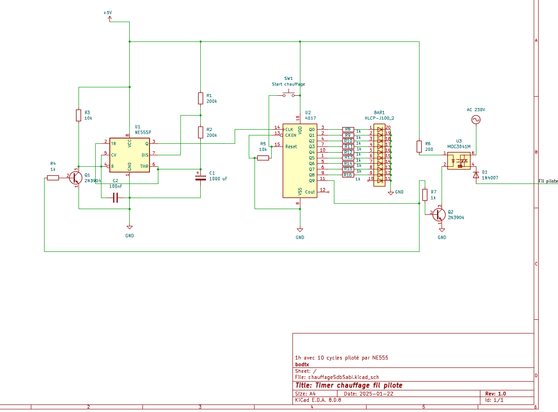
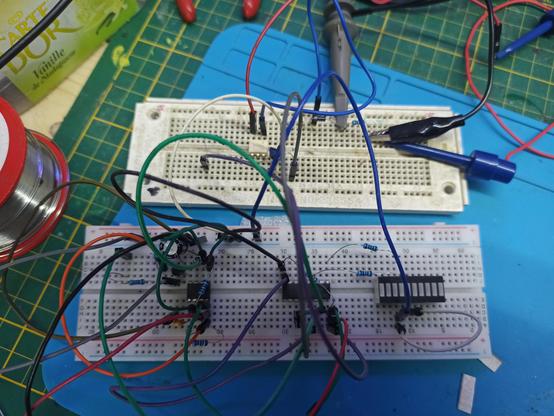
timer controler for an heater with the electric pilot wire.

The idea is:
circuit in idle mode: send half negative wave in the heater wire (frozen mode).
when the circuit is counting, send no signal to the wire (heating mode).

Wire controller mode:http://bernard.lefrancois.free.fr/pilote.htm
https://telefab.fr/2013/11/10/controle-a-distance-des-radiateurs/

#timer #electronic #ne555 #CD4017 #MOC3041 #kicad

Le fil pilote

Ordres transmis par le fil pilote

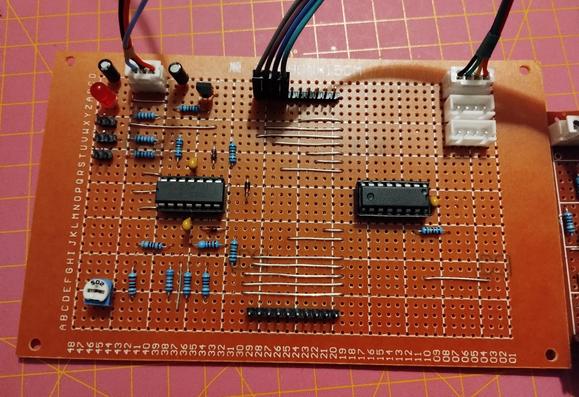
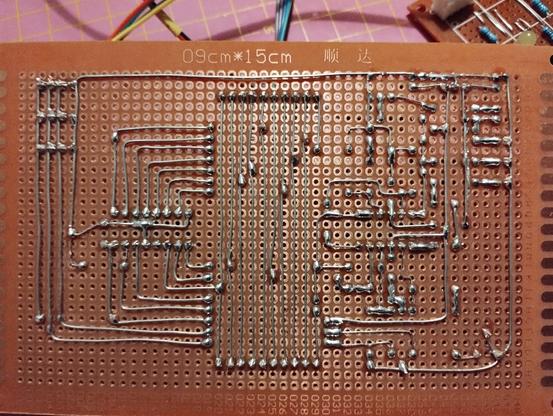
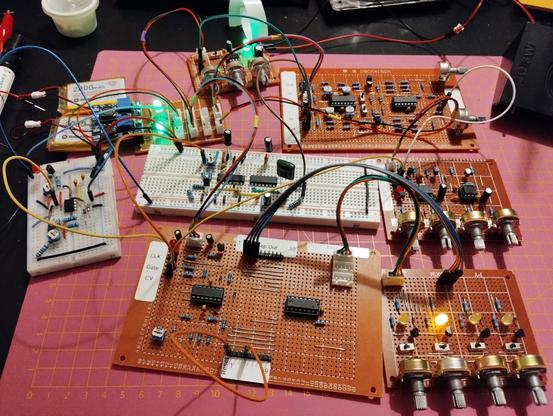
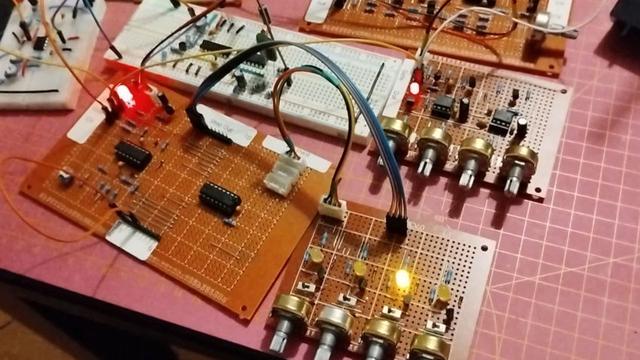
Finished #soldering the next #perfboard, the #sequencer core with the #CD4017 counter chip and a #TL074 #OpAmp. I have connected the control board and the rest, see a demo here: https://makertube.net/w/mEobXiLn5so6Rpe2zQA16E
After soldering all components, I had the idea of adding a #LED for the gate output. Fortunately it fit very nicely.
Only VCO and LFO are still on solderless breadboards, and I wasted some time searching for a fault turning out being bad connections on the breadboard...
#electronics #diysynth
Soldered Sequencer Core Board

PeerTube

555 Timer on its Own In Electronic Dice

One of the most common clichés around here is that a piece of equipment chosen for a project is always too advanced. If a Raspberry Pi was used, someone will say they should have used an Arduino. If they use an Arduino, it should have been an ATtiny. And of course, if an ATtiny was used, there should have simply been a 555 timer. This time, however, [Tim] decided to actually show how this can be done by removing some of the integrated circuits from an electronic dice and relying entirely on the 555 timer for his build.

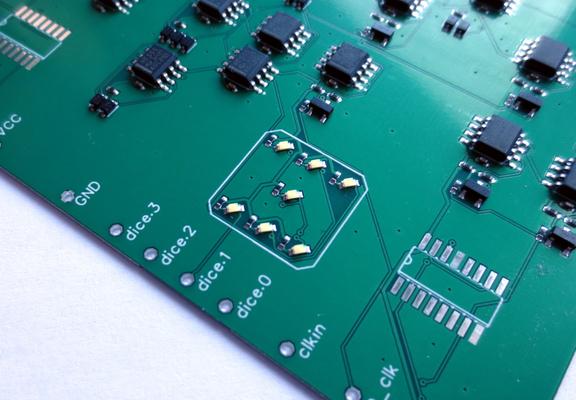
The electronic dice that [Tim] has on hand makes use of two main ICs: a NE555 and a CD4017 which is a decade counter/divider used for cycling through states. In order to bring the 555 to the forefront of this build, he scraps the CD4017 and adds an array of 555 timers. These are used to generate the clock signals necessary for this build but can also be arranged to form logic circuits. This comes at a great cost, however. The 555 chips take up an unnecessarily large area on the PCB (even though these are small surface-mount chips), consume an incredible amount of power, and are very slow. That's fine for an electronic dice-rolling machine like this one, but that's probably where [Tim] will leave this idea.

The 555 timer is a surprisingly versatile chip, and this project shows that there is some element of truth to the folks claiming that projects need naught but a few 555s. We've seen entire CPUs built using nothing but 555s, and even a classic project that uses a 555 timer to balance a robot.

#clockhacks #555 #cd4017 #circuit #clock #dice #electronic #logic #ne555 #randomnumber #timer

555 Timer On Its Own In Electronic Dice

One of the most common clichés around here is that a piece of equipment chosen for a project is always too advanced. If a Raspberry Pi was used, someone will say they should have used an Arduino. I…

Hackaday
Friendica@got-tty (search)

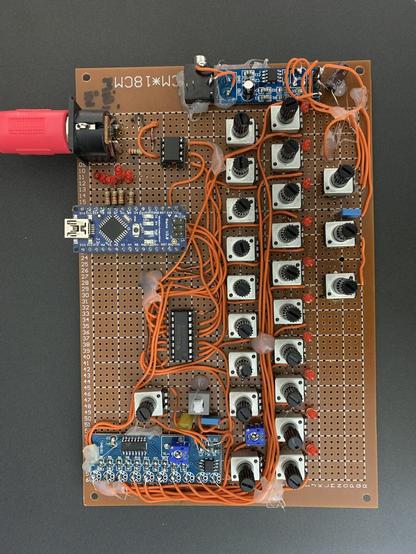
♲ @[email protected]: I finished my work on my bFFM-bom, 8 notes can be controlled over #MIDI - an #NE555 is used as clock for the #CD4017 counter, 10 potentiometers are used to shape the output waveform. This #DIY project is simple to build and fun to play.

pbs.twimg.com/media/DzwS0dAX4A…
Friendica@got-tty (search)